
• Event report · TalentLab 2026 · Paris, 21 May 2026
With this new edition, TalentLab has established itself as the annual event for those who want to understand the recruitment market through real data.
Five talks in the morning, fifteen workshops in the afternoon, and one shared conviction: HR professionals who steer by data make better decisions than everyone else.
Organised by: Laurent Brouat · Les Talents Narratifs
Partners: Cegid · E-Testing · Index Advertsdata · Nicoka · Xtramile
1. The real deficits of the labour market
Bruno Coquet · Labour economist · UNO Études & Conseil · Adviser to France Stratégie & the Ministry of Labour
Bruno Coquet opened the morning with a bold thesis: most recruiters work with a false picture of the labour market, which leads them to the wrong strategies. His analysis draws on the latest data from Eurostat, INSEE and DARES . He built his talk around three deficits that paradoxically coexist in France.
1.1 Deficit 1: a participation problem, not a demographic one
The dominant narrative about a demographic shortage is inaccurate in the short term. The constraint is not the number of people available, it is behavioural. The French participation rate is stuck at 60% of the total population (aged 15-74), compared with 62% for the Eurozone. This 2-point gap mechanically represents around 600,000 potential workers who could be on the market without changing any demographic assumptions.
The calculation rests on a simple rule: for this age group, 1 point of participation rate represents around 350,000 people moving into or out of the labour market. The rise in participation observed since 1990 has come mainly from women and older workers. But Bruno Coquet points to a worrying paradox: the participation rate of men under 45-49 has been falling since 1990, even though they are now better qualified than their elders. “We have a real problem understanding why these people are not working,” he sums up.
While France was among the European frontrunners until the mid-2010s, it has been falling behind ever since. The number of young people aged 15-29 who are inactive in the year after their initial education has been rising steadily since the 1980s. Micro-enterprise (micro-entrepreneur status), which has grown from 0 to 5.4% of total employment in 15 years, now represents 2.5 times temporary work, in direct competition with traditional salaried employment.
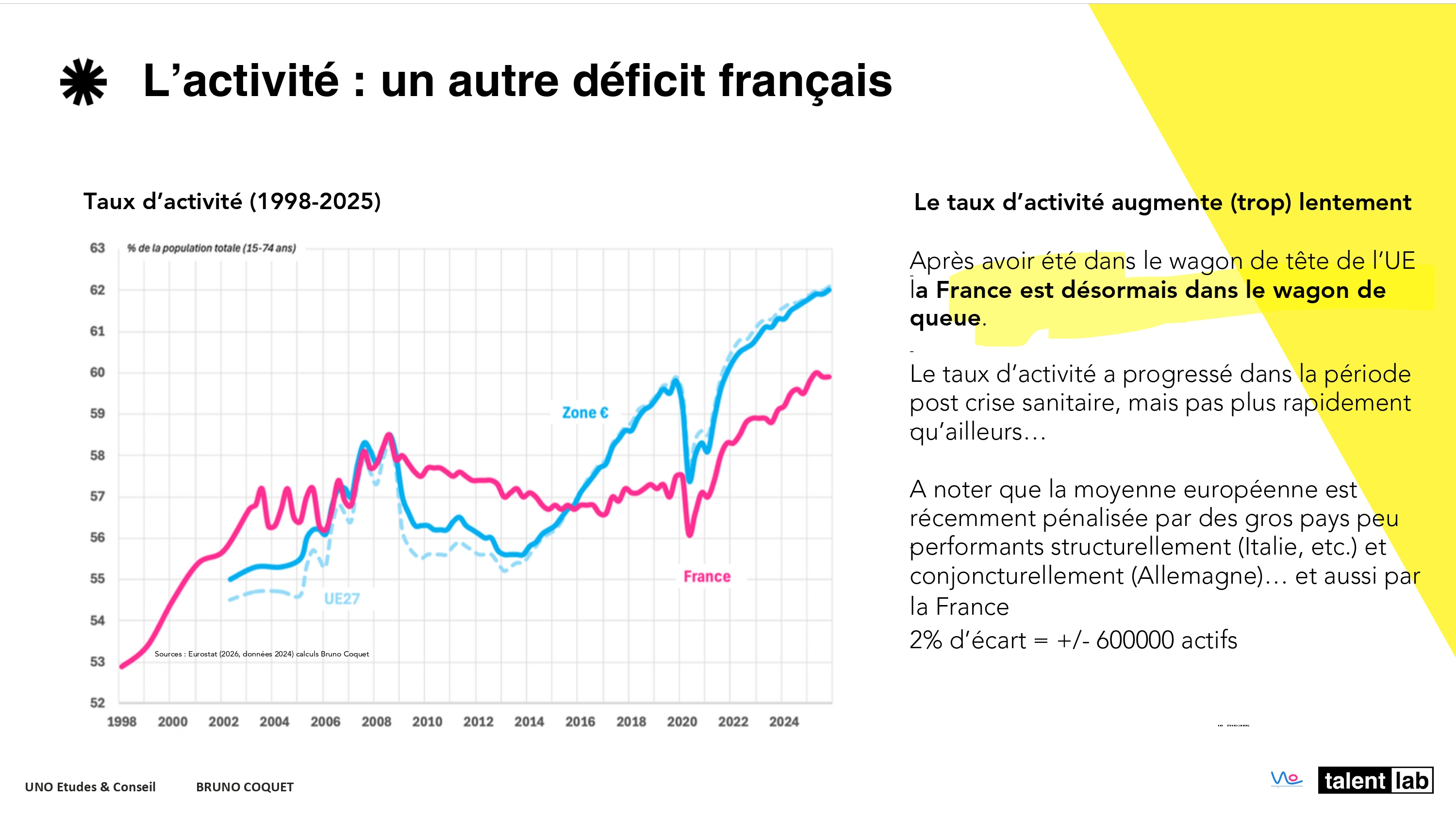
“The immediate constraint is not demographics, it is participation behaviour. Around 600,000 people of working age are available, without any extravagant assumptions, and without even counting their working time.”
Bruno Coquet, UNO Études & Conseil · TalentLab 2026
1.2 Deficit 2: an employment deficit… and a surplus at the same time
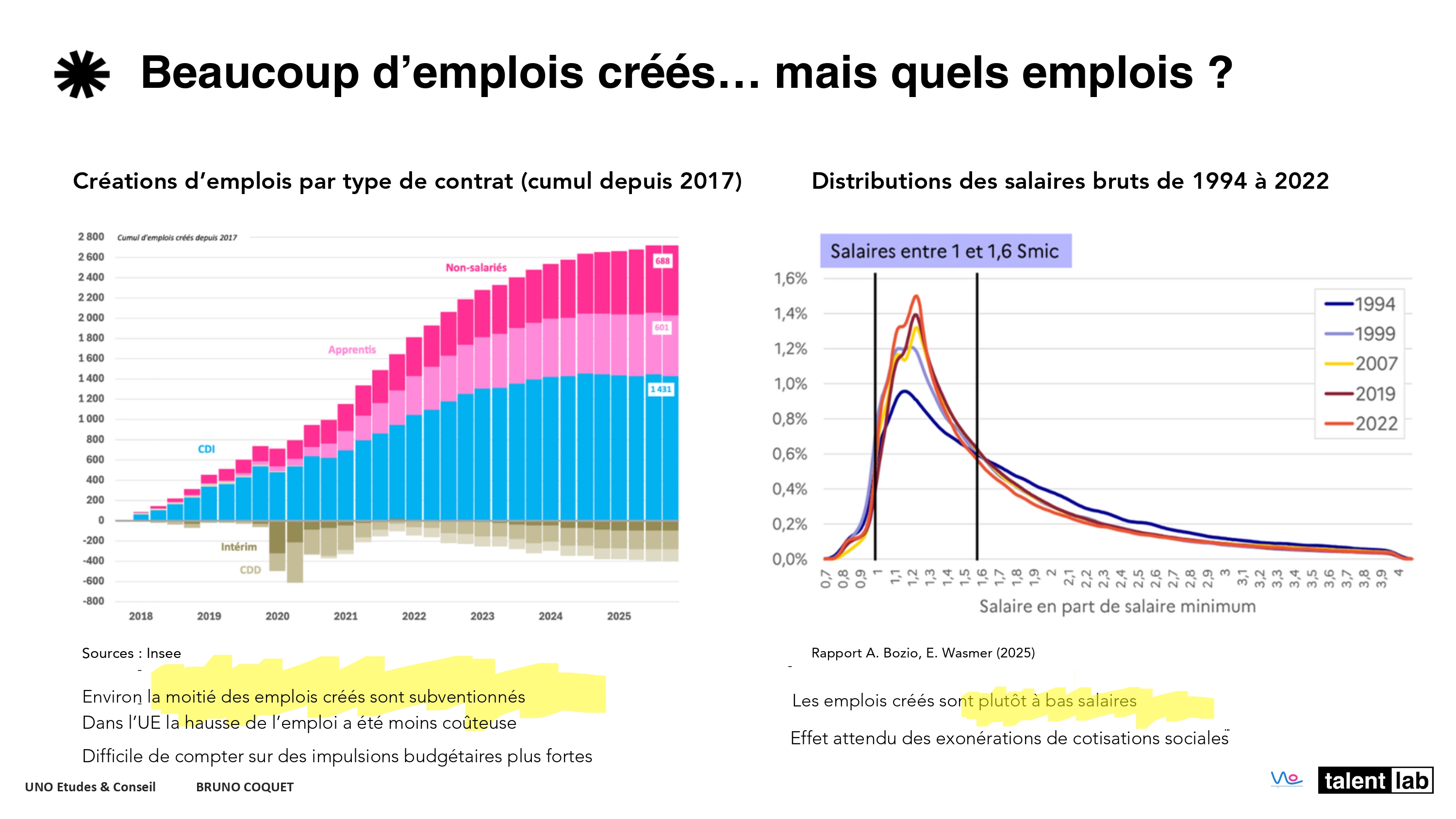
The paradox is striking. Since 2017, France has created jobs on a massive scale:
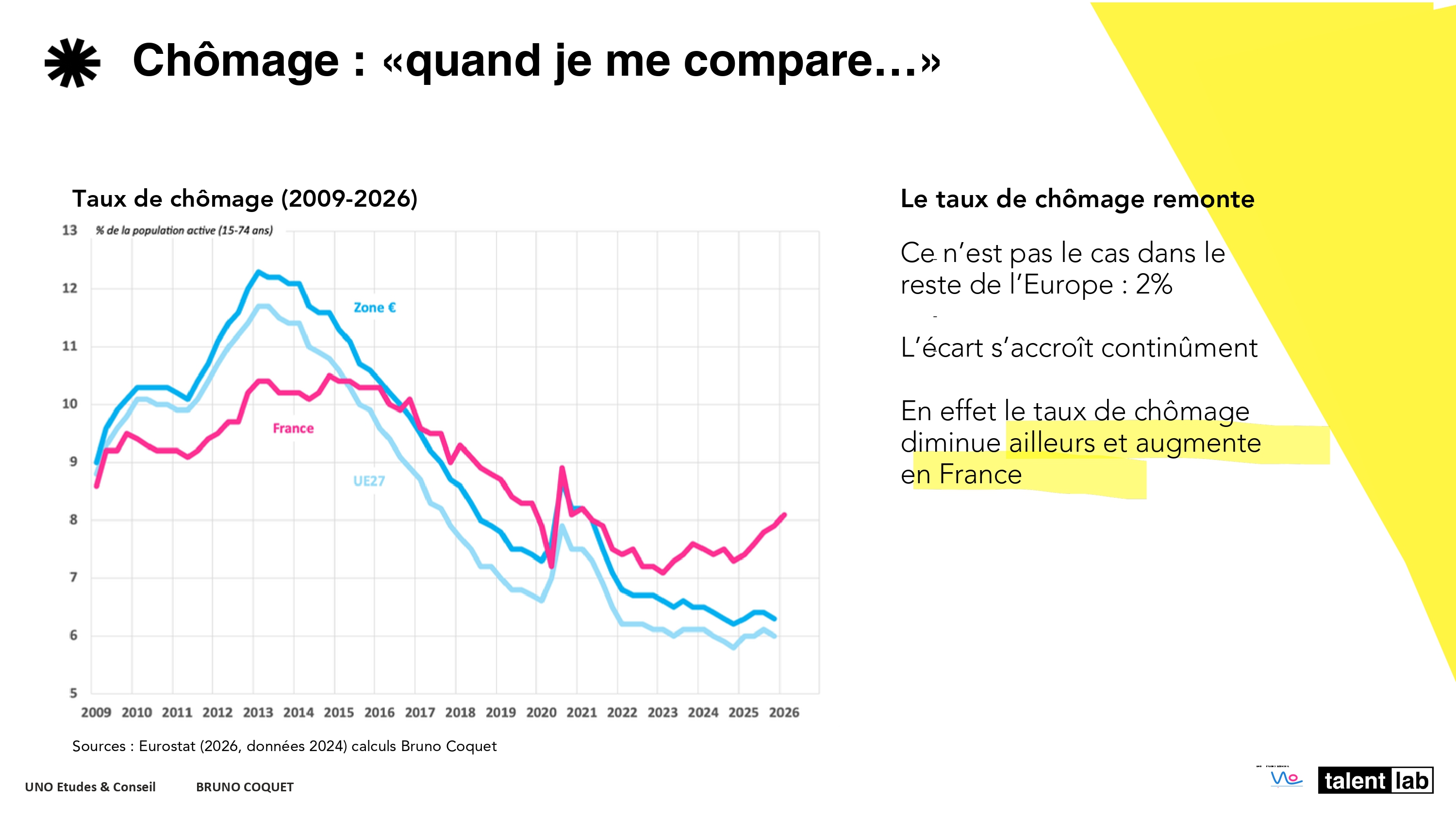
Job creation is concentrated in low-wage jobs, a mechanical effect of the exemptions from social security contributions between 1 and 1.6 times the minimum wage (SMIC). This creates jobs, but not productivity. Subsidised employment led to“over hiring” between 2021 and 2023. The big surprise of 2025-2026: the French unemployment rate is rising again while it continues to fall everywhere else in Europe, with the gap reaching +2 percentage points.
1.3 Deficit 3: a skills deficit… but a surplus of managers
Apprenticeships now account for 4.1% of total salaried employment in France, ahead of Germany (3.2%), at a public cost of €24 billion in 2024. Meanwhile, the proportion of managerial and professional staff (cadres) has reached record levels: the share of cadres has risen from less than 10% in the early 1980s to around 25% today, and since 1983 there has been not a single year in which the number of cadres fell.
People talk about a skills shortage, but there is a structural surplus of cadres. The real pressure is on manual, care and teaching jobs: cleaners, home care workers, teachers, drivers.
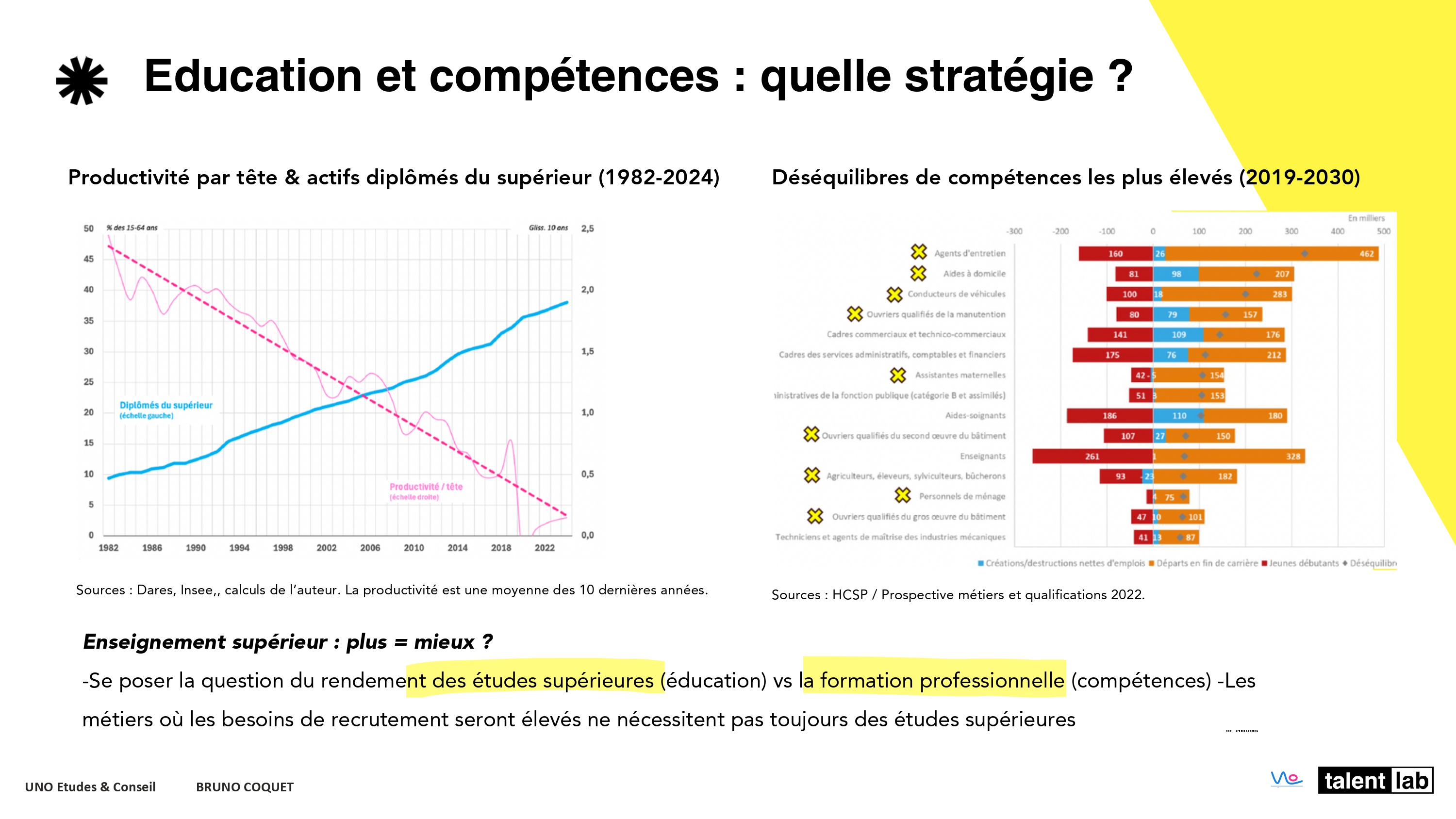
“The jobs where recruitment needs will be highest do not require higher education. We need to ask ourselves about the return on higher education versus vocational training.”
Bruno Coquet, UNO Études & Conseil · TalentLab 2026
What this changes for recruiters: stop thinking in terms of “the market is tight” or “the market is quiet”. The reality varies by sector, by location and by qualification level. The recruiter's real role is to read their field precisely (for this job, in this local labour market, at this salary level, etc.) and to help their clients make better decisions.
2. ATS: AI agents take control
Jean-Baptiste Audrerie · Organisational psychologist, MBA · Co-founder NexaRH · HR Tech consultant (Canada / France)
Jean-Baptiste Audrerie gave the most comprehensive overview of the revolution under way in recruitment tools. His thesis is blunt: we no longer talk about AI as a future trend. Agentic agents are already in production in the ATS on the market, on both sides of the table.
Before getting to the heart of the matter, Jean-Baptiste Audrerie drew a distinction that many still confuse: an AI assistant talks, an AI agent acts.
• The generative AI assistant (ChatGPT, Copilot, Gemini) responds to your prompts.
• The AI agent, on the other hand, operates within your digital environment: it opens a browser, accesses your ATS, books meetings in Outlook, fills in forms, produces Excel documents, sends emails.
“Assistants have learned to talk and to code. Agents have learned to work. They copy your actions: that is all you need to remember.”
Jean-Baptiste Audrerie, NexaRH · TalentLab 2026
This distinction is not a matter of semantics: it determines what you can delegate and what stays in your hands.
2.1 Candidates are already surrounding themselves with AI agents
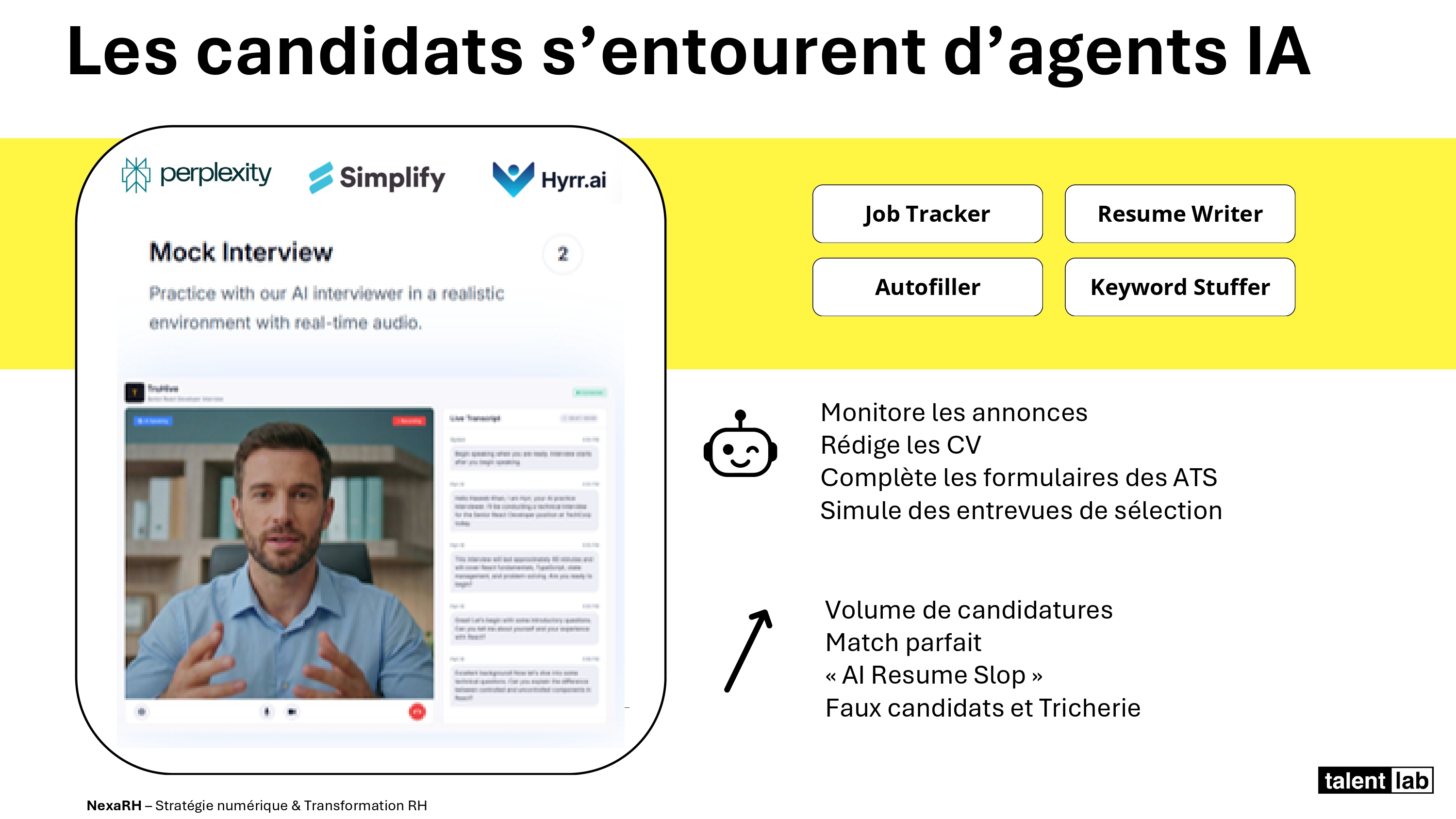
Candidates now use AI tools to monitor job ads, write and optimise their CV, automatically fill in ATS forms (Simplify already covers 32 major ATS) and simulate selection interviews. The result: +50% applications received in North America in 12 months, with 75% of candidates using at least one AI assistant. We are seeing the emergence of“AI Resume Slop”: perfectly optimised CVs, all identical, which lose any power to differentiate.
The race goes further. A Canadian solution, Hyrr.ai, trains candidates to deliver the perfect interview: it loads the job ad, generates the likely questions and coaches the candidate in front of avatars until they give “the right answer”. Add to this the growing number of fake candidates and cheating in pre-selection video interviews. Some tools, such as Simplify, even make it possible to apply automatically while you sleep.
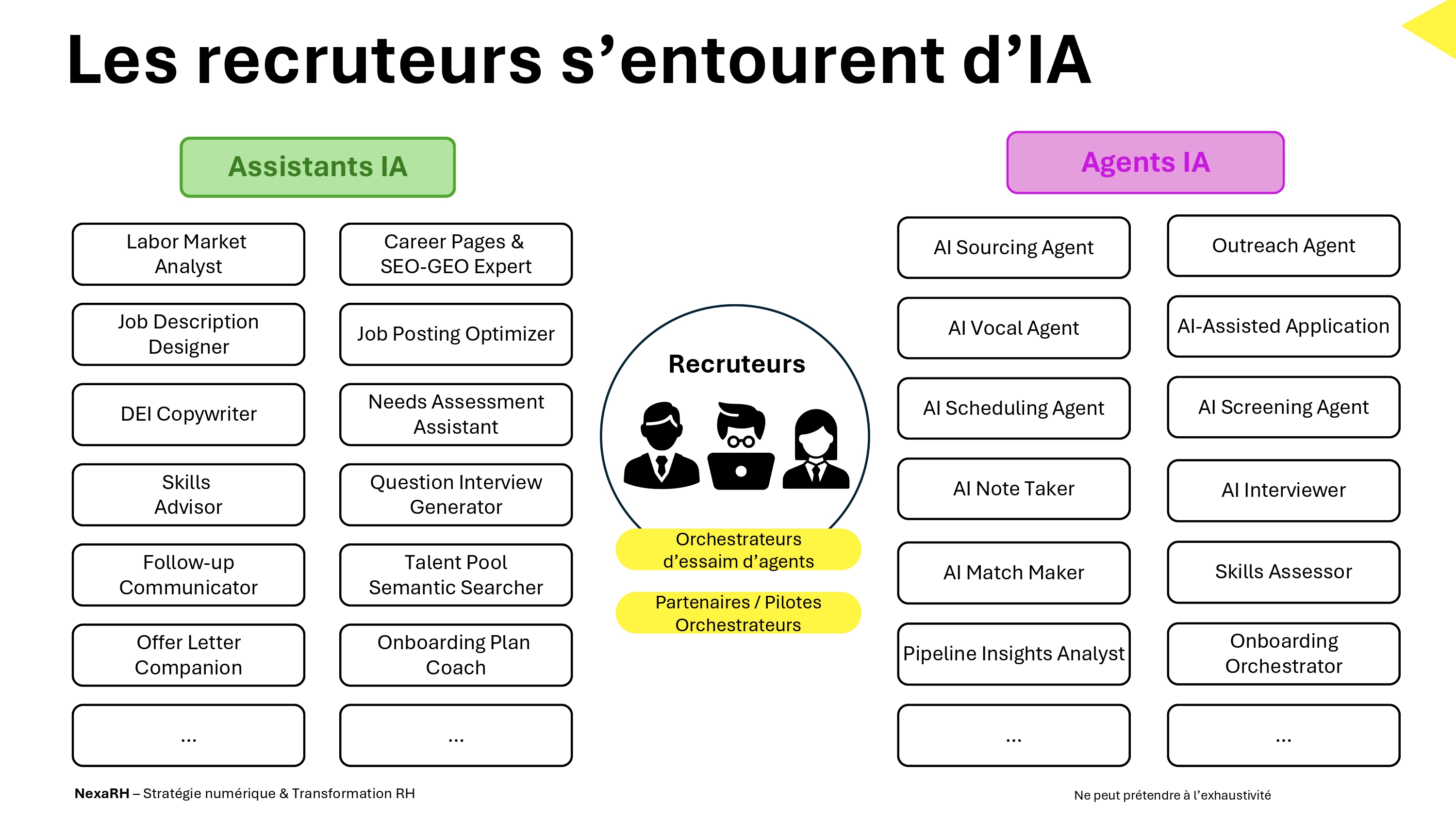
2.2 16 AI agents already named and deployed in ATS
Every major ATS vendor now has its own agentic agent. These agents no longer simply assist, they act autonomously: they launch searches, fill pipelines, schedule interviews, send offers.
OliviaParadox (acquired by Workday)
WinstonSmartRecruiters (acquired by SAP)
RayBeamery
HubertHubert AI
TallieJobvite
TairaRadancy
IlluminateWorkday
HapiVonq
Talent ScoutIndeed
SamSeekOut
AnnaFountain
RosiRival
ZiaZoho Recruit
ShiroMaki People
MorganTenzo AI
ScoutHyrr AI
2.3 The ATS market is consolidating at breakneck speed
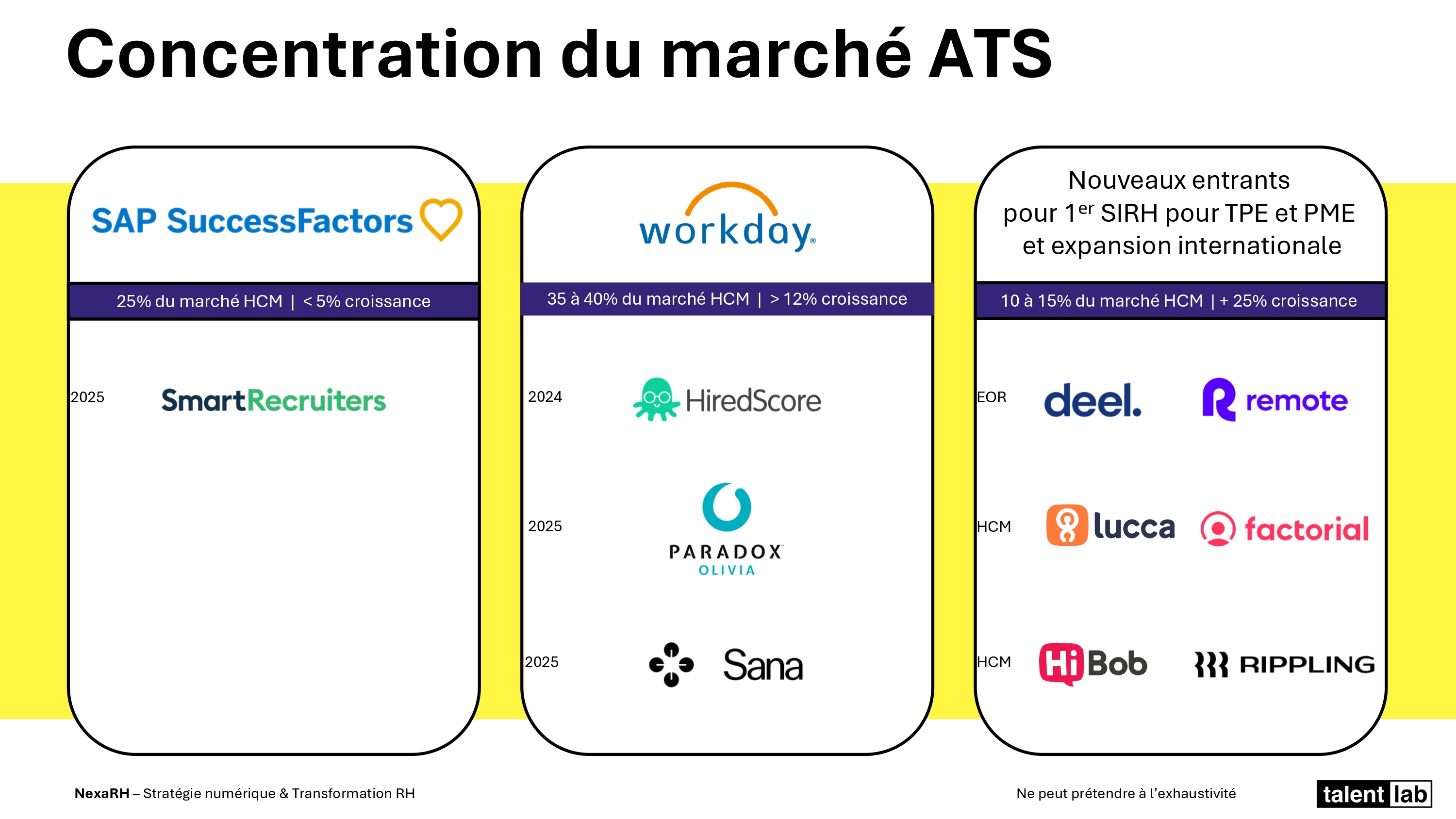
- SAP SuccessFactors (~25% of the market, <5% growth): acquisition of SmartRecruiters in 2025. Risk of obsolescence across 30 to 40% of its application base.
- Workday (35-40%, >12% growth): the big winner of the consolidation. Acquisitions of HiredScore (2024), Paradox/Olivia (2025) and Sana (2025). Positioned on agentic high-volume recruitment.
- New entrants (10-15%, +25% growth): Deel, Remote, Lucca, Factorial, HiBob, Rippling, driven by the needs of very small businesses and SMEs and by internationalisation.
On SAP's side, the acquisition of SmartRecruiters (more than 20,000 customers) aims to modernise a suite that is robust but seen as heavy. A technical building block is also changing the game: the MCP connector (introduced by Anthropic at the end of 2024), which some ATS already offer. It allows an agent to read any structured or unstructured field in the ATS, and to drive it on the fly with a simple prompt. This is what makes the “bridge” possible between systems that have so far been siloed.
A striking figure: only 6% of workers hired into AI roles hold an AI-related degree. Skills are emerging faster than qualifications.
2.4 The Pilot / Co-Pilot / Autopilot triad
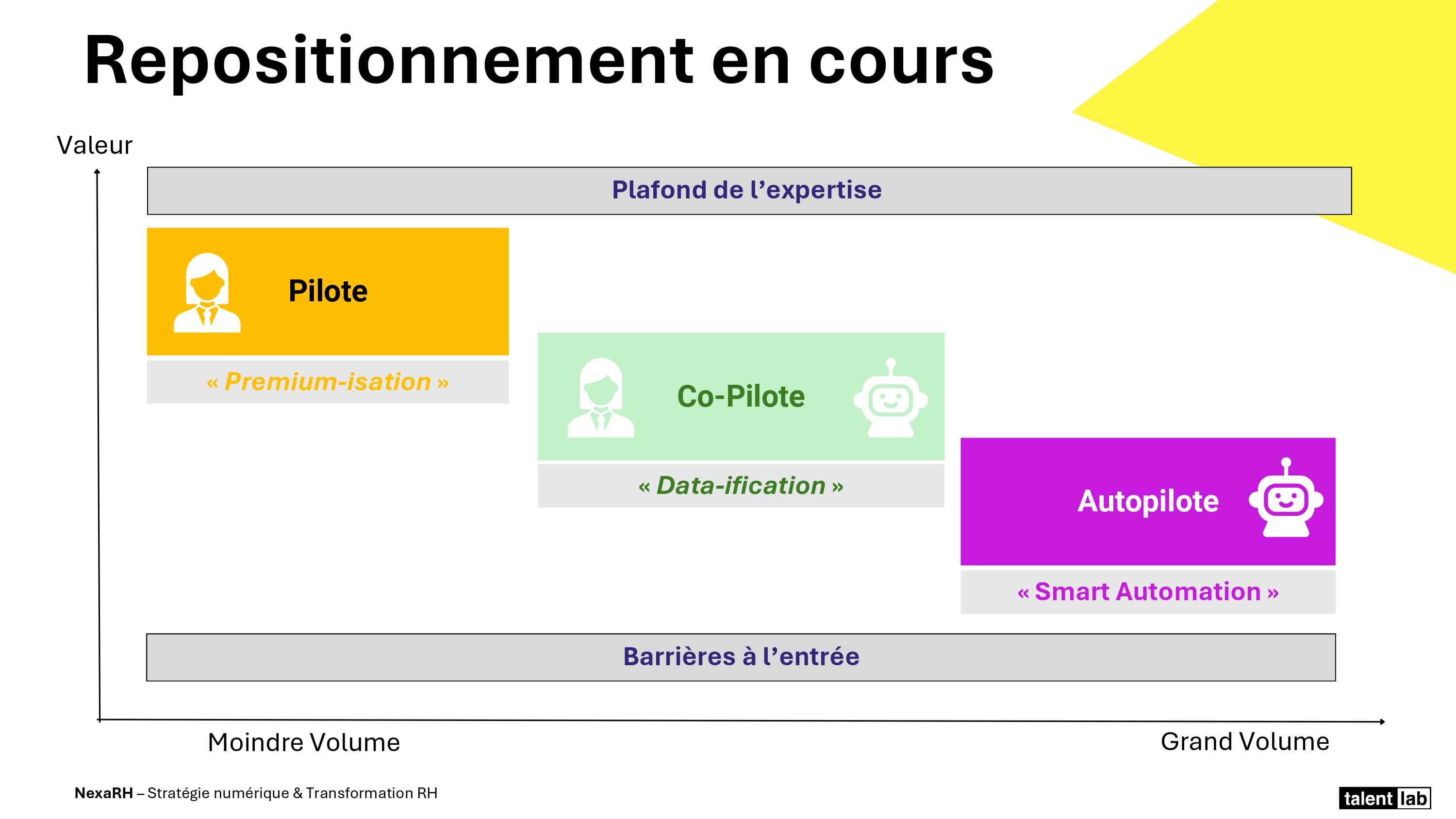
Pilot
“Premium-isation”: human hyper-skills
- Understanding the organisational culture (Culture-Fit)
- Maintaining the relationship with Hiring Managers (Team-Fit)
- Negotiating salaries and conditions
- Handling confidential applications
- 50+ relational tasks with a lasting advantage
Co-Pilot
“Data-ification”: augmented professionals
- Writing job descriptions from templates
- Drafting candidate summaries
- Identifying the skills to assess
- Writing outreach messages
- ~10 to 15 tactical tasks
Autopilot
“Smart Automation”: AI agents
- Writing and posting optimised job ads
- Boolean searches and matching
- Interview scheduling
- Pre-qualification through AI voice interviews
- ~10 to 20 operational tasks
Case study: Autopilot in high-volume recruitment
A North American retailer makes 3,000 hires a year in retail. By deploying a dozen agents, it went from 50 recruiters to 2. Store managers receive applications directly, interviews are scheduled according to their availability, and the offer letter goes out to the candidate in a single click. The result: time to hire dropped to around 4 hours, compared with three weeks previously. The freed-up team was redeployed to sourcing and corporate recruitment, exactly the “Autopilot → Pilot” shift described above.
To make this triad operational, Jean-Baptiste Audrerie relies on a fine-grained breakdown: an in-house recruiter handles between 135 and 175 distinct tasks in their work. When this framework is run through the triad, the diagnosis is clear:
• In Pilot mode, there are 50 to 60 tasks of high relational value that are neglected today, crowded out by admin, and that could be strengthened: understanding the political context of a hire, reading a team's culture, negotiating a complex offer, handling a confidential application.
• In Co-Pilot mode, 10 to 15 tactical tasks benefit from generative assistance: writing a job description, preparing an interview grid, summarising a report.
• In Autopilot mode, 10 to 20 operational tasks can be delegated to agents right now.
“Take your job description and do the analysis yourself: Pilot, Co-Pilot, Autopilot. You then have your transformation plan and your plan to raise your value as a recruitment professional.”
Jean-Baptiste Audrerie, NexaRH · TalentLab 2026
“An agent does not replace a job, an agent automates a task. But if you put 10, 15 or 20 agents on a process, the impact becomes considerable. Agentising your work is work in itself.”
Jean-Baptiste Audrerie, NexaRH · TalentLab 2026
The barrier to entry into recruitment is falling (cost of technology, accessible agents). But the ceiling of expertise is rising. Generalist recruiters who only pass on volume will gradually become exposed. Those who bring data, market intelligence and relational value become more necessary than ever.
3. Why does a British recruiter earn twice as much as you?
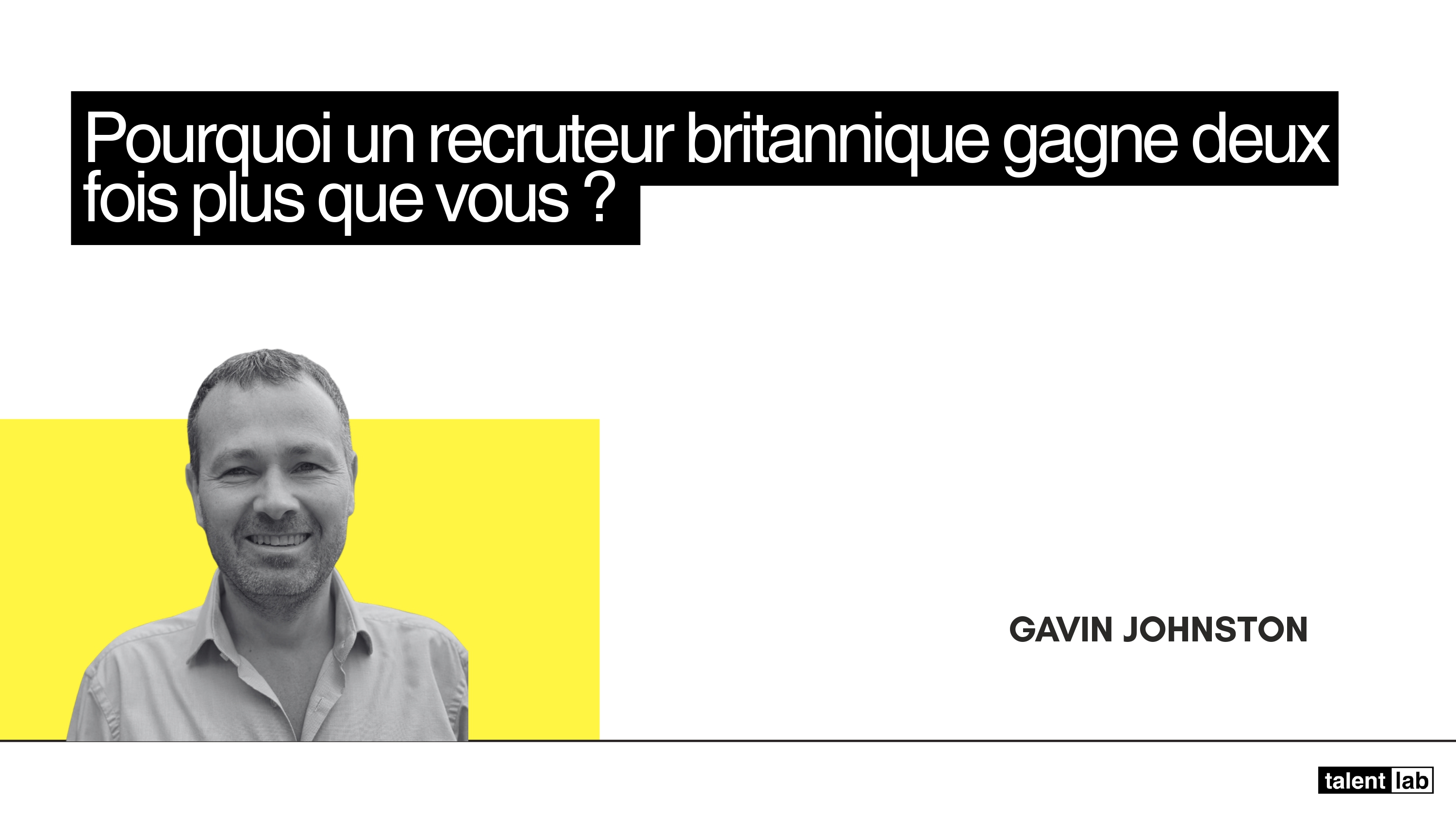
Gavin Johnston · Founder · Everything About Recruitment · Coach and trainer for recruiters (UK / Europe)
The opening question is deliberately provocative. Gavin Johnston has spent six years training and coaching hundreds of recruitment agencies in France. His finding: the pay gap between France and the United Kingdom is neither cultural nor cyclical. It is structural.
3.1 Figures that make you think
Before making the comparison, Gavin Johnston methodically ruled out the other countries: Switzerland (barriers to setting up, languages and cantonal laws), the Netherlands (weight of temporary work, zero-hours contracts),Germany (it is the candidate who takes the lead over the agency, not the other way round) and the United States (too many very high salaries). That leaves the United Kingdom: geographical size, population, tools, channels, candidate expectations and the geographical distribution of jobs are remarkably close to those of France, to the point that you can set Greater Paris and Greater London side by side.
Methodology: the British figures come from the REC, the official body of the recruitment industry in the United Kingdom. The French figures come from six years of coaching and from hundreds of agency heads and independent recruiters interviewed, an estimate that Gavin Johnston even considers “perhaps a little too high”.
3.2 The 4 structural differences
1. It is an openly sales role. In the United Kingdom, recruitment is presented as a sales activity from the job ad onwards: quantified targets, commissions of 30% of the margin brought in, results displayed on the wall. The concept of the desk is central: recruiters run their activity like a mini-business. In France, recruiters are still too often seen as a support function rather than as market developers.
2. Are you coachable? The best British recruiters are willing to question their habits: their follow-ups, their positioning, the way they talk about money. Job ads talk about what will be offered, not just what is expected.
3. Scopophobia. This term, “the fear of being looked at”, illustrates a very French reality: the fear of disturbing people. In a British agency, a recruiter who gets no reply to an email will call three times on the first day, send a text, a LinkedIn request, then a WhatsApp. Selling means disturbing people in a positive way. Not following up means leaving opportunities to others.
4. The niche. This is the main driver of the pay gap. On LinkedIn UK, recruiters present themselves as “Java recruiter in the Lyon area” or “recruitment specialist in London”. Agencies of 254 people place only technical back-office profiles for engineering companies. A niche is not a marketing affectation, it is a sales strategy: a better reading of the market, a denser network, CVs presented within 24 hours.
“Bring a product. A client is not just buying recruiter time, they are buying the ability to access a market, understand it, and move faster with less risk.”
Gavin Johnston, Everything About Recruitment · TalentLab 2026
3.3 The 4 actionable levers to bill more
- Develop a genuine sales culture: talk about money, display targets, structure commissions at 30% of the margin, train management.
- Become coachable: invest in ongoing training, review your scripts and follow-ups, accept learning to recruit differently.
- Cultivate the ability to disturb people in a positive way: call, follow up, keep track, across the whole team. Just do it.
- Choose and own your niche: a market where you can answer any question with authority in under 24 hours, and become the client's go-to reflex for that segment.
Two findings support these levers:
• First, French agencies pay too much fixed salary and not enough commission: the best British agencies pay 30% of the margin brought in, which aligns everyone's interests.
• Second, the French business development reflex of “I know how to recruit, I know how to write job ads” is counterproductive: everyone says the same thing, so the client chooses the cheapest. Specialisation, by contrast, means you arrive with a genuine product: market knowledge that makes the agency a partner, not just an order-taker.
4. Vision as a compass: the L'Oréal Talent Acquisition model
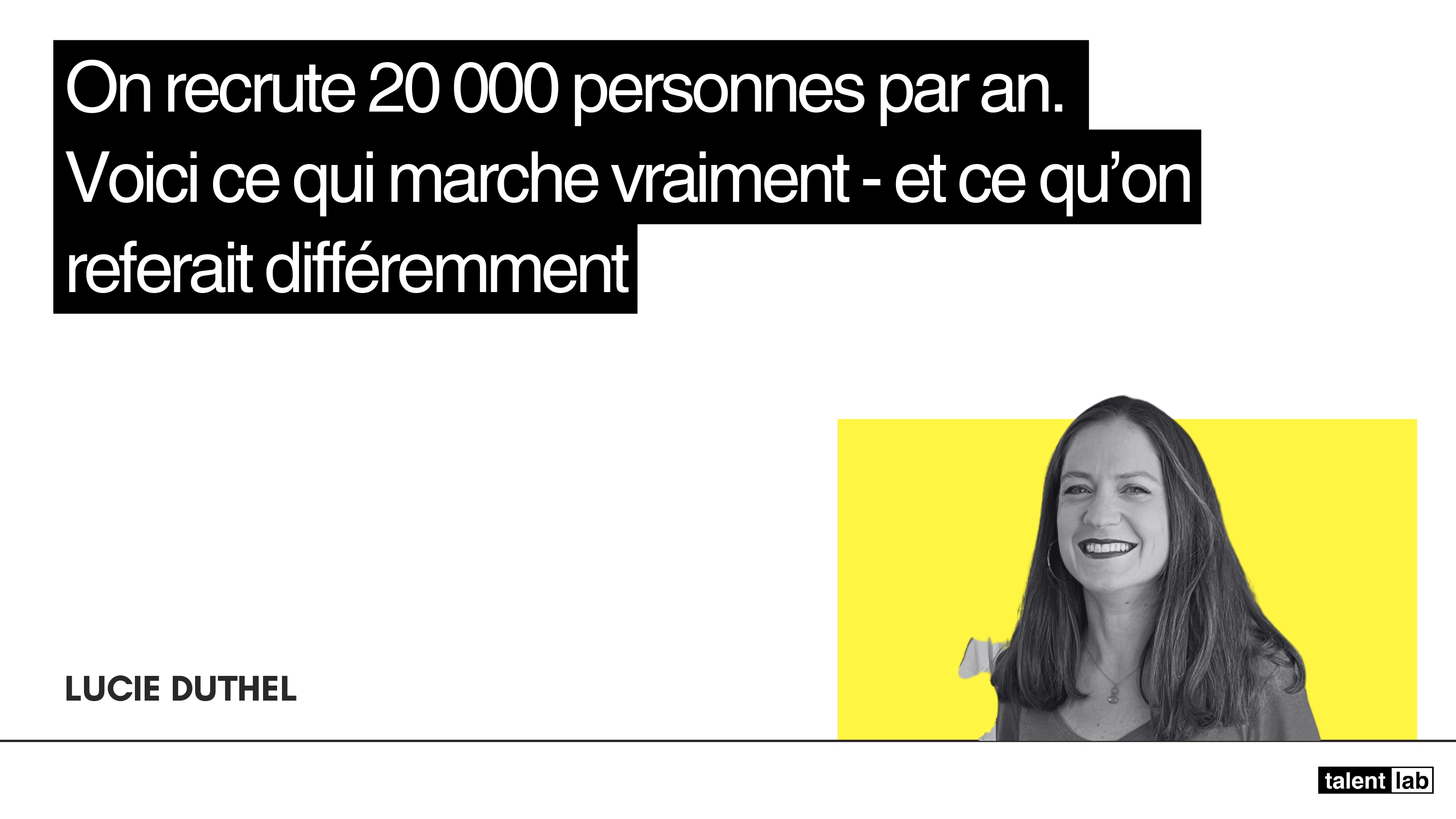
Lucie Duthel · Talent Acquisition Digital Transformation Director · L'Oréal (Global)
L'Oréal: €44.05 billion in revenue, 40 global brands, 95,000 employees, 65 markets. The question put to TalentLab 2026 was precise: how do you decide to hire when you handle 2 million applications a year with 200 recruiters across 65 markets?
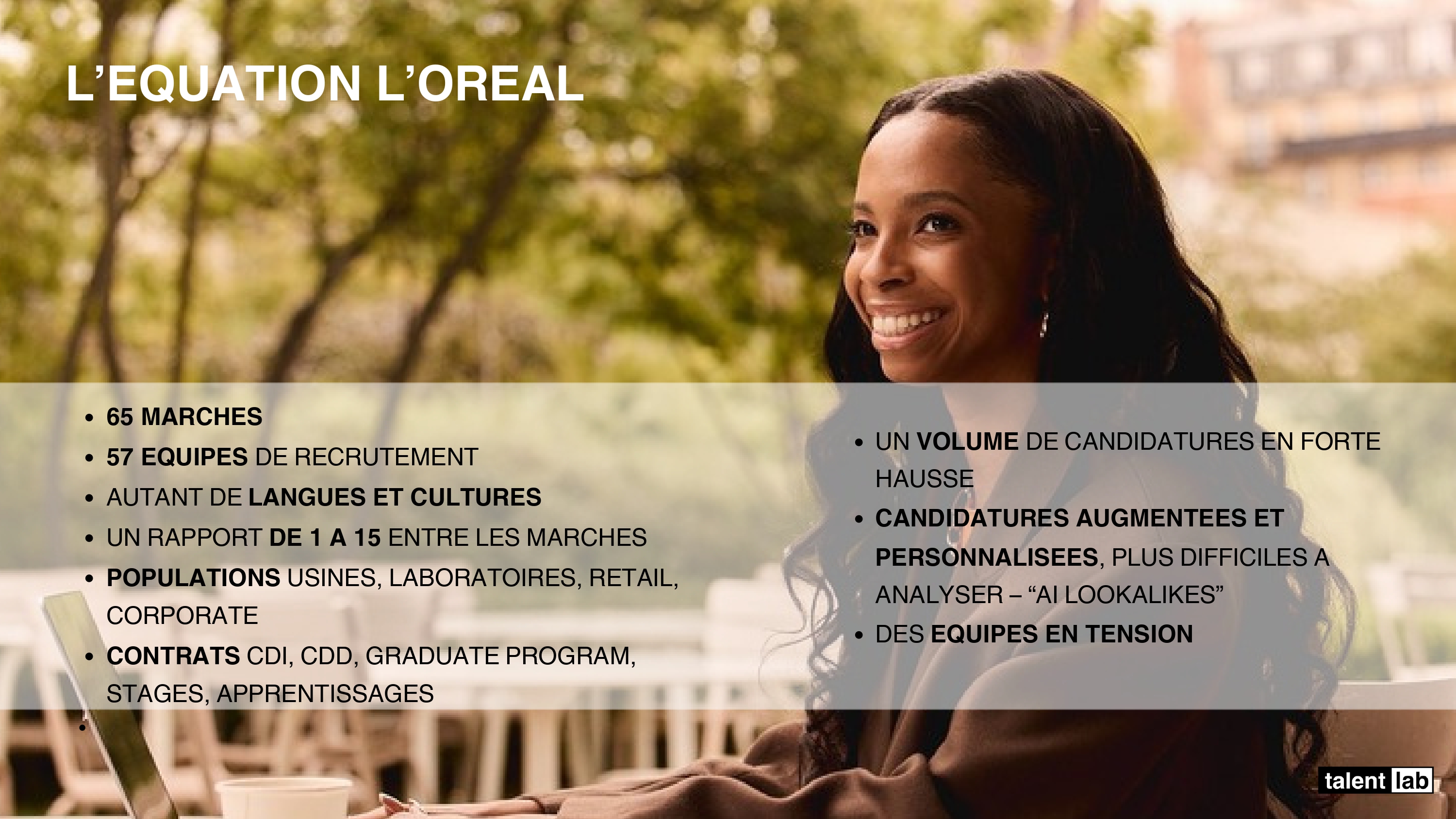
The answer comes down to one formula: vision before AI, intention at the centre. The tool does not define the method, it serves it.
4.1 The 3 questions that shape the Talent Acquisition vision
How do we want to recruit?
(values, culture, long-term outlook)
Which criteria really matter?
(skills, potential, assessment)
Which moments should be protected?
(protecting what makes the human difference)
These questions have concrete consequences. At L'Oréal, recruiting means “recruiting a talent, an individual, a future”, never just the immediate need: a candidate who is perfect for today's role but in whom no future is seen is turned down. Potential is even formalised in five dimensions, based on a competency framework specific to the company and built into its tools.
These three questions come before any technology choice. LinkedIn is treated as a direct extension of the Avature ATS , not as a separate channel. Unused licences are cut without compromise. Candidate experience is measured systematically by team and by country.
4.2 The pruning strategy: aiming for excellence in adoption
L'Oréal's ATS is Avature, its single tool for more than ten years, chosen at the time because it was one of the only pure players able to absorb such complexity, a choice since followed in the CAC 40 by Total and BNP. This stability serves one objective: making the most of the history and quality of the data accumulated. But the downside was a drift towards too many workflows and too many options, unmanageable both for maintenance and for data quality. Hence the pruning strategy:
- Simplification and harmonisation: reduce the number of workflows, standardise on a global scale. Fewer options, better used.
- Continuous updates, zero technical debt: no build-up of obsolete practices.
- An uncompromising data model: data is documented, harmonised and shown even when it is not flattering.
- Ongoing, mandatory training: a gamified programme, “Level Up Challenge” , on the ATS, super-users in every team, competition between teams.
4.3 The place of AI: the AI Free Zone
Faced with the explosion of “AI lookalikes”, L'Oréal has formalised a clear position:
- No AI during the interview: AI can transcribe remote interviews, but does not replace the assessor.
- At least one in-person interview per process: a deliberate return to the “good old interview”, even when it costs more.
- AI automates the whole top of the funnel: parsing, assessment, pre-selection, to free up time for human assessment.
“Vision before AI. Intention at the centre. We do not deploy a tool to see what it can do; we start from what we want to achieve, and we choose the tools that serve that vision. Zero compromise on adoption, zero compromise on data quality.”
Lucie Duthel, L'Oréal Talent Acquisition Global · TalentLab 2026
To hold this line in the face of volume, L'Oréal is preparing an AI charter: by disclosing its own uses of AI, the company can in turn ask candidates to “play by the rules”. The aim is to avoid an AI arms race (a candidate's AI answering a recruiter's AI) and to focus efforts on a pre-screening process able to bring out the truly motivated candidates. Intuition, for its part, is protected but reframed: “we don't want intuition at the start, that's called bias; we want intuition at the end”, once everything else has been made objective.
At L'Oréal, the recruiter has three irreducibly human missions: orchestrating tools and data, coaching candidates and managers, and above all interviewing more and better.
5. The study on recruiter salaries in France (2026)
Arnaud Coulon · HR Data Expert · Lecturer at Sciences Po & Laurent Brouat · Les Talents Narratifs
Data cross-referenced with Index Advertsdata (38,000 job ads analysed · 800 respondents)
5.1 Key findings of the study
- Taking on responsibility pays very well. A recruitment manager takes only 3 to 5 years to reach the same fixed salary as a recruitment officer with 15 years' experience.
- Job ads undervalue actual salaries for juniors. The salary actually received is on average 33% higher than what was advertised in the job ad.
- The Paris / regions gap widens with experience. After 10 years, a recruiter in the Paris region earns on average 31% more than their counterpart in the regions.
- The gender pay gap widens after 10 years. At the start of their careers, women earn slightly more. But after 10 years, the gap exceeds 33% in favour of men.
- Variable pay is much more common in agencies. 89% of agency recruiters receive variable pay (vs 68% in large companies), accounting for 25% of total pay.
- Pay transparency remains patchy. 21% of job ads still show a vague mention despite the gradual entry into force of the European directive.
A final finding, by type of organisation: it is in large companies that the median fixed salary is highest, ahead of recruitment agencies. Two surprises: the median fixed salary is identical in large companies and start-ups, and IT services companies (ESN) sit lower than the audience expected. This should be qualified, however: in agencies, variable pay (25% of the total, received by 89% of recruiters) significantly rebalances the comparison on total pay.
“In recruitment, progression does not depend only on the number of years of experience. It depends on the ability to take on responsibility, generate business, structure an activity and create visible value.”
Arnaud Coulon & Laurent Brouat · TalentLab 2026
Conclusion: 5 cross-cutting lessons from TalentLab 2026
- →Steering by data changes decisions. Intuitions about the labour market are often wrong. 600,000 available workers, unemployment rising in France while it falls in Europe: the data refutes the dominant narratives.
- →Agentic AI is already in production, on both sides. The 16 AI agents identified are deployed. Candidates are using agents too. Recruiters who have not taken a position within the Pilot/Co-Pilot/Autopilot triad are building up a structural lag.
- →Specialisation is the best protection against commoditisation. What AI automates first are generic tasks. A niche and a network of trust remain lasting defences, and very well paid ones (UK/France gap ×2).
- →Vision before tools. L'Oréal illustrates this on a global scale: no tool, be it LinkedIn, ATS or AI , delivers its value unless it is sized from a clear strategic vision.
- →The recruiter remains irreplaceable where intention matters. Assessing, coaching, building a relationship of trust, interviewing with discernment: these are human acts that automation amplifies but does not replace.
