
Laurent Brouat's TalentLab: 2025 edition
On 29 April 2025, a wide range of players (HR professionals, recruiters and many more) came together for the TalentLab, the must-attend event organised by Laurent Brouat. The aim? To take a step back and look at the trends in the recruitment market.
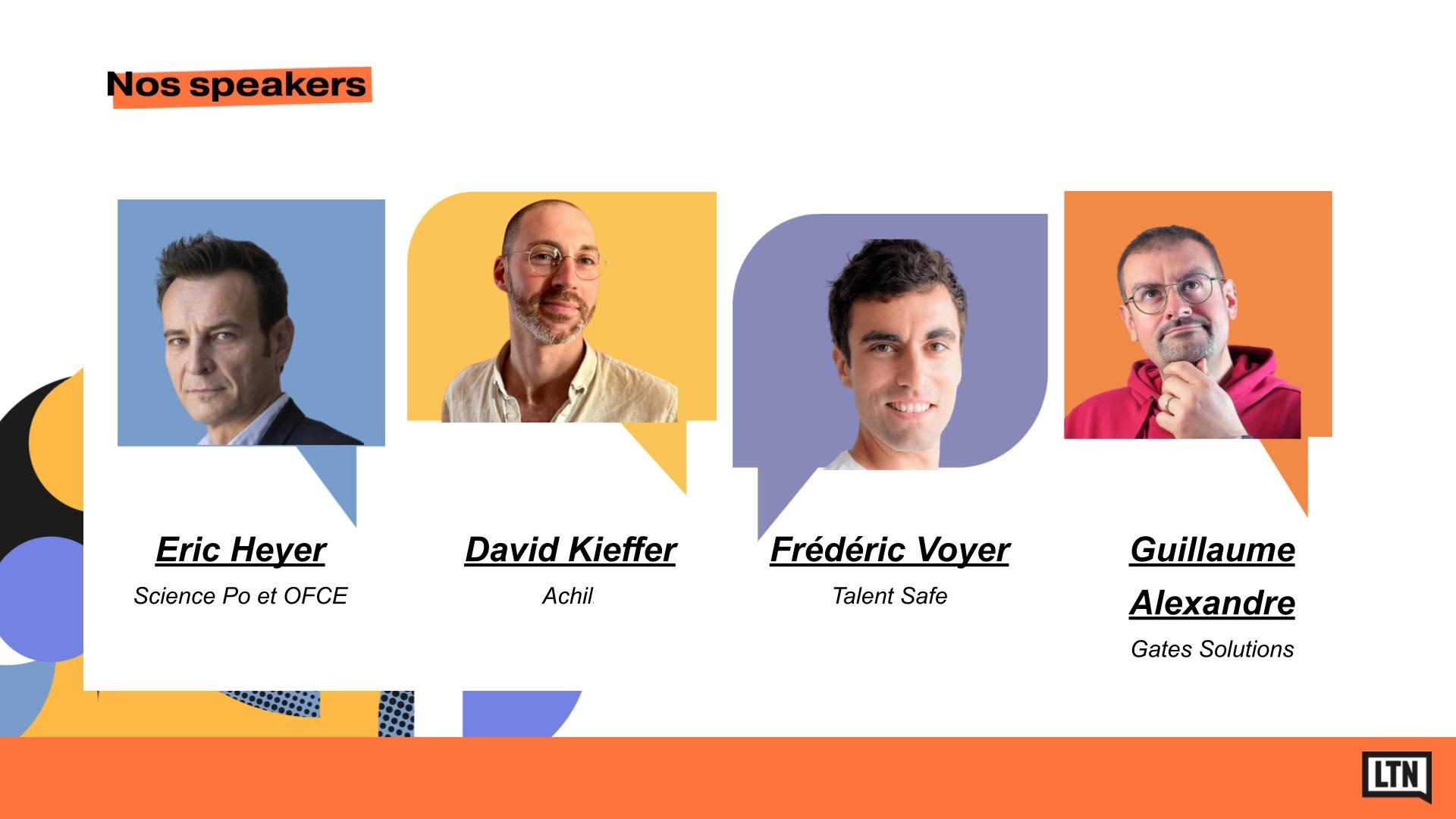
The day featured a number of workshops, but above all four talks, each offering a perspective on today's challenges and tomorrow's opportunities:
*Credit: Talent Lab, Laurent Brouat, Les Talents Narratifs
- Éric Heyer (OFCE) analysed the real reasons behind recruitment shortages in France
- David Kieffer (Achil) explored the rise of collectives of independent recruiters
- Frédéric Voyer (TalentSafe) delivered an unflinching assessment of the state of recruitment agencies
- Guillaume Alexandre (Gates Solutions) warned about LinkedIn's dominance in the world of sourcing
➡️ Recruitment is moving at full speed, and everyone will have to rethink their practices to stay in the race.
Recruitment shortages: where are the workers? (Éric Heyer)
As tensions in the labour market multiply, Éric Heyer, Director of the Analysis and Forecasting Department at OFCE, offers his reading of the reasons behind hiring difficulties in France. His talk reveals a reality that is more complex than it seems: no, France is not experiencing an American-style “ Great Resignation ”, but rather a “ Great Rotation ” in the labour market.
*Credit: Talent Lab, Laurent Brouat, Les Talents Narratifs
Éric Heyer is a director at the French Economic Observatory (Observatoire français des conjonctures économiques (OFCE), and a specialist in employment, purchasing power and macroeconomics. He regularly appears in the media to decode major economic trends and their impact on the labour market.
The Great Resignation: myth or reality?
Unlike the United States, Italy or the United Kingdom, France is not facing a wave of mass departures from the labour market. Resignations are indeed rising, but they reflect a desire for career mobility rather than an outright withdrawal. Employees are changing employers to improve their conditions or switch sectors, which creates instability and an increase in hiring, without overall employment being affected.
A dynamic yet paradoxical job market
Since the health crisis, France has seen moderate growth (+4% since 2019), nothing excessive compared with its neighbours. Yet it has hired on a massive scale: 1 million jobs created, while productivity per employee has fallen. Several factors explain this paradox: a fall in actual working hours, rising absenteeism, stagnating real wages, the boom in apprenticeships (from 300,000 to 900,000 apprentices) and the artificial survival of so-called “zombie” organisations thanks to public subsidies.
The special case of industry
While industrial production is declining, companies keep on hiring. Why? For fear of being unable to replace a skilled workforce that has become scarce. So they hold on to their employees, even during slow periods, thanks to public subsidies and rising prices (inflation), which have allowed them to protect their margins. But as these levers disappear, adjustments are expected from 2025, notably through redundancy plans.
A market turnaround on the horizon?
*Credit: Talent Lab, Laurent Brouat, Les Talents Narratifs
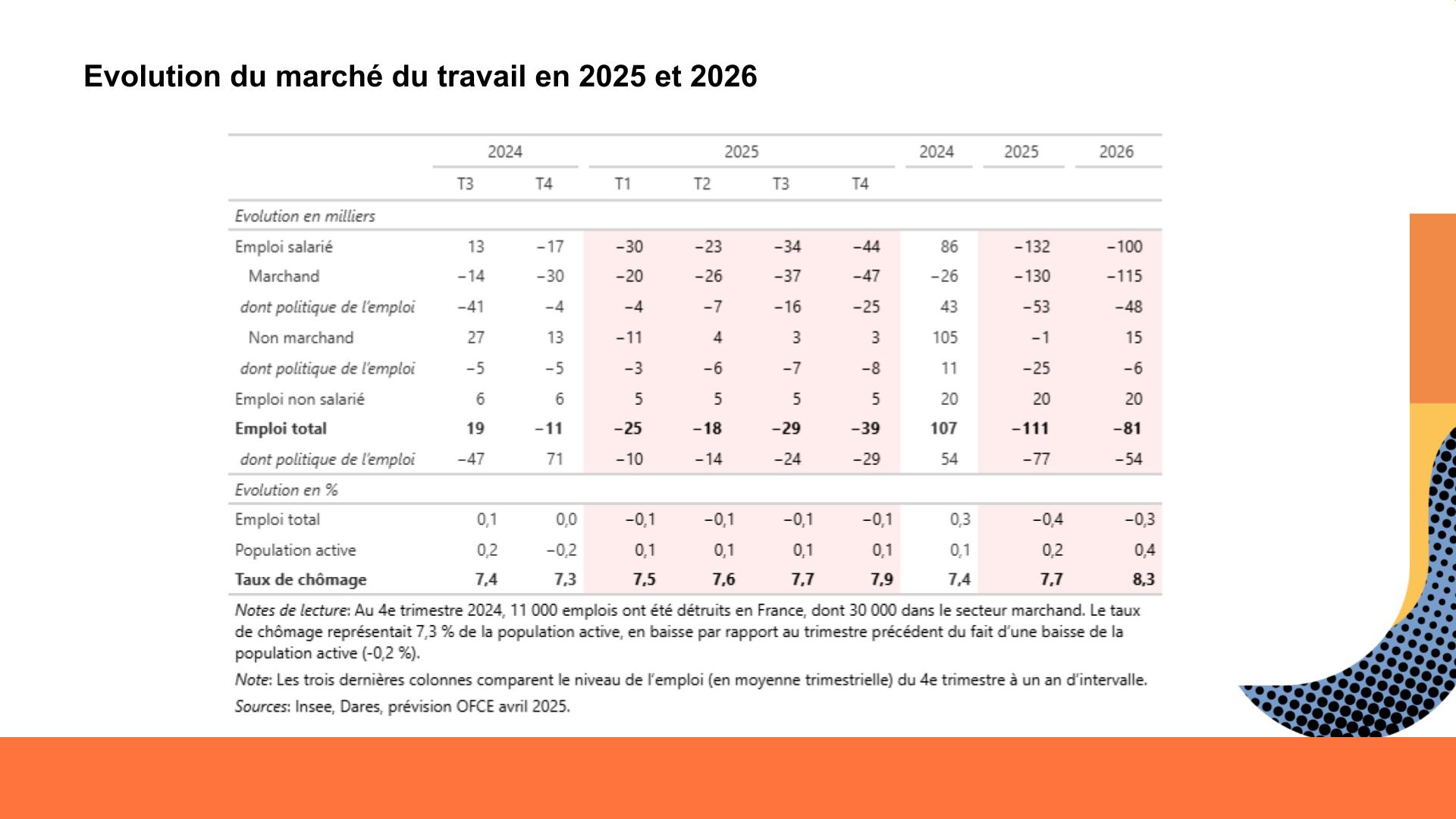
The combination of several factors (fewer apprentices, the gradual disappearance of zombie companies, a return of productivity and rising wages)points to net job losses in 2025-2026 (around 200,000). It is a change of cycle: unemployment will rise again (forecast at 8.3%), but productivity gains will finally allow real wages to increase without hurting organisations' margins.
Éric Heyer's analysis highlights the need for a more targeted employment policy, particularly in favour of young people with fewer qualifications. Cutting apprenticeship subsidies risks hampering their integration into an already tight labour market. To meet structural challenges (an ageing population, the appeal of industrial jobs), the State will have to commit to long-term choices in investment and training.
Recruitment collectives: here to stay? (David Kieffer)
Freelancers, independence, collectives… These words are now everywhere in the recruitment sector. But is this just a passing trend or a genuine transformation of the market? That is the question David Kieffer, co-founder of the Achil collective, set out to answer.
*Credit: Talent Lab, Laurent Brouat, Les Talents Narratifs
A former investment banker, David Kieffer moved into HR entrepreneurship in 2022 by co-founding Achil, a collective of independent recruiters. Drawing on extensive field experience, having met more than 2,500 recruiters, he shares his analysis of the collective phenomenon.
What is a recruiters' collective?
David Kieffer defines it as follows:
“A collective (or network of independent recruiters) is a group of recruitment professionals who work for themselves and decide to come together to pool their skills, their contacts and their best practices. The central structure (the head office) handles coordination and provides a range of services: training, support, legal and financial assistance, marketing, and preferential rates (a purchasing hub).”
Their promise? The best of both worlds: the freedom of independence, with the security and resources of salaried employment.
Why are recruitment collectives emerging?
Freelance recruitment has grown strongly since the Covid crisis. The reasons are simple:
- More flexibility,
- Better pay,
- Less dependence on unstable employers.
But independence also has its downsides: isolation, heavy administrative procedures, difficulty winning assignments… It is against this backdrop that recruiters' collectivesare emerging, an alternativethat blends salaried employment and freelancing.
A few figures
- 42 collectives created in France since 2020 (around ten have already disappeared).
- Around 1,400 recruiters are now members of collectives.
- 3 collectives have more than 100 members.
- The average fee per assignment stands at €8,000.
- Clients are mainly very small businesses and SMEs outside Paris, which traditional agencies serve poorly.
Why does it work?
For clients:
- More affordable services thanks to lower overheads.
- A more flexible and more human approach.
- A close, on-the-ground presence that is often lacking in large agencies.
For recruiters:
- Higher income, more freedom.
- Less isolation thanks to an active network.
- Access to shared tools (CRM, job boards, training…).
The result: a virtuous circle forms between satisfied clients and motivated recruiters.
A new competitor for recruitment agencies?
Collectives are not necessarily trying to compete with agencies, but rather to occupy a “blue ocean”: that of small businesses that receive little or no support from traditional players (recruitment agencies, large recruitment firms, specialist agencies, etc.)
These independent structures serve a market that is not saturated, under-equipped, but in high demand.
Freelance recruitment: here to stay?
According to Everett Rogers' model of innovation adoption:
- À With 11% of recruiters now independent, we are close to the tipping point of 16%.
- This shift is taking lasting root, but it will not suit everyone.
- The collective model will coexist with agencies, not replace them.
The recruiters' collective model meets a twofold aspiration: that of human-sized companies looking for agile solutions, and that of recruiters seeking meaning, autonomy and collaboration. Collectives are not a passing fad. They are here to stay and are already reshaping recruitment in France.
David Kieffer closed his talk with these words:
“We went through hell, but today we provide a living for 50 people. It's hard, but we're proud.”
Recruitment agencies: a crisis? An analysis by Frédéric Voyer
The recruitment agency sector faces many challenges: falling volumes, pressure on prices, fierce competition… but should we talk about a crisis or simply a period of transformation? Through his analysis, Frédéric Voyer invites us to take a step back.
The aim: to better understand what is holding agencies back today… and what could revive them tomorrow.
*Credit: Talent Lab, Laurent Brouat, Les Talents Narratifs
Frédéric Voyer is an entrepreneur and HR sector expert, and co-founder of TalentSafe, a solution that helps recruitment agencies better secure their placements and showcase their offering.
An actuary by training, with experience in the insurance world and in running the scale-up MyJobGlasses, he is known for his ability to combine data, field experience and business vision. His creed: move beyond fads and get back to analysis, real analysis. With nearly 20 years of experience, he now supports talent acquisition players as they professionalise and differentiate themselves.
Statistics that are often misunderstood
Frédéric begins with a warning: figures are not everything. Worse still, when misinterpreted, they can distort the diagnosis.
- Correlation is not causation: two related facts are not necessarily cause and effect.
- Data quality is paramount: online surveys can be manipulated
- The future cannot be read in surveys: hiring forecasts are only intentions, often contradicted by the facts.
Recruitment in decline: a crisis… of slowness
In 2024, the French recruitment market posted a 5% decline. This is not a sudden drop, but a steady erosion over more than two years, an unprecedented situation. It is not the severity of the crisis that is worrying, but its duration.
Meanwhile, the global market continues to grow: +8% per year over the last 20 years. Forecasts remain optimistic for the years ahead, proof that the profession is not doomed… but must adapt.
Three challenges undermining agencies:
1. Exploding competitionThe number of agencies keeps rising (+4% over 10 years), with few barriers to entry. The result: inconsistent practices, falling fees and a profession that is often poorly perceived.
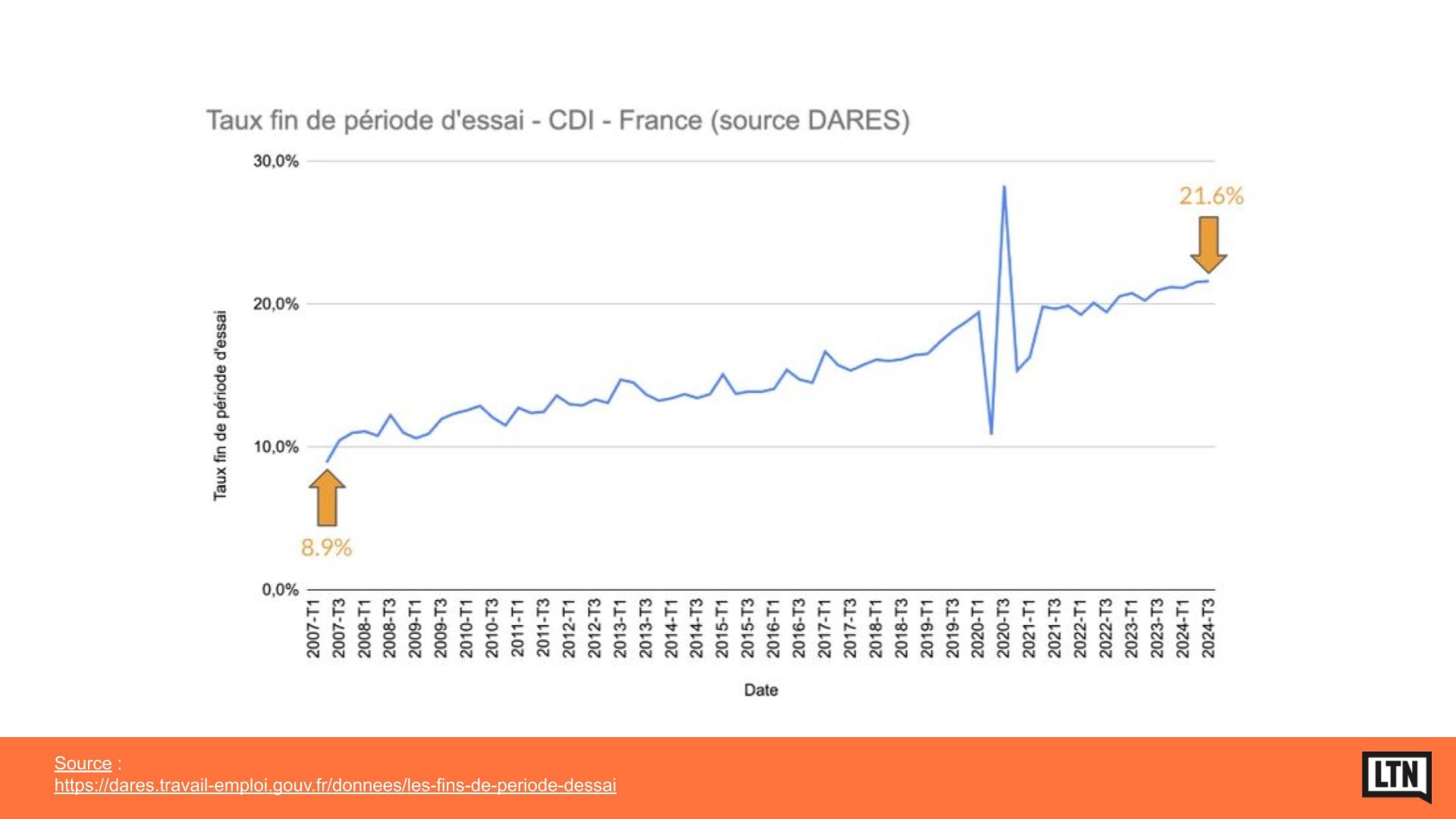
2. A sharp rise in terminations during the probationary period
*Credit: Talent Lab, Laurent Brouat, Les Talents Narratifs
According to DARES (the French Ministry of Labour's research department), 22% of permanent contracts (CDI) are terminated during the probationary period. This instability makes clients cautious and undermines their willingness to recruit through an external service.
3. Profitability under strain
The margin rate of recruitment agencies fell to 2.9% in 2024 (source: Xerfi, a private French institute that produces economic and sector studies and provides analysis on a range of business sectors). An increase in the number of assignments is no longer enough to offset the pressure on prices and the cost of replacements.
The problem is not the market, it is the perception of value
“The added value of agencies is not recognised for what it is truly worth.”
Companies, particularly SMEs, often see agencies as interchangeable. Without differentiation, price becomes the main criterion, at the expense of quality or method.
What if the solution were marketing?
Frédéric Voyer calls on agencies to reinvent themselves, not in their core business, but in the way they present their value.
A few ideas:
- Structure your offering: offer clear service tiers, from “standard” to “premium”.
- Make the most of your data: highlight success rates, average lead times and termination rates that are lower than average.
- Educate the market: explain the strategic role of the recruiter, beyond simply putting people in touch.
“Agencies need to move away from the ‘one-shot’ reflex and think in terms of long-term client relationships.”
Frédéric Voyer does not deny the current difficulties. But above all, he sees them as a call for the sector to mature. Yes, the market is changing. Yes, competition is tough. But the need to bring people into organisations is still there: massive, complex and poorly addressed.
The agencies that come out on top will be those able to:
- position themselves better,
- sell themselves better,
- secure their services better.
What if the real crisis facing agencies was not the market… but their positioning?
LinkedIn crushes everything on the French market (Guillaume Alexandre)
LinkedIn now sits at the heart of every sourcing strategy. For French recruiters, the platform has become unavoidable. In his talk, Guillaume Alexandregave us his analysis of LinkedIn's place in the recruitment market. His warning: LinkedIn has won the data battle. And everyone needs to take that into account.

*Credit: Talent Lab, Laurent Brouat, Les Talents Narratifs
Based in Switzerland, Guillaume Alexandre is one of the pioneers of sourcing in Europe. As the founder of Gates Solutions, he helps companies optimise the way they search for applicants.
With his instantly recognisable red shoes, he fully embraces his geek status: automation, scraping, algorithm optimisation… Nothing escapes him. He often compares the recruiter to a chef: “You can be an excellent cook, but if all you have are rotten carrots, you will never turn out a good dish.” His mission? Supplying recruiters with the right ingredients: the right profiles, the right tools, the right data.
LinkedIn: the most comprehensive global directory
*Credit: Talent Lab, Laurent Brouat, Les Talents Narratifs
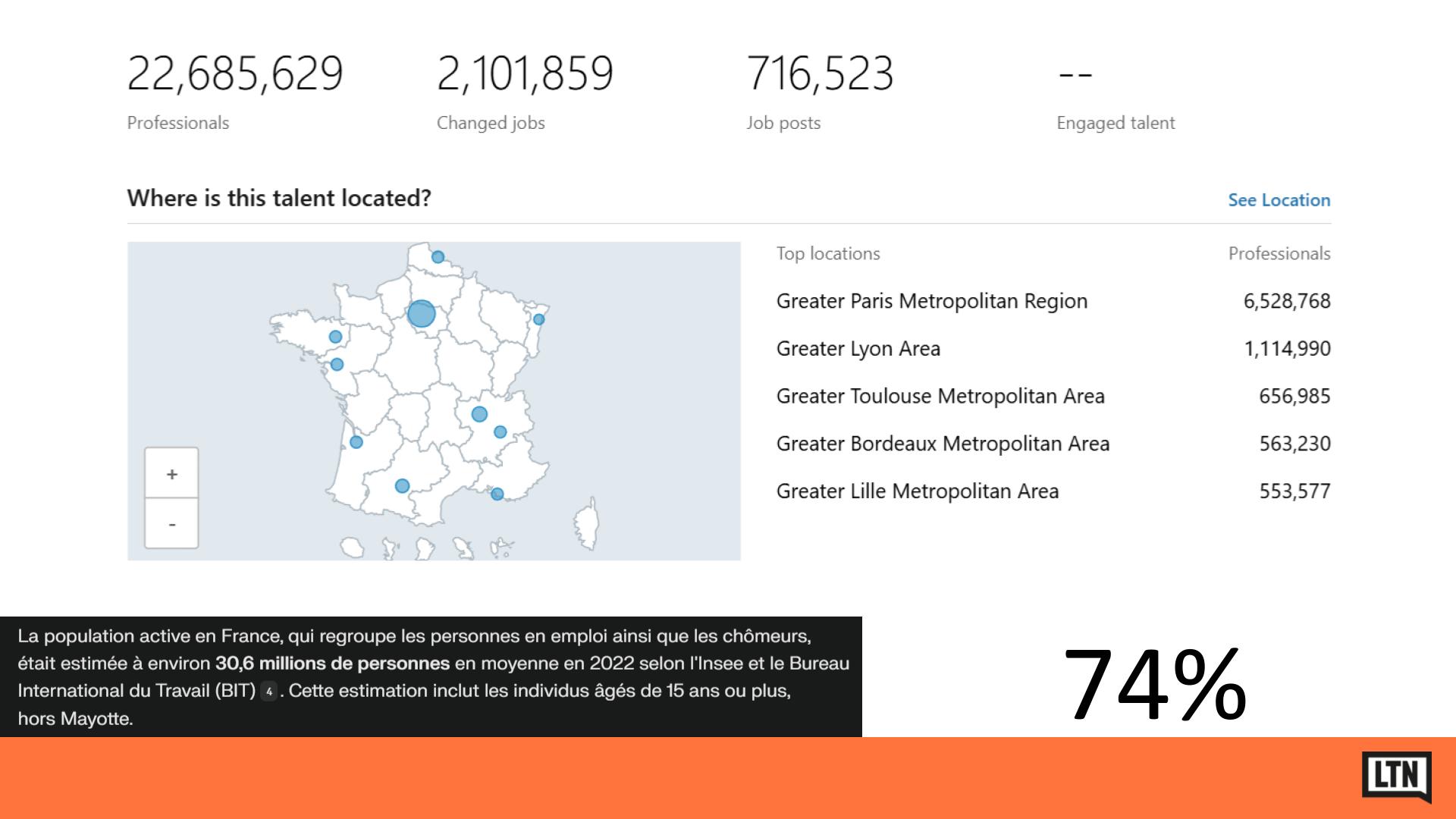
With more than 22.6 million members in France (for a working population of 30 million), LinkedIn covers more than 74% of the workforce. This figure rises to more than 90% in large companies. These figures should be put into perspective: not all members are in work, as the platform also includes retirees, students and inactive profiles.
Guillaume puts it unambiguously:“There will never again be a credible competitor to LinkedIn when it comes to identifying talent.”
The data is entered manually by the users themselves, the structure is unique and the database is up to date: for recruiters, LinkedIn has become the equivalent of a global professional identity card. Viadeo, its former French competitor, has been well and truly buried.
Why job boards can no longer keep up
Job boards rely on a logic ofintent: candidates have to actively look for a job and post their CV. On LinkedIn, the recruiter goes to the talent, whether that person is passively open to offers or currently in post.
Another limitation: data quality. A CV containing the word “Java” could belong to a developer… or to a memory of a holiday in Bali. On LinkedIn, data is structured, sortable and linked to real experience.
The dangers of an absolute monopoly
LinkedIn has become the only gateway to job seekers. But this monopoly brings risks.
Guillaume identifies several:
- Total dependence on the algorithm: only 1,000 profiles are visible in LinkedIn Recruiter. The display order depends on invisible interactions (likes, connections, pages followed).
- Ambiguous positioning for recruiters: connecting with all your prospects can be counterproductive. In open searches, LinkedIn favours 2nd-degree connections over direct connections.
- Possible price inflation: in the future, LinkedIn could raise its prices many times over without fear, as other monopolistic platforms have already done.
How to adapt?
For Guillaume, it is urgent to change stance towards LinkedIn:
- Better understand the algorithm in order to appear in the right results.
- Use the platform not as a passive CV database but as an HR marketing and community management tool.
- Use your ATS (applicant tracking system) as a truly living database.
“You paid to get these candidates. Don't leave their CVs to rot in the fridge!”
LinkedIn has become the supermarket of recruitment
LinkedIn is the shop where everyone does their shopping. Recruiters must accept this and build it into their strategy, but they must also stand out elsewhere: in the way they source, approach candidates and build relationships over time.
Guillaume Alexandre is clear: the recruitment of tomorrow will not happen without LinkedIn. But it will only pay off for those who know how to use data intelligently.
Conclusion: recruiters will have to reinvent themselves
The TalentLab 2025 event showed just how much the recruitment sector is gradually transforming. Between the current tensions in the French market, the emergence of freelancing through collectives, the questioning of traditional agencies and the omnipresence of LinkedIn, one thing is certain: the old methods are no longer enough.
Everyone must act! Whether that means anticipating economic changes, adopting new ways of working, better showcasing your services or using better technology tools (ATS, CRM, job boards, generative AI, etc.)
Ultimately, the future of recruitment belongs to those who know how to reinvent themselves, evolve and meet the expectations of the market.
Further reading
➡️ Les 3 défis des recruteurs en 2025 (Hellowork Place)➡️ Emploi, chômage, revenus du travail (Insee Références, Édition 2024)
➡️ Les offres d'emploi diffusées par France Travail de 2016 à 2024
➡️ Les fins de période d'essai (Dares)
