The Montaigne Institute recently published a survey it commissioned and conducted with the polling institute Kantar Public among French employees on their vision of work.
Methodology
The survey was conducted from mid-September 2022 to early October 2022 with a panel of approximately 5,000 active individuals.
The quotas used to infer the results to the population are gender, age, socio-professional category, region, and type of urban area.
All types of active workers were surveyed: private sector employees, public sector employees, and self-employed individuals.
A questionnaire of over 60 questions, lasting a maximum of 20 minutes, and self-completed by the respondent.
The survey themes
Through the questionnaire, 5 themes were chosen by the Montaigne Institute.
- Job satisfaction and its determinants
- Duration, workload, and work challenges
- Remote work
- End of career and retirement
- Career development and professional mobility
The Nicoka team invites you to examine the results from these different themes together.
You can find our first four articles on job satisfaction and its determinants, perceived workload, on remote work and end of career and retirement.
Today, we present to you in this 5th and final part, the theme of career development and professional mobility.
Career development and professional mobility
Career development and professional mobility are essential aspects of an individual's career. Employees often show a strong interest in these opportunities, seeking to advance and develop their skills within their current company or organization. However, despite this stated aspiration, many obstacles can hinder their path.
The lack of career advancement prospects in the current job is identified as one of the main sources of job dissatisfaction. This can even lead some workers to leave their position sooner than expected, thus refusing to extend their working life.
A form of enthusiasm around career advancement
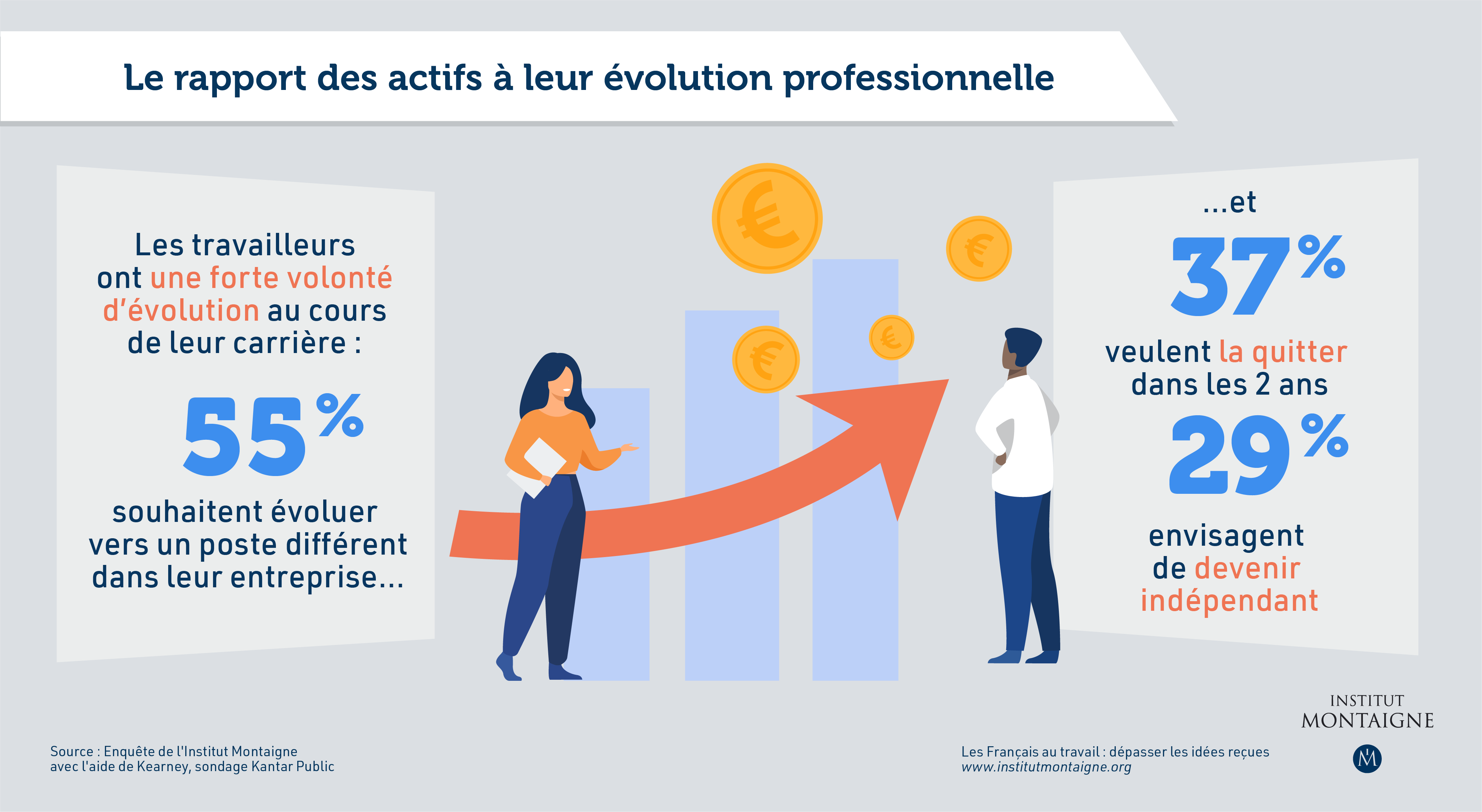
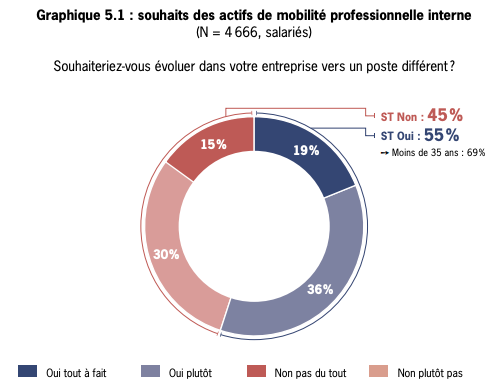
In this survey, we can distinguish three types of career advancement. The first type concerns advancement within the current company or organization, an aspiration shared by 55% of the surveyed employees. This means that these workers wish to climb the ladder, hold higher responsibility positions, or further specialize in their field of activity within their current company.
The second type of advancement is external to the company, a desire expressed by 26% of French employees within a 6-month timeframe and 37% with a 2-year timeframe.
Professional advancement desires
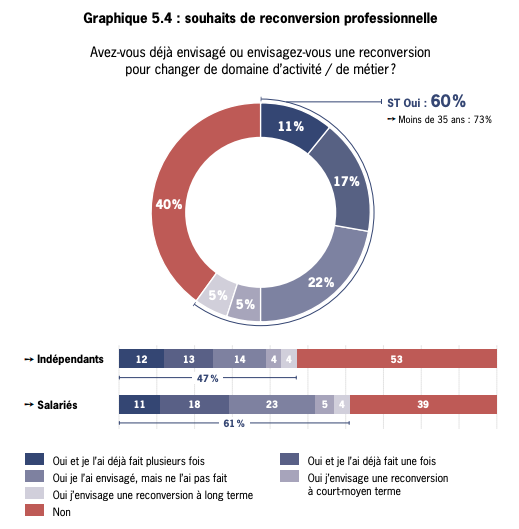
The third form of career advancement concerns career change, namely a change in field of activity, status, or profession. Only 10% of respondents are considering career change for the first time in the short, medium, or long term. This form of advancement is less frequent than the previous two.
However, this desire translates into a strong aspiration to become self-employed (29%) while continuing to work in the same activity, here representing a change in status. Despite this expressed desire by French employees to become independent, only 9% actually take the step, while the remaining percentage (20%) shows a rather favorable inclination.
Professional mobility
Professional mobility in France has not increased since the early 2000s. Immobility is more easily measurable than mobility, and OECD data indicate that the average duration of employment is high in France, with an average tenure of 10.6 years since 2021. The age group of 55-64 years has the highest tenure, with an average of 20 years in the same job.
The main concern for French employees in opting for mobility involves the loss of income, fear of failure, and fear of change. Regarding unemployment, this concern is only cited as the fifth obstacle, probably due to the general improvement of the labor market.
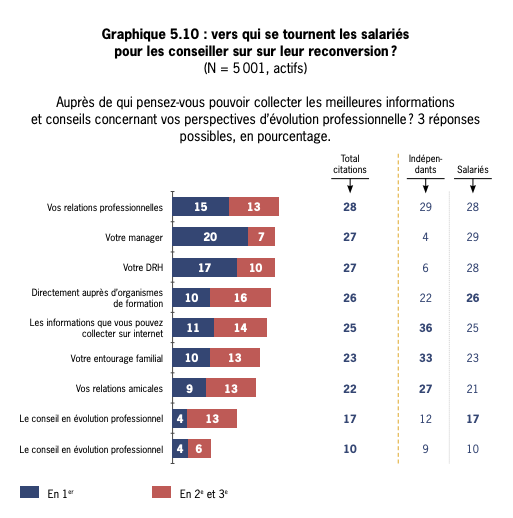
Employees seek advice on career advancement mainly from their professional relationships, their manager, human resources, and training organizations, as well as the Internet. However, institutional support such as Pôle emploi and career development advice (CEP) is less often solicited. The public employment service garners only a low level of trust; in case of unemployment, French employees rely more on themselves and their social capital to find a job.
Career development and professional mobility are significant aspirations for many French employees. They seek to advance and enhance their skills within their current company but also wish to explore external opportunities or consider a career change.
However, obstacles such as the lack of advancement prospects, fear of change, or loss of income can hinder their path.
Employees primarily turn to their professional relationships, their manager, human resources, and the Internet for career advancement advice. Institutional support is less solicited, with French employees preferring to rely on their network and social capital in case of unemployment.
It is essential to consider these aspirations and obstacles to promote a satisfying and fulfilling career development for workers.
Sources
Montaigne Institute Survey: The French at Work: Overcoming Preconceptions
