The Montaigne Institute recently published a survey commissioned and conducted with the polling institute Kantar Public among French employees on their views about work.
Methodology
The survey was conducted from mid-September 2022 to early October 2022 with a panel of approximately 5000 working individuals.
The quotas used to infer results to the population are gender, age, CSP, region, and type of agglomeration.
All types of active individuals were interviewed: private sector employees, public sector employees, and self-employed.
A questionnaire of more than 60 questions, lasting a maximum of 20 minutes and self-completed by the respondent.
The survey themes
Through the questionnaire, 5 themes were chosen by the Montaigne Institute.
- Job satisfaction and its determinants
- The duration, workload, and hardships of work
- Remote work
- Career end and retirement
- Career evolution and mobility
The Nicoka team invites you to explore together the results from these different themes.
You can find our first three articles on job satisfaction and its determinants, perceived workload, and on remote work.
Today, we present to you in this 4th installment the theme on career end and retirement.
Career end and retirement: a massive and collective rejection
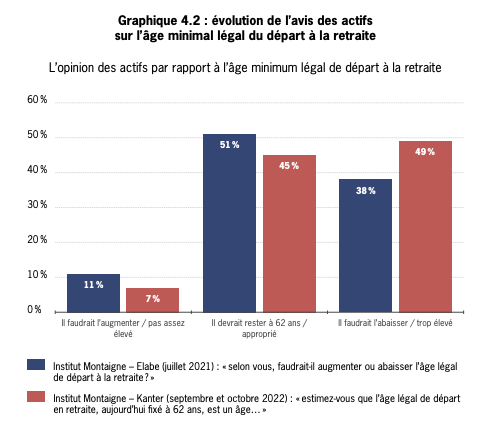
The survey conducted by the Montaigne Institute highlights the opinions of French workers regarding retirement age and explores the collective dynamics influencing these opinions. Although a very small minority (7%) considers the current retirement age insufficient, a relative majority (49%) already deems it excessive. This trend transcends usual categories, thus indicating a deeper political crisis than the mere issue of retirement.
Individual factors linked to this rejection
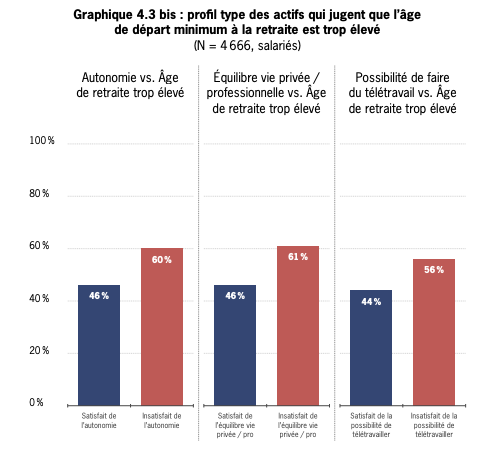
Certain work dissatisfaction factors favor the most hostile opinions towards the ongoing reform. Dissatisfaction with working hours, career prospects, autonomy, work-life balance, the inability to practice remote work, and physical strain are cited as contributing elements to viewing the current retirement age as excessive.
French workers' willingness
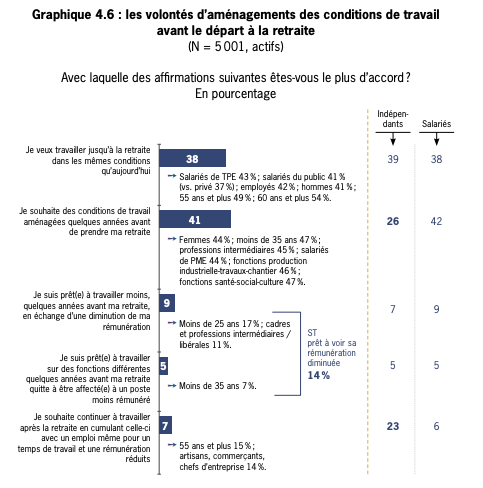
In the face of the inevitable prospect of an increase in the retirement age, workers show a certain pragmatism. A significant proportion (41%) expresses the wish to benefit from adjusted working conditions a few years before retirement. This paves the way for career-end adjustments such as combining work and retirement, career-end leave, and phased retirements, at both company and professional branch levels.
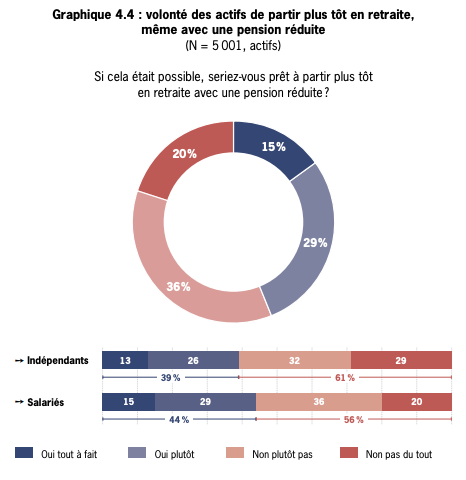
A relative majority of employees express the desire to retire early, even with a reduced pension. This aspiration raises the question of the financial impact of a further extension of the contribution period without raising the legal minimum age. It is suggested that this could lead to numerous early retirements with a reduced pension, thus diminishing the financial yield of the reform.
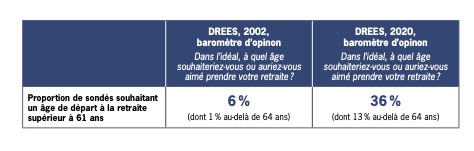
According to the annual surveys by the DREES, the "ideal" retirement age declines due to pension system reforms since 2003, which aligns with the actual retirement age increase. This ideal age decline is also observed over time within a specific generation. For example, for those born between 1965 and 1969, the ideal age was on average 54.8 years when they were between 30 and 34 years old, but it has now reached a little over 61 years for this same generation.
Career-end adjustments
A significant minority of employees are willing to work less or take on different roles, even with reduced pay. This pragmatic attitude offers opportunities for career-end adjustments at the company and professional branch levels. To encourage these initiatives, it would be necessary to adapt fiscal and social incentives and target them at workers and companies facing the most difficulties. Moreover, it is crucial that social partners truly engage on the issue of senior employment at all levels, whether in branches or companies.
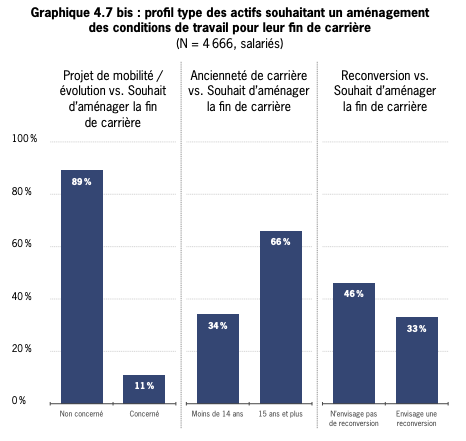
Employees wishing for adjusted working conditions at career end generally have at least 15 years of seniority and do not plan to change positions. Other explanatory factors include an increase in workload over the past 5 years and/or a high mental burden.
The survey reveals a widespread refusal to extend working life among French workers, but also a pragmatic approach to career end and retirement. This suggests that many workers do not wish to work beyond the legal retirement age, but they are willing to adopt an adapted approach to manage this transition.
This pragmatic approach could be linked to the balance between the desire to enjoy life after retirement and the necessity to ensure financial security. French workers seem to be aware of the importance of preparing for retirement and ensuring their long-term financial well-being. This could explain their realistic attitude towards their career end and retirement period.
Sources
Montaigne Institute Survey: The French at work: going beyond preconceived notions
Drees Survey 2022: Opinions and wishes regarding retirement
