
AI, data, automation… Is the recruiter (really) ready?
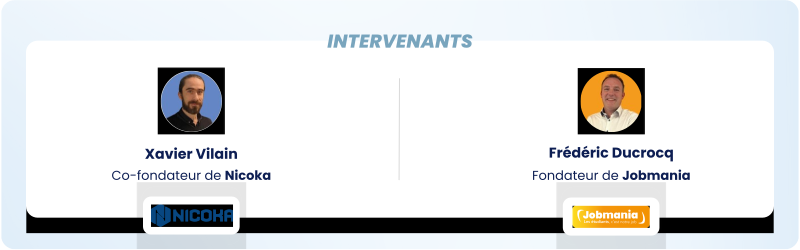
On 9 April, Xavier Vilain, CEO of Nicoka, spoke alongside Frédéric Ducrocq, CEO of Jobmania (a Nicoka customer and specialist job board), during a webinar organised by
▶️ Watch the webinar replay on YouTube
A discussion in which technology and HR common sense found common ground.
👉🏼 Nicoka , founded in 2009, offers an ATS (Applicant Tracking System) - Nicoka CABS, designed specifically for recruitment agencies and staffing companies. The aim is to simplify recruiters' day-to-day work with AI-powered tools such as matching, job ad generation, application management, etc.
👉🏼 Jobmania, founded in 2010, is a recruitment consultancy with a diverse range of activities:
- Its recruitmentbusiness, with two strong specialities: young talent (students, work-study students, interns) and RPO assignments (recruitment process outsourcing).
- HR events, with more than 200 events organised to promote careers to different audiences (secondary school pupils and post-baccalaureate students) with a focus on guidance and awareness.
- Its employability training, via an in-house SaaS solution, to help candidates gain a better grasp of every stage of the recruitment process.
“Being a candidate is not a profession. An applicant does not necessarily master the different stages of the recruitment process, so we give them the tips to get through them.”
- Frédéric Ducrocq
↘️ During this webinar, Xavier and Frédéric discussed the concrete impact of AI on recruitment, as well as the limits of the tools, the place of people, and how the recruiter's role is evolving in the digital age.
Automated matching: a superpower… that needs taming
On the Nicoka side, Xavier shared the latest developments in our ATS, in particular the CV matching and correlationfeature, which can identify profiles similar to a given candidate, even without identical keywords. A technological asset that recruiters still make little use of, but one that raises real fundamental questions.
The matching system goes well beyond simple keyword sorting. It relies on logic similar to generative AI: when a recruiter spots a good candidate, the tool can automatically suggest similar profiles, even if they do not use the same terms or have the same background. The algorithm seeks to establish deeper correlationsacross the data available on all candidates.
“We are trying to answer this question: in my database, who resembles this profile I liked, even if they don't say the same things on their CV?”
- Xavier Vilain
Frédéric, for his part, remains measured: while matching is useful for high-volume roles, he stresses the importance of the human element.
“A CV is a business card. It says nothing about soft skills or real potential.”
- Frédéric Ducrocq
And when you consider that some candidates turn up to interviews “with their hands in their pockets”, not out of casualness but because they have also come to assess the company, you realise that the algorithm has its limits.
Generation X, Y, Z? Let's stop putting everything in boxes
Asked about how the personality of young candidates is changing, Frédéric dismisses the idea of “generational boxes”. For him, talking about generations is reductive and often misleading. What he observes is a deep and very real change, societal rather than generational.
“Today I see the same expectations in 25-year-old candidates as in 40-year-olds. It is less a question of age than of the times we live in.”
- Frédéric Ducrocq
Why this change? The search for balance between professional and personal life.
Candidates of all ages no longer want to sacrifice their personal lives on the altar of work. They are willing to commit fully… within a clear, respected contract. And beyond pay, it is the working environment, respect for personal time and freedom that are becoming the deciding factors.
“I bring you my enthusiasm, my skills and my time. In return, you pay me, within a defined framework.”
This relationship stems from a realisation: companies can part ways with their employees at any time. So employees protect themselves, look for meaning and refuse to “give more” without good reason.
According to Frédéric, this shift is neither a loss of motivation nor a lack of commitment, but a healthy evolution of expectations. And this phenomenon is shared by all age groups, even if younger people are often the first to embody it.
It is a real turning point for recruiters, who need to adapt their messaging, their offers… and above all, the way they listen.
Prepared candidates vs spontaneous candidates: a reflection of the balance between supply and demand
The days when all candidates arrived ultra-prepared for their interviews seem to be over. Frédéric has noticed a change: more and more talent is turning up “with their hands in their pockets”, not out of a lack of interest, but because they too are in a position toassess the company. This attitude is not specific to younger people, but rather reflects a rebalancing between supply and demand in the labour market.
Faced with candidates who are pursuing several opportunities at once, the recruiter is no longer the only one choosing: the candidate also has the power to say no. And this turns traditional assessment logic upside down. Far from being a lack of motivation, this attitude often reflects higher expectations of the project on offer, the purpose of the role or the working conditions. The recruiter's role, strengthened by AI but still deeply human, is therefore to create a genuine encounter rather than tick boxes.
Employer brand and CSR: criteria that have become essential
Today, candidates are not just looking for a job, but for a company they can believe in. As Frédéric points out, to attract talent, the employer brand must go beyond corporate messaging. It must reflect values and genuine commitment. CSR thinking (Corporate Social Responsibility) plays a part in this appeal: environmental impact, equal opportunities, wellbeing at work… all things that influence candidates' decisions. The days when a ping-pong table was enough to make people dream are long gone: today, sincerity and aligned values have to take centre stage.
Will all CVs end up looking the same?
An attractive CV, yes, but above all a readable one
At a time when tools such as Canvaor CV DesignRmake it easy to create stylish CVs, it is tempting to go further and further visually. But Frédéric warns: “the beautiful is often the enemy of the good”. A CV is first and foremost a tool for quick reading, designed to make the reader want to call the candidate. Trying too hard to impress with form can sometimes undermine the clarity of the content.
AI to better showcase skills
A candidate's real value is not just a matter of a nice layout. While some now use artificial intelligence to generate or rephrase their career history, the real benefit lies in the tool's ability to bring out the skills gained from past experience. Where a candidate sometimes struggles to identify what they have really learned or developed, artificial intelligence can help them articulate their hard skills; when it comes to detecting soft skills, however, nothing replaces a genuine human conversation.
Better structuring information for semantic analysis
As Xavier explains, in theNicoka CABS ATS, AI can detect matches between profiles, even without identical keywords. This is no longer simple reading, but intelligent reading, where semantics come first. But the content of the CV still needs to be well structured: that is what will allow the machine to bring out the right elements at the right time… without sacrificing the candidate's personality.AI as an ally, not a substitute
Far from replacing the recruiter,AI plays the role of a helpful assistant. Generating job ads, parsing CVs, structuring interviews using the STAR method (Situation, Task, Action, Result), summarising briefs or phone call reports: the uses keep multiplying. Thanks to automatic transcription and the analysis of the key points of a conversation, recruiters save time, reduce their mental load and can refocus on what really matters. Integrating these tools into an ATS such as Nicoka CABS becomes a real productivity lever. But be careful not to hand everything over to AI: what may be true today may no longer be true tomorrow, and assessing a candidate remains a complex, human task.AI can help to structure and summarise, but only the recruiter's intuition, nourished by dialogue and experience, can fully grasp who a person is.
Xavier and Frédéric agree: tools are there to save time, not to bypass human interaction. The goal is still to do a better job of selling a role to a candidate, and a candidate to a client. And there, no prompt will ever replace a genuine relationship of trust.
The new role of the recruiter: between AI, instinct and common sense
The recruiter's role is evolving, there is no doubt about it. But not to disappear. It is less about stepping back behind the machine than about reaffirming their added value: understanding a need, building a connection, assessing potential, providing support over time.
Xavier makes the point clearly: “You don't keep a client just because you make good hires, but because you build a relationship."
“Common sense, presence, listening… These are the basics that will always make the difference.”
- Frédéric Ducrocq
As Xavier Vilain, CEO of Nicoka, says, the most powerful product demos are not the ones where he runs through dozens of features. On the contrary, they are the ones where he takes the time to listen, understand and identify the client's real needs. Convincing someone is not just about impressing them with technology: it is also about creating value through the conversation.
Frédéric, founder of Jobmania, follows the same logic: skills can be acquired, knowledge can be passed on. However, aptitudes such as listening, the ability to build a relationship of trust, or emotional intelligence are much harder to develop. That is where the recruiter's eye makes the difference. It is what he himself calls “human matching”: the ability to perceive a candidate's potential beyond their CV, to sense whether the person will thrive in a given company culture. AI can just as easily generate a job ad as pre-qualify profiles. Tomorrow, it may even conduct structured interviews or generate recommendations. But be careful not to delegate everything to it. An approach that is too automated, too linear, risks producing standardised, impersonal experiences that are disconnected from the realities on the ground.
A reassuring conclusion: no need to panic, but stay alert
Far from an alarmist message, this webinar sketches the outline of an augmented recruiter: curious, tech-friendly, but deeply human. Technology is moving fast, of course. But the essentials remain: knowing what you are looking for, understanding who is in front of you, and creating a genuine encounter.
▶️ Watch the webinar replay on YouTube
Discover Nicoka CABS, the tailor-made ATS + CRM.
