TheMontaigne Institute recently published a survey that it commissioned and conducted with the polling institute Kantar Public among French employees regarding their views on work.
Methodology
The survey was conducted from mid-September 2022 to early October 2022 with a panel of about 5,000 working individuals.
The quotas used to infer the results to the population are gender, age, socio-professional category, region, and type of agglomeration.
All types of workers were interviewed: private sector employees, public sector employees, and freelancers.
A questionnaire with over 60 questions, lasting a maximum of 20 minutes, and self-completed by the respondent.
Survey themes
Through the questionnaire, 5 themes were chosen by the Montaigne Institute.
- Job satisfaction and its determinants
- Work duration, workload, and hardships
- Remote work
- End of career and retirement
- Career evolution and professional mobility
The Nicoka team invites you to explore together the results from these various themes.
You can find our first two articles on job satisfaction and its determinants, and perceived workload.
Today we present to you in this 3rd part the theme on remote work.
Remote work
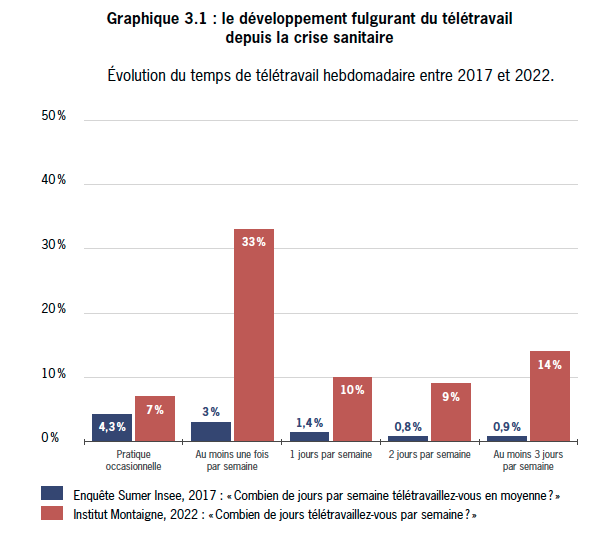
Compared to 2017, the increase in the share of work time performed outside the workplace is staggering.
Occasional remote work practice has almost doubled.
Remote work practice at least once a week has increased by 1100%!
And today, nearly 1 in 4 workers report working remotely at least 2 days a week.
All together: more than 70% of workers report working remotely in 2022 compared to 10% in 2017... That's an increase of 700% in remote work over 5 years!
Remote work is no longer an exception, it is now weekly for 6 out of 10 workers (at least once a week).
Possibilities to practice it?
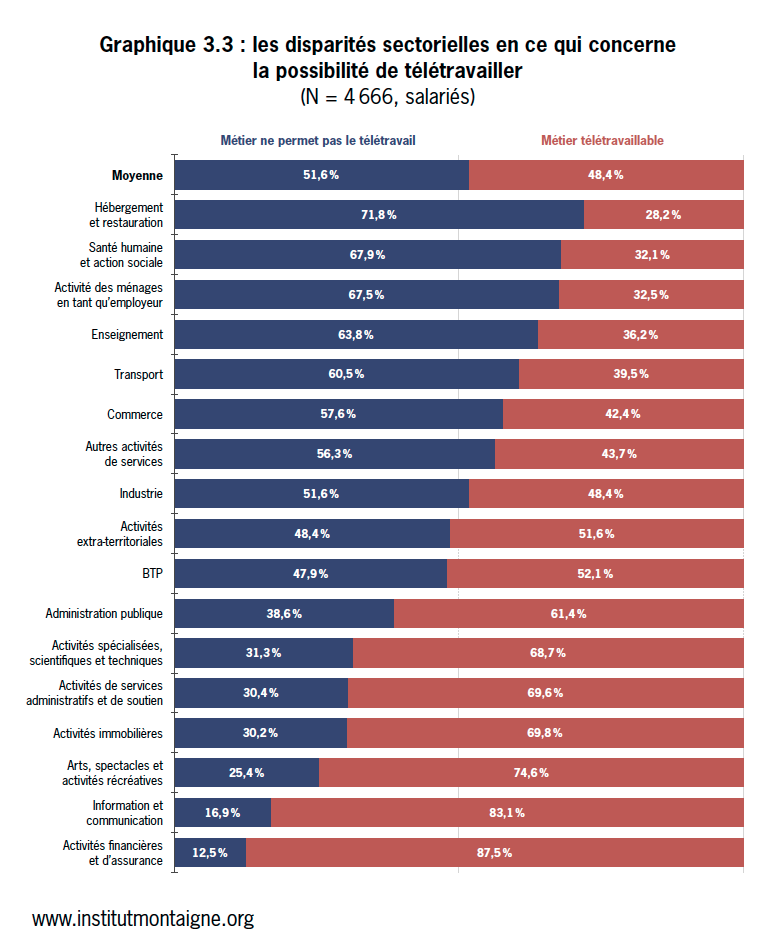
Not all jobs or positions can use remote work: today 51.6% of workers report that their job cannot be done remotely.
A minority of employees report that remote work is prohibited for them.
The reasons for the lack of remote work mainly translate to a job that does not allow it, an employer's refusal even if feasible, or an employee who does not want it. It is only in 9% of cases that an employer issues a refusal. This shows that employees' wishes to use remote work are largely respected.
Remote work favored by employees
The difficulty of using remote work is a reason for dissatisfaction among employees, but not only that, a positive impact is noted on family life, professional life, and also on work efficiency and autonomy.
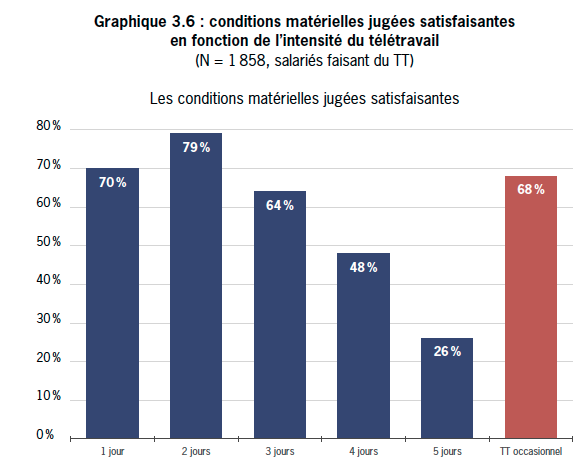
In general, the material conditions are deemed satisfactory by workers when remote work does not exceed 4 days a week; it is noted from the graph below that this satisfaction decreases with the intensity of remote work.
Professional and social interactions
What about the quality of interaction for employees practicing remote work?
Survey respondents report a deterioration in human interactions. Indeed, remote work has a negative impact on the effectiveness of these interactions.
It is not always easy to maintain a connection with colleagues while being at home; remote work somewhat deprives of the informal.
Remote work, no excessive or psychological burden?
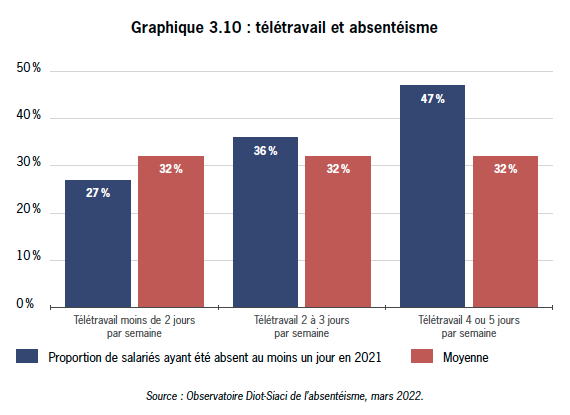
According to the study results, excessive and psychological burdens are not linked to practicing remote work. However, caution should be observed when the intensity of remote work exceeds 3 days, and this topic remains to be further explored.
According to a survey by Insee conducted on managers and remote work in 2019, a warning on intensity and health highlighted their health status as poor. Managers reported having taken sick leave during the year.
17% of remote workers present a moderate or severe depressive risk when working two days or more. According to the study by IFOP for the Diot-Siaci Observatory, there is talk of increased absenteeism when remote work becomes very intensive.
An effect on the carbon footprint?
Since the expansion of remote work, effects are noted on CO2 emissions.
This practice helps avoid car traffic, as it reduces home-work-home commutes, leading to an estimated 10% reduction in annual CO2 emissions.
If they do not drive, regular remote workers save an average of 159 hours of commuting per year, equivalent to nearly 6 and a half days.
Sources
Montaigne Institute Survey: The French at work: overcoming preconceived ideas
IFOP Survey: Work Perceptions
Insee 2019: Does remote work improve working conditions for managers?
