The Montaigne Institute recently published a survey it commissioned and conducted with the polling institute Kantar Public among French employees about their vision of work.
Methodology
The survey was conducted from mid-September 2022 to early October 2022 with a panel of approximately 5000 working individuals.
The quotas used to infer the results to the population are gender, age, socioeconomic status, region, and type of urban area.
All types of workers were surveyed: private sector employees, public sector employees, and self-employed individuals.
A questionnaire with more than 60 questions, lasting a maximum of 20 minutes and self-filled by the respondent.
The themes of the survey
Through the questionnaire, 5 themes were chosen by the Montaigne Institute.
- Job satisfaction and its determinants
- Duration, workload, work hardships
- Remote work
- End of career and retirement
- Career development and mobility
The Nicoka team invites you to explore the results from these different themes together.
You can find our article on job satisfaction and its determinants.
Today, we offer you an article on the 2nd theme: duration, workload, work hardships.
Duration, workload, work hardships
Work is an essential element of our life. It not only allows us to improve our skills and earn income, but it can also be a significant source of stress and anxiety.
That's why we've decoded the 2nd theme of the survey results from the Montaigne Institute to observe how French employees perceive work in terms of duration, workload, and hardships.
We will see together that the survey shows that more and more French employees are experiencing a high workload and significant psychological burden.
The 35-hour workweek is far from being the norm.
On average, French workers work a little over 37 hours per week.
For full-time workers, the average working time is 39.8 hours and 39.6 hours for those with permanent contracts.
A very variable average depending on the activity among full-time workers.
- 45.8 hours for the self-employed
- 39.6 hours for private sector employees
- 39.1 hours for public sector employees
According to the study, we learn that the "traditional framework of the five-day workweek with office hours has become very minor." Today, 6 out of 10 full-time workers work after 8 PM and on weekends.
The legal working time has not changed since the 2000s, it remains fixed at 35 hours.
Since 2015
- the proportion of managers working evenings or Sundays has significantly increased by 5% in the evening and 8% on Sundays.
- the increase in "atypical hours" does not concern employees, workers, and intermediate professions.
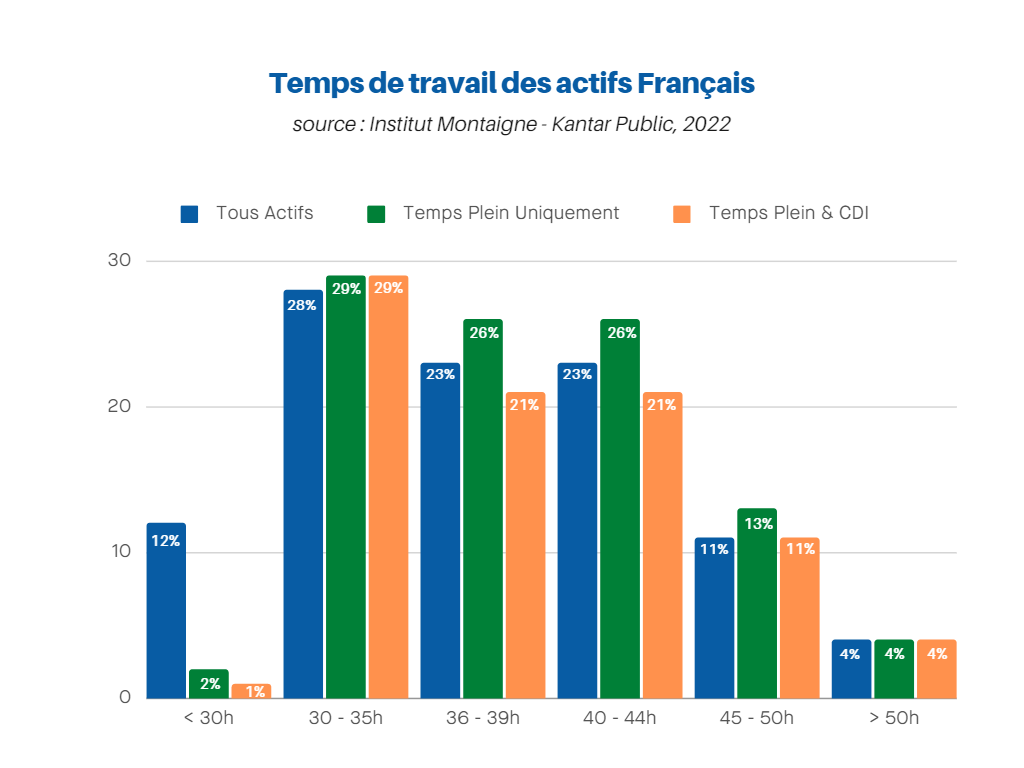
The legal working time does not constitute a factor of excessive workload, it is considered satisfactory by employees
In addition to this survey, another survey conducted by IFOP shows that 3/4 of employees (excluding the self-employed) consider themselves happy at work.
Is this satisfaction linked to the stable and satisfactory working hours? Not necessarily if we consider the decreasing motivation at work.
Indeed, 42% of them feel that this overinvestment is not recognized by their manager, mainly for those alternating between remote work and on-site presence.
What workload is perceived?
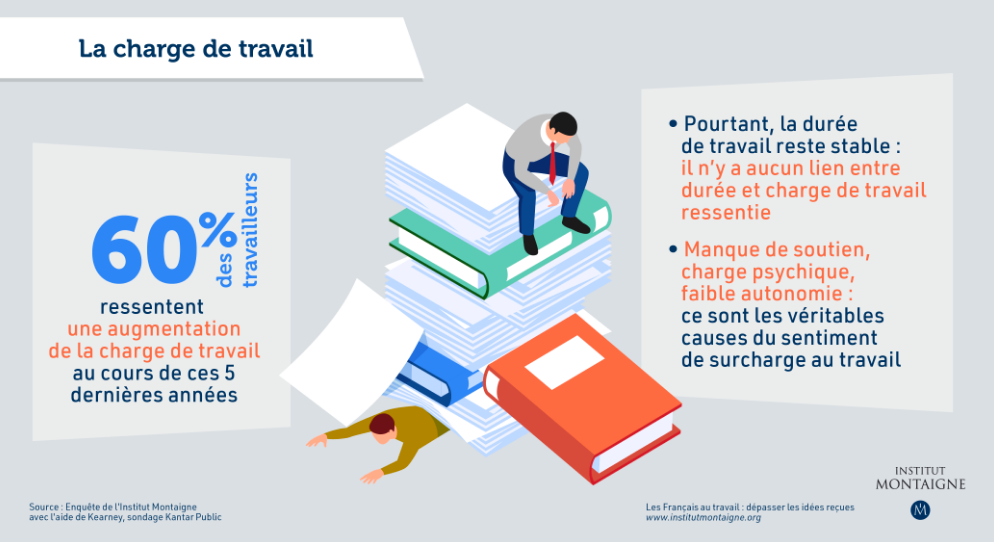
One in 4 employees feels an excessive workload and 6 out of 10 employees report an increase in their workload over the past 5 years.
The self-employed, on the other hand, do not describe it as excessive but remain those who work longer hours than employees.
This infamous "excessive" workload is blamed on job dissatisfaction or a new form of organization but not its duration.
Indeed, the main factors related to this workload are rather subjective; they may be linked to a poor relationship with one's manager, a heavy psychological burden, or even low work autonomy.
Physical and/or psychological hardships
Working conditions can sometimes weigh on the physical and mental well-being of workers.
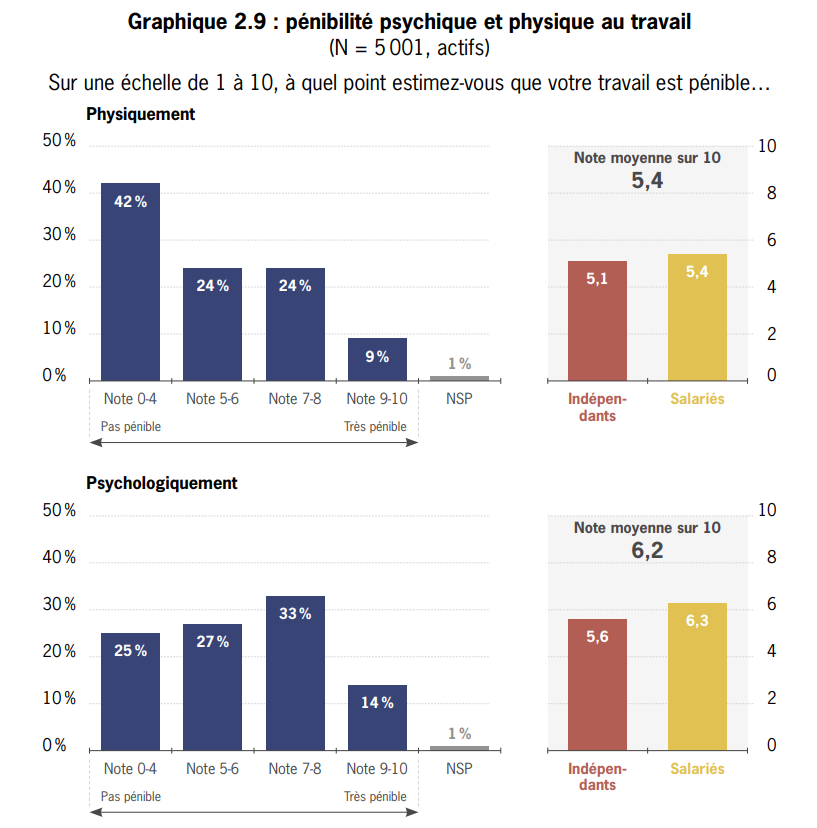
The survey measured these 2 types of hardships using a score from 1 to 10. According to the score, hardships are considered low (0-4) or very high (9-10).
We can thus see that psychological burden is more significant than physical hardship for both the self-employed and employees: while 4 out of 10 workers report no physical hardship, 5 out of 10 report psychological hardship as burdensome or very burdensome. This finding does not concern workers, and the self-employed also experience less hardship than employees.
Farmers are the most affected by physical hardship, followed by domestic professions (housekeepers, cooks, gardeners, concierges, babysitters, secretaries, ...), healthcare and social action professions, production jobs, and transport.
Psychological hardship mainly concerns health and social action professions, accommodation and catering, education, and finance and insurance.
Explanatory factors of hardship
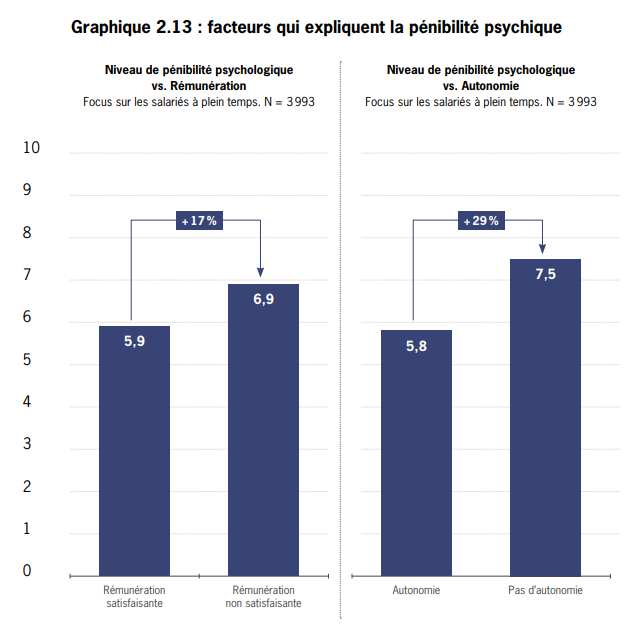
Among the many factors explaining psychological hardship, we mainly find unsatisfactory remuneration and lack of autonomy.
This is partly confirmed by the IFOP survey, which notes that employees primarily consider remuneration when choosing a company. Employees associate work more with a constraint (41%) than a means of fulfillment (32%).
Another interesting element is that physical and psychological hardships influence each other and can then have a negative impact on workers' health.
Moreover, the duration of work does not influence these hardships and is, therefore, not automatically synonymous with burnout.
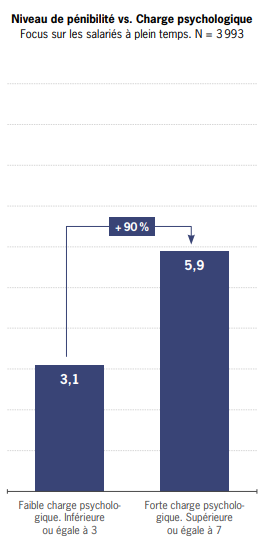
During the survey, the hardship factor of working on weekends was observed, with full-time employees considering working on weekends as burdensome. It is noted that 56% of employees seek to find a better balance between their private and professional lives.
Lastly, according to the survey conducted by the Montaigne Institute, a majority of workers do not wish to work more to earn more. 1 in 2 workers wants to maintain the same working hours, while 15% of them wish to "work less even if it means earning less." This formula generally concerns employees with low job satisfaction.
Sources
Survey Montaigne Institute: The French at Work: Going Beyond Common Beliefs
IFOP Survey: Perceptions of Work
