Pay remains a strong taboo in France.
However, salary transparency is becoming an increasingly central issue in the recruitment field, accelerated by the new European directive of May 10, 2023.
From the candidates' perspective, they didn't wait for Europe to act to express strong expectations regarding salary information. According to a HelloWork study from 2022, 87% of candidates wish to know the salary, or at least a salary range, from the moment they read the job advertisement.
In 2022, only 30% of recruiters indicated the salary in their job offers. In 2024, this figure rose to 60.6%. This evolution is significant and reflects a growing trend towards greater transparency.
You've probably already noticed: many job boards now encourage filling out the salary section when posting a job offer (Indeed, HelloWork) to accelerate this much-desired transparency from the candidates' side.
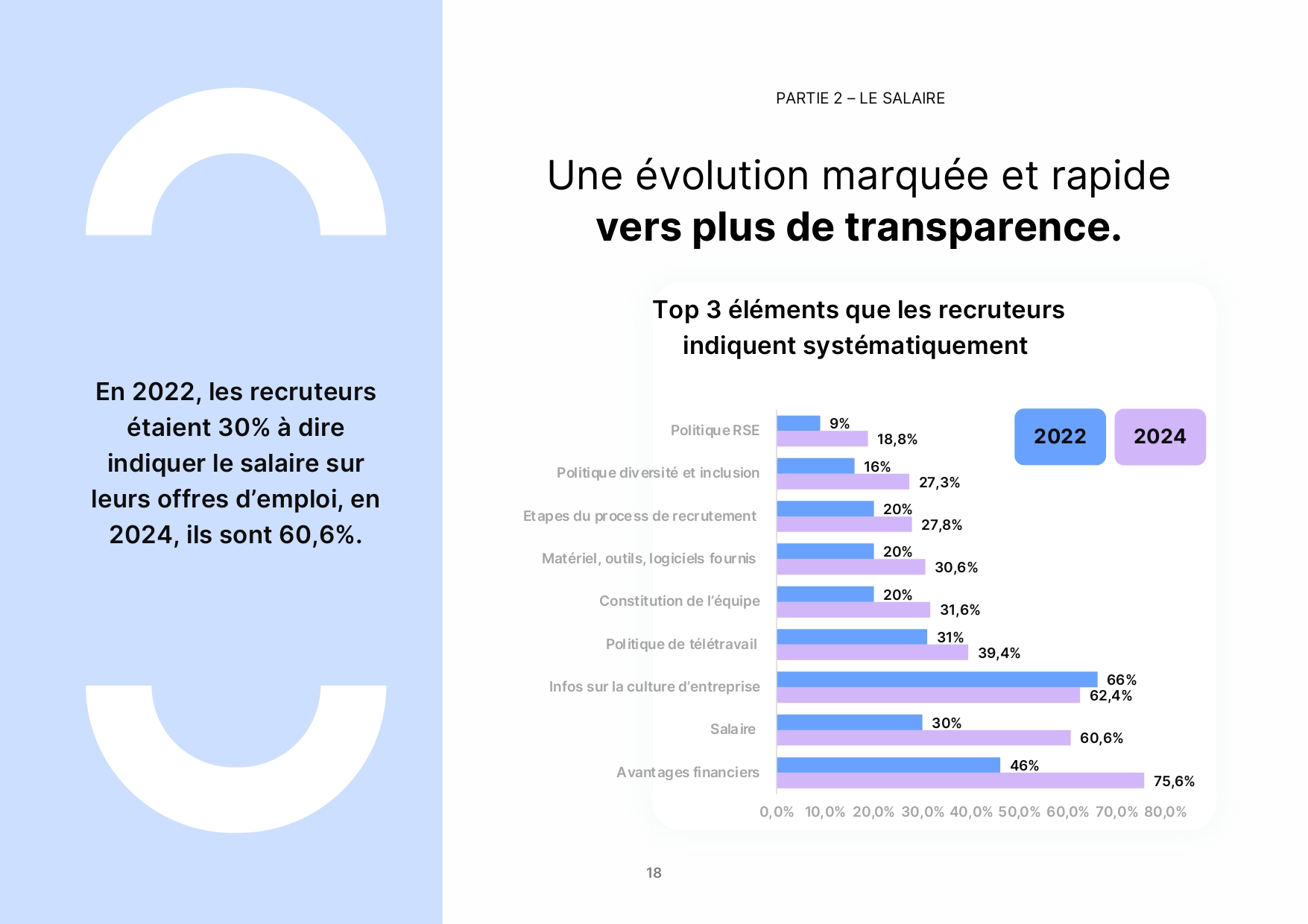
Source : Hello Work - Revolution or Evolution? What 15 years of research teaches us about recruiters' practices and candidates' expectations.
Why salary transparency is important
In 2024, 64% of candidates affirm that salary is a crucial factor that captures their attention. According to a Robert Half survey, nearly one in two candidates does not respond to job offers if the salary is not mentioned. This trend, highlighting the importance of salary transparency to attract and retain talent, will significantly accelerate with the implementation of the European Directive of May 10, 2023.
The European Directive of May 10, 2023
The text requires member states to implement, by June 7, 2026, mechanisms that allow for better transparency and communication of salaries, both during the recruitment phase and during the execution of the employment contract.
The European Directive of May 10, 2023 aims to strengthen the application of the principle of equal pay between women and men for the same work or work of equal value through salary transparency and enforcement mechanisms, the European directive of May 10, 2023 aims to establish minimum requirements, notably through salary transparency and the strengthening of enforcement mechanisms.
The directive provides, in Article 5, a right to salary transparency before hiring, meaning that any job applicant has the right to receive from the potential employer information on the initial salary or the initial salary range. Such a right does not limit the right to negotiate a salary but ensures a more informed and transparent negotiation.
In clear terms, all candidates will have a right to information concerning the initial salary level associated with the position they are interested in or, at the very least, a salary range. And this, from the beginning of the recruitment process.
Other elements of the law to know:
- An employer can no longer ask a candidate for their salary history;
- Once hired, the candidate has the right to request from the company the average salary levels in the company and the criteria used for salary increases.
Beyond the early stages of hiring, the European Directive provides for the introduction of a new obligation for employers to produce a report on data relating to the pay gap between women and men.
- From June 7, 2027, companies employing 150 to 249 employees will have to produce a report every 3 years. Companies employing at least 250 employees will have to produce a report every year.
- From June 7, 2031, companies employing between 100 and 149 employees will have to produce a report every 3 years.
- Companies with fewer than 100 employees are not affected by this measure for now.
Let's recall that in France, there is already an obligation to publish the professional index for employers with at least 50 employees. This directive goes far beyond a simple legal formality and embodies a major social and ethical transformation.
Note: the European directive on salary transparency must be transposed into French law by June 7, 2026.
Best practices to apply as soon as possible
1. Internal salary audit : evaluate and analyze current salary practices. Experts like Sandrine Dorbes can assist you in this process.
2. Build and communicate salary grids to employees and discuss salary evolution criteria. Internal transparency is essential to avoid corridor discussions and establish a relationship of trust. Engaging managers in this process will be a key success factor. Of course, you can rely on your conventional grid to build your own grid.
3. Work on the compensation package : Include benefits such as full health insurance coverage, bonuses, meal vouchers, and additional leave.
4. Display the proposed salary in offers : This allows you to maximize your chances by attracting better-informed candidates from the start, which can reduce recruitment time. Not displaying a salary in an offer is like not displaying a price to sell. If you opt for displaying a salary range, it should not be too wide, ideally 20% maximum between the low and high values.
Inspiring example from Shine
The company Shine, a specialist in online professional accounts, has implemented salary transparency at the recruitment stage. On their career site, candidates can estimate their future salary using a simulation tool before even deciding to apply.
This tool is the result of a comprehensive reflection on their compensation practices; discover the complete approach of this company which could give you ideas ....
Benefits of implementing salary transparency at the recruitment stage
👉 Better-informed candidates from the start = time-saving in recruitment steps. Salary transparency allows filtering candidates from the beginning of the recruitment process.
👉 More serious and objective Candidate / Recruiter negotiations. Transparency places the exchange on a win-win ground. Salary discussions will no longer be based solely on negotiation but according to the most objective criteria possible defined in a grid.
👉 Establish a relationship of trust between candidates and future employers. Salary transparency strengthens trust from the first stages of recruitment and avoids misunderstandings.
👉 Reduction of salary inequalities. According to an INSEE study published in March 2024, the wage gap between women and men would be 14.9% for identical working hours in 2022.
👉 Opportunity to be competitive : the salary grid can be revised based on market practices.
👉 Encourage highlighting other benefits: If you cannot be attractive in terms of salary, knowing this allows you to emphasize other types of benefits (flexible hours, career prospects, job content...) to compensate for your lack of financial attractiveness but still enhance your employer brand.
Conclusion
Adopting these practices now will allow companies to effectively prepare for legal deadlines while positioning themselves as employers of choice in an increasingly competitive labor market.
References & Resources
- Le Monde Article: Salary transparency: a major challenge opens for companies
- Hello Work - Interview: The expert in compensation strategy Sandrine Dorbes highlights the lifting of the salary taboo emphasized by our survey.
- HelloWork Survey: Revolution or Evolution?
- MCR Consultants: Focus on salary equity in EuropeWould you like to discover our NICOKA ATS or NICOKA HRIS solution?
