In the imaginary waiting room of a recruitment agency, two doors face each other.
On the left, a brass plate: “Recruiter”. On the right, a halo of LEDs: “AI Agent”.
You would expect candidates to line up on the side of the warm human smile.
Yet in a full-scale experiment, 78 % of them pushed open the door… to the AI.
This scene is not a stylistic flourish. It is taken from a recent academic study conducted in the Philippines:
Voice AI in Firms: A Natural Field Experiment on Automated Job Interviews (SSRN).
It examines what happens when 70,000 job applications are entrusted to two different interviewers (a human and an AI) and, in a third scenario, when the candidate is left to choose.
Beyond the public debate and its caricatures, the data here tells a story worth dwelling on.
What the data says, without the noise
Three scenarios were compared: 1) human interview, 2) AI interview, 3) free choice.
To avoid bias, the allocation was randomised: 60% AI, 20% human, 20% choice.
Period: March to June 2025, 19 cities, 7 sectors (technology, insurance, telecoms, retail, finance, healthcare, transport).
A follow-up questionnaire was also sent out (19,200 requests, 2,764 responses).
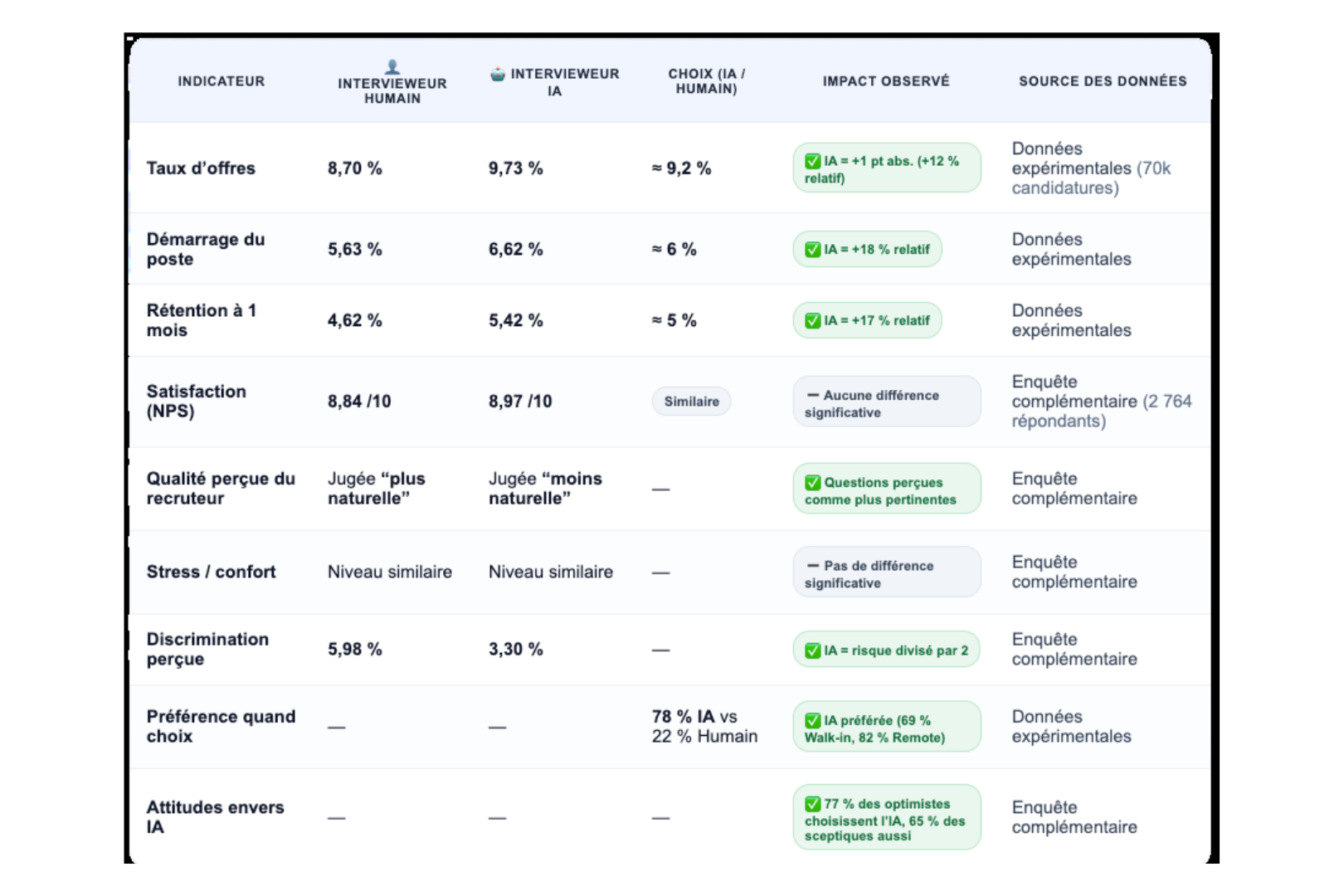
Summary comparison of AI vs human recruiter (source: field experiment, Philippines).
- Offer rate: 9.73% with AI vs 8.70% with a human → +12 % offers.
- Job start: 6.62% vs 5.63% → +18 %.
- 1-month retention: 5.42% vs 4.62% → +17 %.
- Satisfaction (NPS): almost identical (8.97/10 vs 8.84/10).
- Perceived discrimination: halved with AI (3.30% vs 5.98%).
- Preference when given a choice: 78 % of candidates opt for the AI (69% in person, 82% remotely); even 65 % of the most sceptical choose the AI.
The machine does not charm: it aligns. And sometimes that is exactly what we expect from recruitment.
Why does AI “win” here?
1) Consistency and steadiness
The AI asks the same questions, in the same order, with the same follow-ups. This stable framework reduces differences in treatment and sheds more light on the skills that can actually be observed.
2) Operational neutrality
Not every bias disappears at once, but it removes obvious sources of perceived discrimination (appearance, assumed age, micro-reactions). The gain on this point is massive in the study.
3) Psychological safety
Many candidates say they feel less judged when facing an AI: less social pressure, less interpretation of silences. People speak better when they breathe more easily.
Blind spots to keep in mind
A good recruiter always keeps a healthy, methodical doubt.
- Cultural context: the study took place in the Philippines. Trust in technology may well be higher there than in Europe; the findings should not be transposed without caution.
- Timeframe: retention was measured at 1 month. What about 6 or 12 months?
- Job mix: seven sectors were covered, but not all jobs lend themselves equally well to a voice interview.
- Self-selection effect: in the “choice” scenario, those who prefer the AI are not the same people as those who prefer a human; this may affect offer rates.
In short: an important piece of the puzzle, not the whole picture.
What this changes for HR teams
Recruitment is not becoming “automatic”. It is becoming instrumented. And that changes the way the job is done.
- Standardise the opening moves: build a core set of questions aligned with the expected skills, which both humans and AI can share. A clear interview guide is already a step towards fairness.
- Measure beyond the verdict: track not only offers, but also job starts, retentionand signals ofcandidate experience (NPS, perceived stress, reasons for disengagement).
- Audit fairness: set up regular reviews to track down differences in treatment and fine-tune the calibration. AI leaves a trail: make use of it.
- Keep the relationship where it matters: hand the AI the screening or the first structured conversation, and keep for humans the moments that call for finesse: managerial projection, team context, weak signals of cultural fit, and steering the final choice.
- Explain the method to candidates: be transparent about the use of AI, its purposes and data storage; trust is built upfront.
A word on tooling (no advertising)
At Nicoka, we see AI not as a replacement, but as a framework that makes human judgement fairer.
In a modern ATS , the value comes from traceability: which signals led to a given decision, which questions were asked, and with what effect onperceived fairness and the hiring rate.
It is in this spirit that we are developing Nicoka CABS: a crystal-clear pipeline, explicit workflows, metrics that follow the flow (offers, job starts, short-term retention) and AI integrations that are configurable.
- Discover the ATS approach: Nicoka CABS
- Streamline your application pipeline and collaboration: Nicoka CABS ATS
Methodology (key facts)
- 70 884 applications submitted (67 056 retained), 64 556 unique candidates (≈ 8 % multiple applications).
- Randomisation: AI 60% (40,103), human 20% (13,557), choice 20% (13,396).
- Period: March to June 2025. Locations: 19 cities in the Philippines.
- Sectors: technology, insurance, telecoms, retail, finance, healthcare, transport.
- Follow-up survey: 19,200 requests, 2 764 respondents (≈ 14%).
Reference: Voice AI in Firms: A Natural Field Experiment on Automated Job Interviews, SSRN.
Conclusion: alignment rather than replacement
AI does not “speak” better than a good recruiter. It provides structure better than an uneven process.
In the study, that alone is enough to increase offers, job starts and short-term retention, while lowering perceived discrimination.
What comes next will depend on the combination: AI that structures, humans who decide.
This is not an abdication of the profession; it may well be its refinement.
Further reading
- SSRN study: Voice AI in Firms: A Natural Field Experiment on Automated Job Interviews
- A product approach focused on traceability and fairness: Nicoka CABS
