A well-structured recruitment process is essential to attract, assess and hire the best talent. However, many companies still face obstacles that slow down their recruitment or make it unnecessarily complicated.
💡 In this article, we look at how to optimise each stage of the process to make it smoother and more efficient, drawing on best practice and avoiding common mistakes.
1. Why a good recruitment process is essential
Well-structured recruitment improves the quality of hires, reduces staff turnover and optimises the time recruiters and managers spend on each application. A poor process, on the other hand, can lead to excessive delays, a bad candidate experience and, ultimately, difficulty attracting the best talent.
The benefits of an optimised process
- Shorter time to hire: a well-designed process minimises the time between publishing the job offer and the new hire starting, which is known as time to fill.
- Better candidate experience: informed, engaged candidates are more likely to accept an offer and recommend the company.
- Better collaboration between teams: a structured framework encourages exchanges between recruiters, managers and other stakeholders.
- Lower costs: an overly long or inefficient process can be expensive in terms of human and financial resources.
2. Brainstorm as a team to rethink your process
Before optimising a recruitment process, it is essential to take stock with all the stakeholders. This collaborative step helps identify bottlenecks and come up with solutions suited to the company’s needs.

- Bring together a panel of recruiters, managers and recently hired employees: their feedback is invaluable for identifying the weak points of the current process.
- Use the Design Thinking method: put the candidate experience at the heart of your thinking by asking: “How can we improve each stage so that it is smoother and more engaging?”
- Analyse existing data: average time to hire, candidate drop-out rate, manager and candidate satisfaction, etc.
- Audit the candidate journey: test the process internally as if you were a candidate to identify the pain points.
Key questions to ask yourself
- How many stages does our process have? Are they all necessary?
- What is our candidate drop-out rate?
- Is the process well suited to the profiles we recruit?
- Are our response times to candidates satisfactory?
- How do our recruiters and managers perceive the effectiveness of the process?
- What feedback do we get from candidates, including those who were not selected?
- Which technology tools could we integrate to optimise certain tasks?
3. Structure the stages for a better candidate experience
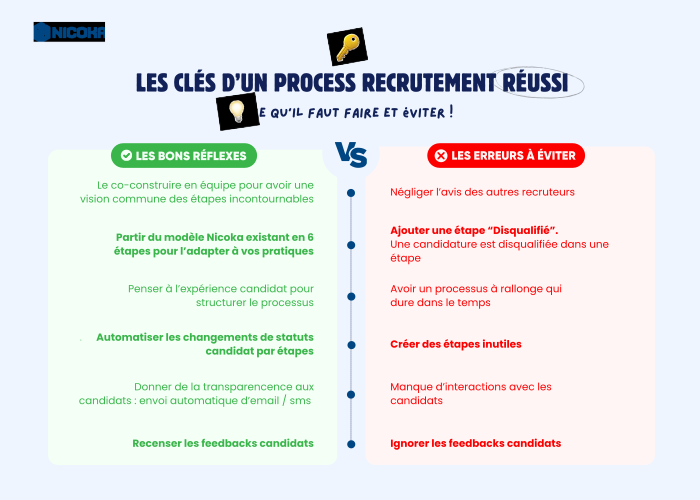
- Limit the number of stages: an effective process has between 4 and 6 stages at most (for example: telephone pre-screening, technical interview, HR interview, offer, final approval).
- Define objective criteria at each stage to avoid any discrimination and secure the decision.
- Think about the candidate experience: provide quick, constructive feedback at each stage to keep the candidate engaged.
- Adding a “disqualified” stage: it is better to inform an unsuccessful candidate directly rather than create a pointless intermediate stage.
- Not collecting candidate feedback: this prevents you from identifying areas for improvement and optimising the process.
4. Use technology to optimise the process
Recruitment software such as Nicoka, developed by our teams in Angers, makes it possible to automate stages and improve communication between recruiters and candidates.
- Automate status updates: for example, send an interview confirmation email directly from the tool.
- Use an applicant tracking system (ATS) to centralise information and enable better internal collaboration.
- Analyse the performance of the process: measure the average time to hire, the conversion rate between each stage and the level of candidate satisfaction.
- Ignoring the views of other recruiters: recruitment is a collective decision. It is essential to gather shared feedback before finalising a hire.
- Not taking post-hire feedback into account: asking a new employee how they experienced the process can reveal areas for improvement.
5. Measure the effectiveness of your recruitment process: the key KPIs to track
To continuously assess and improve the recruitment process, it is essential to track key performance indicators (KPIs). Here are three essential KPIs to monitor:
1️⃣ Time to hire
- How do you calculate it?The average length of a recruitment can be calculated in different ways, depending on the level of precision you need. The simplest method is to add up the duration of each recruitment completed over a given period and divide by the number of recruitments.
- Where can you find it in Nicoka? Several indicators will help you carry out this analysis: the “Days open” indicator is available in the assignments (or jobs) table, and you can also consult the “Average time per stage” report. Of course, you can also opt for a tailored approach by creating a report that fits your needs, using the reporting tool built into Nicoka.
2️⃣Recruitment rate: this measures your ability to fill positions.
- How do you calculate it?It is the ratio between the number of positions filled and the number of positions to be filled.
- Where can you find it in Nicoka? You can calculate it using the “Performance Analysis” or “Annual Overall Analysis” report: 2 reports available among Nicoka’s standard reports.
3️⃣ Average number of interviews per candidate
- How do you calculate it?It is the ratio between the number of positions filled and the number of positions to be filled.
- Where can you find it in Nicoka? It is a report you can create using our built-in reporting tool.
Tracking these indicators lets you keep adjusting the process and improve recruitment efficiency.
Conclusion
A good recruitment process relies on a balance between structure and flexibility. It should be designed to offer candidates a positive experience while making recruiters’ work easier. By applying these best practices and avoiding common mistakes, you will be able to attract and select the talent that will make the difference in your company more effectively.
Further reading
If you would like to rethink your recruitment process and make your day-to-day life as a recruiter easier, our teams are available to show you the many features of Nicoka.
The tailored ATS + CRM for recruitment professionals.
