The challenges of IT recruitment in Angers

On Tuesday 30 September, an exclusive event took place in the new Métamorphose building in Angers! It was organised by ADN Ouest, Angers Loire Métropole & Aldev on the challenges of IT recruitment in the Angers area.
The morning began with the presentation of the 2024 / 2025 survey by theRegional Digital Skills Observatory (Observatoire Régional des Compétences du Numérique) (ORCN) covering the Brittany and Pays de la Loire regions, with the results presented by Sébastien Journet.
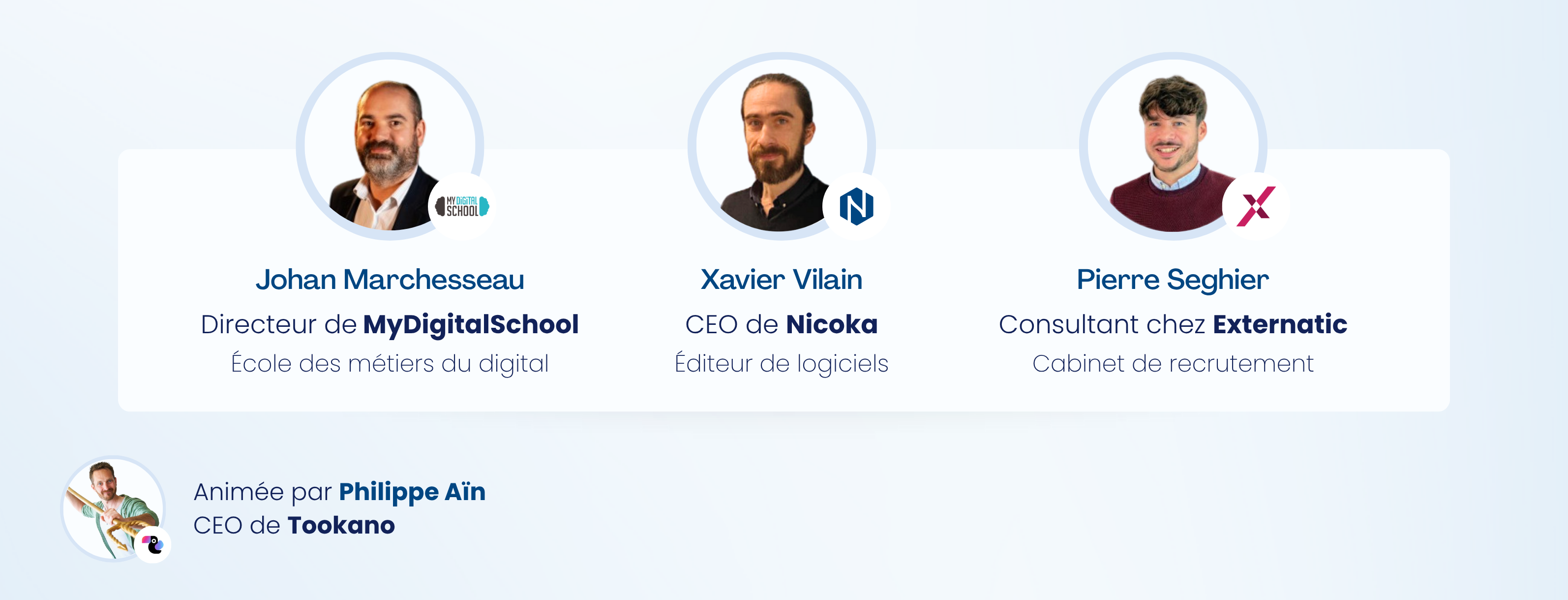
Next, a round table moderated by Philippe Aïn made it possible to decipher the results andopen up perspectives for 2026. It brought together:
- Xavier Vilain, CEO of Nicoka
- Pierre Seghier, Recruitment Consultant at Externatic
- Johan Marchesseau, Director of the school MyDigitalSchool
What does the ORCN survey say? (Brittany and Pays de la Loire)
Observatoire Régional des Compétences du Numérique aims to answer three questions:
- Which digital professions are recruiting today?
- Which skills are emerging or becoming scarce?
- How can companies, schools and employment stakeholders anticipate the changes in the sector?
Market & territory
According to the survey report:
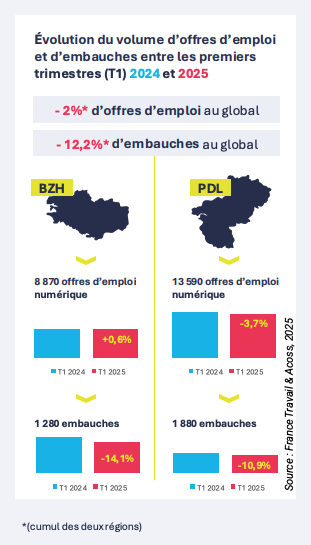
Between Q1 (first quarter) 2024 and Q1 2025, the digital market within the observed scope experienced a notable slowdown:
- -2% job offers,
- -12.2% hires across both regions combined
This trend reflects a return to balance after the years of post-Covid overheating!
As can be seen below:
- In Brittany, job offers rose slightly (+0.6%), but hires plummeted (-14.1%)
- In Pays de la Loire, job offers fell (-3.7%) and so did hires (-10.9%).
On the market side, ESNs (digital services companies, Entreprises de Services Numériques) appear weakened by a double pressure that is slowing their momentum:
- The drop in rates
- The lengthening of sales cycles
The urban hubs of Nantes, Angers and Rennes nevertheless continue to drive regional growth: these cities remain the engines of IT employment in both regions.
Professions & skills
The results presented by ADN Ouest show:
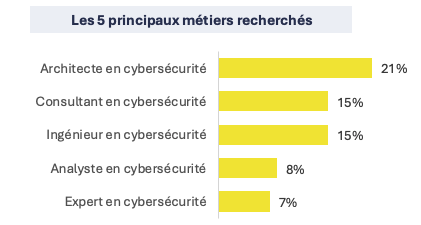
In recruitment, cybersecurity dominates by far, with 23,183 job offers identified between June 2023 and June 2024, i.e. more than 49% over 5 years.
Professions related to Data - AI: Data Scientist and Data Engineer, as well as inInfrastructure and Cloud: Systems & Network Technicians, are in high demand but remain in short supply.
Beyond technical skills, demand focuses on soft skills (teamwork, communication, advisory skills and autonomy) which are increasingly decisive.
Recruiters mostly require profiles who are quickly operational, often with three to five years' experience, able toadd value immediately.
Sourcing: what are the main channels?
The study shows that companies are diversifying their recruitment channels to reach profiles that are harder to attract.
- LinkedIn, still growing, notably for direct approach, particularly for experienced profiles
- Employee referral, a widespread method, especially in SMEs and mid-sized companies that set up internal schemes
- Recruitment agencies, the use of agencies is declining but holds up for strategic profiles
Processes, tools & artificial intelligence
“Today, companies are more demanding: they take more time and want candidates who meet 200% of their specifications. The goal is to “recruit better” rather than recruit in large numbers.
Recruitment now focuses on more experienced and expert profiles, to the detriment of junior profiles. This pushes us to seek out profiles who are not necessarily looking, but who bring real added value beyond the job description.”- ORCN report p.21 I Brice Aubert, Co-founder of the recruitment agency - Seyos
The recruitment processes are getting longer and give companies more time to select the right profile, but this makes things harder for recent graduates.
As forartificial intelligence, its use is emerging to help with screening and writing, but there is still reluctance to automate decision-making, human remains at the centre. AI is still used cautiously in screening applications, but is already establishing itself as a support tool (writing job ads, pre-qualification, data generation). According to the data shared, 16% of employees say they use generative AI at work.
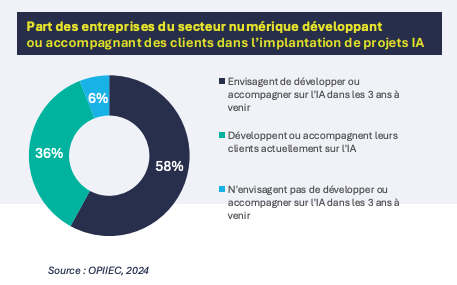
Among digital companies, 36% are already rolling out artificial intelligence projects, 58% plan to do so within 3 years, and a minority (6%) are not yet considering any deployment.
“AI is not seen as one technological option among others, but as a structural shift that no player in the IT sector will be able to escape. Everyone agrees that the question is no longer whether they will commit to it, but when and how. ”
- ORCN report p.54
The perceived benefits of AI relate to quality, cost reduction, productivity and creativity, but artificial intelligence is forcing companies to strengthen their IT security and their data management.
Furthermore, digital players are questioning theenvironmental impact of intelligent technologies. They require a lot of energy to develop and use, which raises the question of their consumption and sustainability.
Several point to a gap between the speed at which AI solutions are developing and the still insufficient consideration of ecological and ethical issues in their design.
At Nicoka, we have taken the plunge: in an article, we explain how we have builtAI into our software.
➡️ Artificial intelligence (AI) at the heart of the Nicoka software
Work-study (alternance) & training
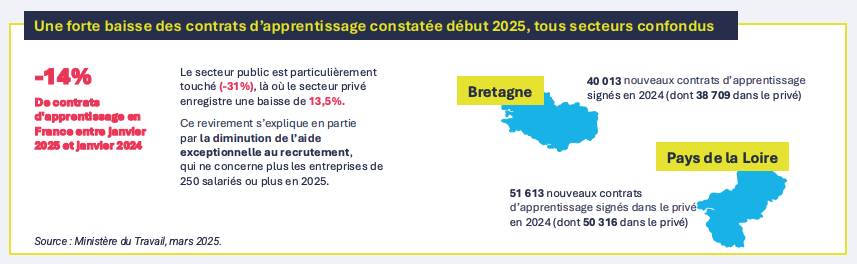
The report highlights a mixed situation:
- On the one hand, there is a decline in apprenticeship contracts (around -14%) within the observed scope.
- On the other, training centres are multiplying, a sign of a dynamic but sometimes overly fragmented ecosystem.
The report also points out:
“Companies expect candidates with a five-year degree (Bac+5) and 2 to 3 years of professional experience. A work-study student clearly fits that pattern, but to have that profile in 3 or 5 years' time, you need to keep taking on work-study students today.”
- ORCN report p.39
In this context, faster progress is expected on updating training programmes in AI, Data and Cybersecurity.
Juniors and work-study students are struggling to find their place, and some schools are even closing, because they cannot fill their intakes.
Diversity, gender balance & quality of working life
Diversity and gender balance remain structural issues for the digital sector.
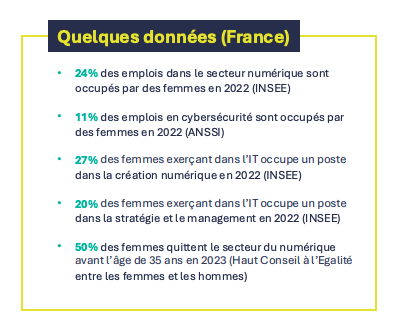
Today, women hold around 25% of digital jobs and only 11% in cybersecurity. Nearly half of them leave these professions before the age of 35, often because of persistent stereotypes, theisolation of technical teams, a lack of mentoring or recruitment practices that are not very inclusive.
In light of these findings, the areas for improvement identified are:
- The gender balance of teams and the fight against stereotypes,
- career support and the introduction of mentors,
- A working environment more conducive to work-life balance,
- Implementing HR policies that are inclusive
The ORCN 2024/25 report also emphasises QVT (quality of working life, Qualité de Vie au Travail) as a driver of attractiveness: employees' expectations are growing regarding the organisation of work, work-life balance and theworking environment.
From the round table to the field: what is changing
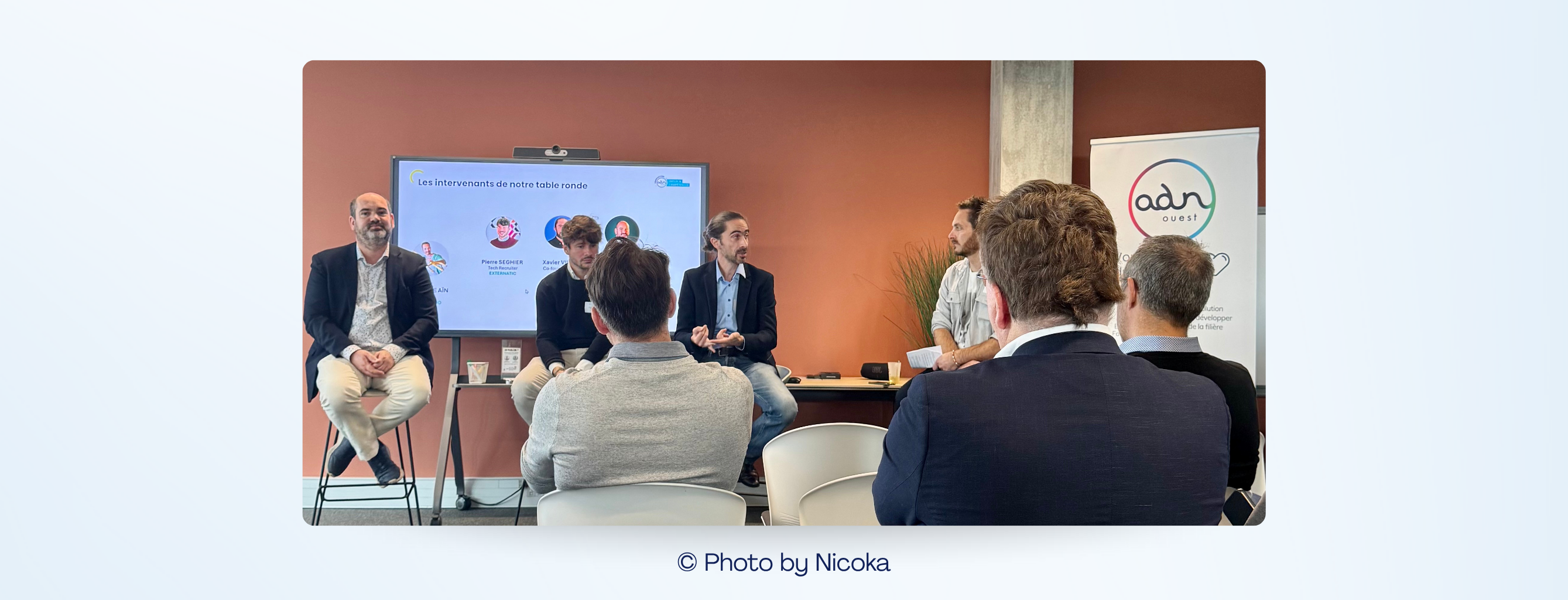
After the survey's figures, the round table put this reality to the test: each speaker shared their view on the market, the skills actually expected and the day-to-day impact of AI.
The discussions confirmed these trends:
Back to balance in the Angers IT market: the upper hand returns to companies
After the post-Covid euphoria, IT in Angers has returned to a more “classic” balance: more applications for slightly fewer job offers, tighter budgets and recruitment that is more selective. As a result, the dynamic is shifting from a candidate-driven market to a company-led market, with stronger requirements on technical fit… and above all on business fit.
The question of remote working is no longer the ultimatum it used to be. We are seeing a renegotiation towards hybrid working (typically 2 to 3 days on site), driven byonboarding, knowledge transfer and team cohesion, notably to help junior profiles grow. Candidates are more willing to accept this framework, as long as the project and theorganisation are clear (team rituals, equipment, flexible hours, no “office presence for its own sake”).
As one interview in the report puts it:
“Full remote (or 100% remote working) is less sought after by companies and less requested by employees. The hybrid model (2 days of remote working / 3 days in the office) is becoming the standard.”
- ORCN report p.34 I Brice Aubert, Co-founder of the recruitment agency - Seyos
When it comes to pay, salary ranges are stabilising and the arguments are shifting: less outbidding, more value of the role (product impact, stack, career path), total rewards (profit-sharing, training, internal mobility) and QVT (setting, actual workload, management). Candidates increasingly make their choices based onwork-life balance and the clarity of the career path.
However, pressure remains high for experienced profiles able to deliver quickly on data/cyber/DevOps roadmaps. Competition is local (Angers ecosystem) but also remote: some organisations outside the area still attract talent from the local pool remotely.
Companies want “ready-to-produce” profiles
The market favours profiles able to be productive quickly, generally with between three and five years' experience.
“For a long time, the market accepted career changers and profiles who came “by opportunity” rather than out of genuine passion, which lowered the standard (less curiosity, less desire to “understand how it works”).”
- Johan Marchesseau, Director of the school MyDigitalSchool
Pressure on roadmaps, tighter budgets and the need for expertise in data, cyber or DevOps are pushing companies to secure their hires with candidates who are already autonomous. Conversely, entry for recent graduates has become harder after the period of euphoria when hiring was broader.
What makes the difference is no longer just the stack but the ability to reason and to understand the “why” behind the code. Recruiters value technical curiosity, reading documentation, the ability to debug methodically and to link a solution to a business use.
Work-study remains a real springboard: it makes integration easier, secures pre-hiring and makes it possible toassess the real value of the future employee in real working conditions.
The medium-term risk is a drying up of the experienced talent pool if we do not invest in juniors right now. Hence the value of mentored pathways, clear 90-day learning objectives and assessments that measure potential as much as mastery of tools.
Data and cybersecurity dominate
Demand is intensifying in data and cybersecurity, with high expectations in abstraction, modelling and a maths/logic culture. The profiles sought know how to structure a problem, choose a robust approach and measure the impact on quality, performance and security.
The low-code or no-code approach speeds up prototyping and use validation, but reaches its limits when it comes toindustrialisation or high volumes. Many teams end up recoding the application core to handle the load, optimise costs and keep security under control. Good practice: prototype fast, design the architecture early, isolate the business domain in an API, set a “ go/no go prod ” with performance, cost and security criteria.
In cybersecurity, SMEs still do little in-house recruitment; they mainly rely on service providers. However, requirements are rising through large accounts and calls for tender (security, compliance), which will eventually filter through the whole ecosystem.
One topic is emerging on the visibility front: Generative Engine Optimization (GEO), or the art of appearing in the answers given by generative AI. At the crossroads of SEO, data and content, this skill aims to structure information, schemas and proof of authority so that generative systems cite the right source when they answer.
Candidates are better considered and AI assists without replacing
The market is returning to processes that are a little longer and better structured: structured interviews, short case studies, meetings with the team/manager to testbusiness and cultural fit. It is a gain in quality, but it can slow down access for juniors if care is not taken.
On the tools side,AI is settling in as a support: writing job ads, extracting requirements from a business need, pre-qualification (chat or multilingual voice agents), note-taking and interview summaries, generation of assessment grids. The final decision remains human, with safeguards for GDPR, bias prevention and traceability.
“AI is above all a support (job ads, outreach): the decision remains human, and companies want more authentic assessments than mere AI detection.”
- Pierre Seghier, Recruitment Consultant at Externatic
As Xavier Vilain, CEO of Nicoka, pointed out in his op-ed published on Parlons RH, the challenge is not to hand recruitment over to AI, but to give recruiters back their time and show respect to candidates.
➡️ AI gives recruiters back their time. And candidates their respect.
Conversely,automation on the candidate side is growing (cloned CVs, generated cover letters, mass applications). The answer is not unreliable “AI detection”, but authentic assessments: short contextualised case studies, factual questions about past experience, oral presentations, peer review with a future colleague, and targeted reference checks.
Training must speed up and connect technical skills
Technology is evolving faster than skills frameworks; we need to speed up updates (AI, data, cyber) and link technical skills more closely to business processes (purchasing, logistics, finance, industry, healthcare). Schools and companies alike are converging towards fewer “stacks of languages” and moreadaptability, reasoning and learning ability. accessibility and responsible digital practices are progressing, but require concrete choices in programmes and architectures.
2026 outlook & conclusion
The IT recruitment market is heading towards a more selective future: companies will above all be looking for specific skills in Data, Cybersecurity and DevOps, with profiles able to be operational immediately.
Projections for 2026 remain marked by caution and uncertainty. Most digital players expect a year of continuity with 2024-2025, characterised by stable headcounts and slower activity.
As the ORCN report points out:
“The projections of digital players for 2026 are marked by caution and uncertainty. For many players, next year will probably be a year in continuity with 2024-2025, characterised by stabilising headcounts and slower activity.”
In the short term, no return to the hypergrowth of 2021-2022 is expected. Companies anticipate more structured growth, more mature and undoubtedly more selective, guided by tighter budgets and more precise project management.
At the same time,AI will become more firmly embedded in practices: from writing job ads to structuring processes, its adoption will move from isolated experiments to genuine strategies.
The business leaders surveyed are also counting on macroeconomic stability, a revival of public procurement, a successful integration of AI and a strong capacity to adapt on the part of companies to revive momentum by 2026-2027.
One challenge remains: rebuilding the pool of experienced profiles of tomorrow. This means investing today in juniors, consolidating the role of work-study, taking care of thecandidate experience and creating solid mentored pathways.
Companies will also need to target hybrid profiles, able to connect technical skills with business understanding, while taking human and environmental issues into account.
Finally, diversity, gender balance and digital responsibility will remain priorities. Women still account for only 24% of the sector's workforce, and substantial work is still needed on inclusion, job retention and digital sobriety.
