Introduction
The job market is becoming more complex, digital tools are multiplying, we are chasing productivity more than ever and Artificial Intelligence is turning our working practices upside down.
As the world of work is being profoundly reshaped, our aspirations and ambitions are being redrawn.
The recruitment sector itself is on the front line of these transformations: changing processes, redefined professional relationships, evolving individual ambitions...
Three phenomena reflect these profound changes. First of all, the rise of AI which calls into question the future of certain jobs and is upending the distribution of skills.
Remote working has been in some decline for the past few months after a decade of widespread adoption and finally,
the strengthening of a new relationship with work, less focused on performance and strongly represented among younger generations.
I- AI: can your job be replaced?
1.1 The rise of AI is creating as many new opportunities as it is worries among employees.
ARCOM recently published its 2026 digital barometer,
carried out by Crédoc for Arcep, Arcom, the CGE and the ANCT among 3,544 people representative of the French population (survey conducted from 5 to 21 June 2025). The finding is clear:
Adoption has more than doubled in two years, driven by younger generations and the most highly skilled professions.
▲ +28 pts vs. 20% in 2023A third of users use AI every day.
Trust remains the main barrier to adoption: among those who do not yet use AI, 75% say they do not trust it. A paradox, given that 73% of those who use it trust it, while remaining critical of the reliability of its answers. Across the French population as a whole, attitudes towards AI remain cautious: fewer than one in two respondents expect a positive effect on their daily lives over the next twenty years, a level well below the European average.
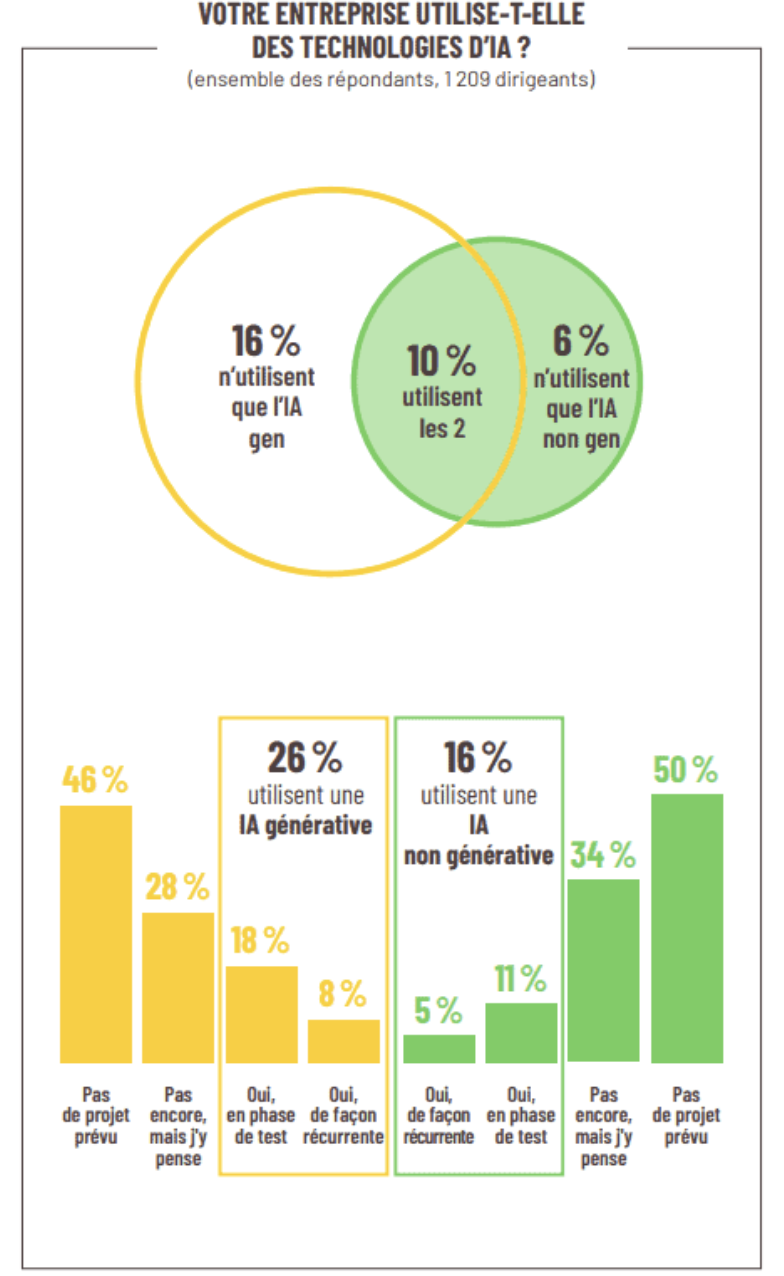
As you will have gathered, AI is becoming widespread despite the lingering mistrust and companies are starting to adopt it. According to Bpifrance Le Lab, 26% of French SMEs and mid-sized companies now use AI, a figure that is still modest but growing steadily, revealing strong potential for future adoption.
Source: Bpifrance Le Lab - L'IA dans les PME et ETI françaises
For most people, AI has become a go-to reflex for finding information in the same way as Google and all the other search engines.
As shown by Siècle Digital, which reports figures from Microsoft, France ranks in the world's top 5 for AI adoption.
The rise of AI is creating as many new opportunities as it is strong concerns among employees.
In 2023, the OECD published a survey that already reflected this phenomenon:
That is 3 in 5 workers worried about their job by 2035. A paradox was emerging: the productivity gains from AI were not necessarily translating into better pay.
→ The same proportion of respondents feared a drop in salary.AI was not eliminating jobs: it was profoundly reshaping the way people work.
The feeling that work is becoming denser and more demanding is shared well beyond the sectors usually exposed to digitalisation.
AI does not mechanically eliminate jobs: it reshapes the way we work, freeing up time for some activities while absorbing it for others.
For the recruitment sector in particular, uses, challenges and limits have yet to be clarified.
1.2 - The skills disruption: a sense of urgency
With the rise and ever faster adoption of AI, new skills are expected and in demand on the job market, while others will evolve or become obsolete.
This time, no professional category is safe from the digital divide. AI is reshuffling the deck at every level.
According to Siècle Digital, it is generally the lack of skills in using these tools that holds back their adoption, a strong signal of the need for support at every level of qualification.
France Stratégie, in its study Métiers 2030, also anticipates a profound transformation of the profiles sought on the French market in the coming years.
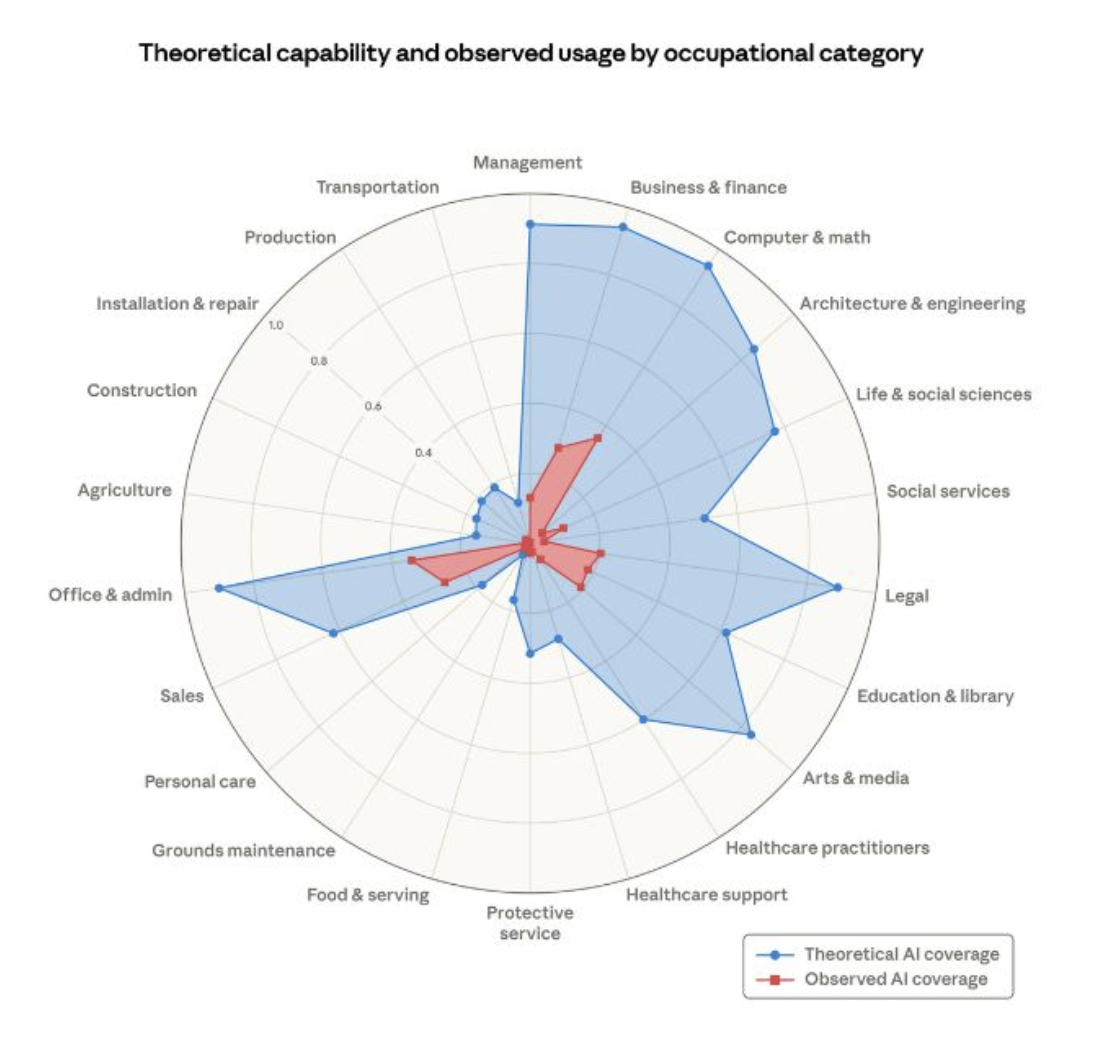
The chart recently published by Anthropic compares AI's theoretical capacity to take on certain activities with the actual use made of it today by sector; this gap represents a central challenge for organisations in the years ahead:
Source - Survey conducted by Anthropic - PDF report
1.3 Preparing for a shift in value
Rather than replacement, we need to prepare for a shift in the value of work and a change in our skills.
The question to ask is no longer “Is my job going to disappear?” but rather “How is it going to evolve, and am I ready to evolve with it?”
This calls for a new mindset: keeping up to date with these technologies, accepting new processes, learning to hand certain tasks over to AI agents and, above all, knowing how to steer them, correct them and evaluate their actions.
This means knowing reliable performance indicators capable of measuring the value actually created.
The World Economic Forum's report on the future of jobs (Future of Jobs Report 2025) confirms this trend:
half of the skills considered essential today will be profoundly transformed by 2030, and companies that invest in the continuous training of their teams will gain a decisive competitive advantage.
Far from being a simple budget line, training is becoming a strategic lever on a par with investment in technology.
II- Remote working is in decline
2.1 The figures
After a decade of continuous growth, remote working has been in some decline since 2025.
The return to the office is becoming widespread: Kering is moving from 2 days of remote working to 1, JCDecaux and Société Générale are reducing the number of remote days, Stellantis has required 5 days on site since March 2026, and Axa is moving towards a maximum of 2 days of remote working for everyone.
These decisions send a clear message to candidates: total flexibility can no longer be taken for granted.
Since 2024, the trend has been reversing in organisations of every kind. The same reasons keep coming up: collective productivity, team cohesion and knowledge sharing.
These decisions by leading players are creating a knock-on effect and gradually redefining market standards.
2.2 The main arguments behind this decline
The arguments put forward by management come up with remarkable regularity from one company to the next. Three main reasons stand out.
- The cohesion of teams appears to be the number one concern.
A sense of belonging, cultural alignment and the quality of interpersonal relationships are considered hard to maintain remotely over the long term. - The sharing of knowledge and company culture is the second major argument, particularly when it comes to integrating new starters.
Mentoring on the job, learning by observation and informal access to a mentor are all mechanisms that full-time remote working struggles to reproduce. - The collective productivity comes last.
While individual productivity is generally maintained or even improved when working remotely, collective productivity (the kind that comes from spontaneous exchanges, quick decisions and problems solved in a corridor) is weakened.
2.3 The real question: trust
Beyond the “on site vs remote” debate, the fundamental question that emerges is that of trust.
As highlighted by the magazine Courrier Cadres,
the return to the office can be read as a signal sent to teams, one of distrust towards their autonomy.
For companies that manage to combine high standards with trust, flexible remote working remains a powerful lever for attractiveness, retention and quality of life.
For those that used it as a concession without any real framework, the return to the office looks more like a corrective measure than a strategy.
The line between these two approaches implicitly outlines two management models that will clash in the coming years, and it is there, rather than in the number of days on site alone, that tomorrow's attractiveness will be decided.
What is becoming of our relationship with work today?
3.1 The new generation
A generational gap combined with a deep sense of misunderstanding. Young people are seen as less committed, less loyal and less respectful of hierarchy, but more at ease with digital tools and AI.
These figures reflect a real unease in the relationship between business leaders and young employees. More than one business leader in three believes that the arrival of new generations has complicated the organisation of work, a perception that says less about young people than about how hard companies find it to evolve their management models. Because what business leaders perceive as a lack of commitment is often, from the young people's point of view, a request for clarity: clarity about expectations, about what they get in return and about career prospects.
3.2 And yet, young people want to work
A strong aspiration to commit, provided that commitment is meaningful and comes with clear rewards in return.
→ The dividing line is not the amount of commitment, but its nature80% prefer to work in a medium-sized company: a sign of a desire for more autonomy, not disengagement.
These figures tell a different story from the one we often hear. Young people want to get involved, they want to work, commit and progress. But they set clear conditions regarding recognition and reciprocity. What many business leaders read as disengagement is in fact an expectation of transparency. It is not disengagement: it is a request for reciprocity.
3.3 Reconciling the two visions
The misunderstanding is less a clash of values than a failure of translation.
Younger generations are not rejecting work: they are rejecting a certain kind of relationship with work, made up of unpaid hours, one-way commitment and implicit sacrifices in the name of “company culture”.
Instead, they are asking for transparency about what they get in return, recognition of their efforts and consistency between what is said and what is done.
Organisations that are able to hear this request, without mistaking it for disengagement, will have a powerful source of attractiveness.
Those that cling to a negative reading of Gen Z will deprive themselves, in an already tight recruitment market, of a pool of motivated and skilled talent.
The APEC study on the futures of work identifies five major shocks
which, in the years to come, will test companies' ability to adapt.
The generational shock is one of them, and it calls for concrete responses: redefining career paths, setting out mutual commitments more clearly in contracts and transparently recognising contributions beyond the job description.
Conclusion
AI transforming the value of work, remote working declining in the name of cohesion and knowledge sharing, and younger generations questioning our relationship with work: these three major movements may seem unrelated.
In reality, they form one and the same transformation, deeper than it appears.
This transformation is that of a world of work that can no longer rely on the same foundations as yesterday.
The world has changed, and so have our personal priorities. The implicit promise of a linear career, with stable skills and professional commitment, is no longer enough to satisfy our own aspirations, in a world where we must constantly prove our motivation and personal worth.
For companies, and particularly for recruitment players, the challenge for the coming years is clear: restore meaning, provide a framework and set indicators.
This requires massive upskilling in AI, workplace relationships built on trust but also on closeness with a clear relational foundation, and finally a new standard for career development.
These movements will help build the new job market in which we are all currently evolving.
