Goals are always part of a company's life. They give meaning to work and serve as a source of motivation and engagement for employees.
100% of employees should have goals.
Individual goals must align with the company's strategic objectives so that everyone can contribute to collective success!
Setting goals presents numerous advantages:
- Time saving,
- Transparency and trust,
- Employee involvement,
- Taking action,
- Increased motivation,
- Effective tracking.
However, it is not so simple to choose the goals to achieve. It is often one of the most complicated tasks as the goal needs to be ambitious enough, but not too much to become unattainable. So, which method should you choose to ensure the goals are clear and understandable?
We propose you discover two methods, and it's up to you to choose the one that suits you!
SMART Method
This method is attributed to George T. Doran who first shared it with the public in an article in the "Management Review" journal in the 1980s. This method gained popularity and has become a standard in many fields, from management to personal development.
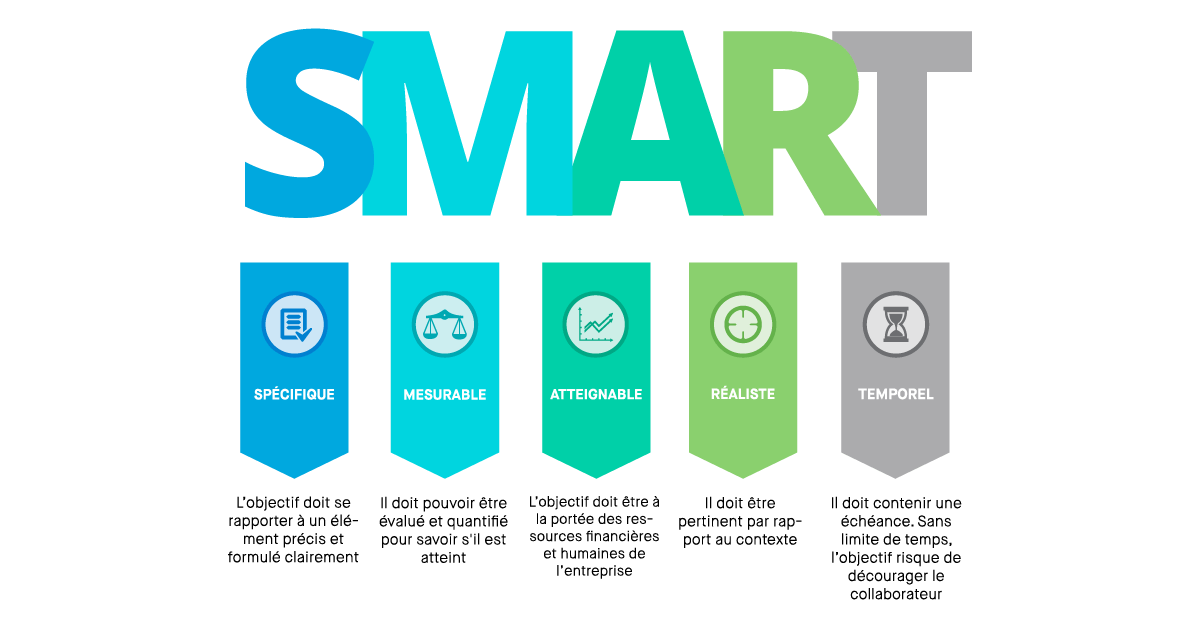
It allows for defining objectives to develop a project or activity and achieving them effectively. The acronym S.M.A.R.T. defines a goal to be:
- S - Specific: The goal must relate to a specific element and be clearly formulated.
- M - Measurable: It must be evaluable and quantifiable to know if it is achieved.
- A - Achievable: The goal must be within the financial and human resources of the company.
- R - Realistic: It must be relevant to the context.
- T - Time-bound: It must have a deadline. Without a time limit, the goal risks discouraging the employee.
In recent years, an “E” has emerged in this method referring to the emotional and/or ecological dimension of a goal.
Examples of SMART goals
The simplest way to understand this method is to take some examples:
Example 1 :Safety in the logistics warehouse: Organize mandatory safety training for 100% of employees by the end of the 1st semester 2024
Example 2 :Customer satisfaction: Achieve a customer satisfaction score of 90% on phone support by the end of 2024
Example 3 :Increase sales of the new product: Increase sales volume by 15% by the end of 2024
OKR Method
Well explained in the bestseller Dream Team byLudovic GIRODON, the OKR, or acronym for "Objectives and Key Results", is a methodology born in the United States in the 1950s that has proven itself in numerous Silicon Valley companies, but it can be applied to companies of all sizes. The concept is relatively simple: the company's vision is broken down into annual operational objectives for employees.
- The Objective is a qualitative description of what we want to accomplish, usually long-term. It is a clear and inspiring vision of the direction to take.
- Key Results (Key Results): These are quantitative indicators measuring the effectiveness of achieving the objective. They are specific, limited in number (usually 2 to 5 per objective), and must be measurable.
In an OKR, objectives must be ambitious and challenging, pushing teams to be creative and surpass themselves, especially since these objectives are public and shared throughout the company. One of the peculiarities of the OKR method is that it is not necessary to achieve 100% success for the objective to be considered accomplished; 60 to 70% suffices.
The OKR method perfectly complements the SMART method. While SMART focuses on formulating individual goals, OKR aims to align these goals across an entire organization. By using both methods together, a company can ensure each member works towards clearly defined goals (SMART) that align with the company's overall vision (OKR).
Example of OKR goals
Example 1 : Objective (O): Increase customer satisfaction
Key Result 1 (KR): Achieve a customer satisfaction rate of 95% or more in customer surveys over the next quarter.
Key Result 2 (KR): Reduce the average customer support response time to less than 2 hours by the end of the year.
Example 2 : Objective (O): Increase the number of qualified applications for job offers
Key Result 1 (KR): Increase the number of qualified resumes received via Indeed by 20% over the next quarter.
Key Result 2 (KR): Identify the 3 most effective recruitment channels over the next quarter.
Combining SMART and OKR methods
Combining SMART and OKR methods offersa comprehensive and powerful approach for managing objectives across all employees within your company.
While the SMART method focuses on setting specific, measurable, achievable, realistic, and time-bound goals, the OKR approach emphasizes creating ambitious goals aligned with the company's long-term vision, accompanied by quantitative key results.
By merging these two methods, you benefit from the clarity and specificity of SMART goals, as well as the ambition and strategic alignment of OKR goals. This combination allows each team member to clearly understand their responsibilities and impact on the company's objectives while being motivated by ambitious goals that inspire excellence. Additionally, by integrating KPIs (Key Performance Indicators) into this approach, you can quantitatively measure progress and adjust your strategy based on the results obtained. Ultimately, combining the SMART, OKR, and KPI methods offers a holistic approach to objective management, thus fostering collective success and aligning the entire organization with a common vision.
A glance at other methods:
When it comes to setting objectives for your company, a multitude of methods and tools are at your disposal. In addition to the SMART and OKR methods, which are widely recognized for their effectiveness, other approaches also deserve exploration.
In this section, discover these two other methods: KPIs (Key Performance Indicators) and FAST. These complementary methods offer unique perspectives for measuring performance and achieving your company's goals. Let's see how they can enrich your goal management strategy and contribute to your organization's overall success.
KPI
A KPI from the acronym "Key Performance Indicator" or Key Performance Indicator is an essential measurement tool for your company.
These numerical measures allow tracking the effectiveness of an action based on previously established objectives.
KPIs can take various forms, providing a concrete vision that enables leaders to make informed decisions and adjust their plans accordingly.
Indeed, KPIs offer valuable insights into the company's performance, allowing for measuring the effectiveness of implemented actions, identifying strengths and weaknesses, tracking progress, and detecting any deviations from objectives. KPIs thus complement the SMART and OKR methods by providing crucial quantitative data to evaluate the company's overall performance.
FAST Diagram
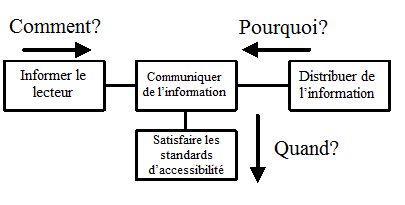
The FAST diagram, or acronym "Function Analysis System Technique", is a visual method representing logical relationships between different functions in a process or system. This pragmatic approach is action-oriented for defining and achieving goals. An essential in objective and structured project management!
Built from left to right, this diagram offers a clear and structured overview of the necessary steps to reach a given objective.
In the context of the FAST diagram, each function is described by answering the questions "how" and "why." The left side of the diagram examines the reasons why a function is necessary, while the right side details how this function is accomplished.
For example, in a business context, the FAST diagram can be used to understand how to inform readers through web article publication. The left side of the diagram might indicate that the goal is to inform readers, while the right side would detail the steps to achieve it, such as using a publication platform like WordPress.
The use of the FAST diagram is particularly beneficial in functional analysis, where it helps determine the architecture of a system or process. It offers a visual representation of interactions between different functions, thus facilitating understanding and communication within the team. In summary, the FAST diagram is a valuable tool for breaking down a complex objective into clear and measurable steps. It promotes structured and collaborative thinking, making it an essential element of project management and functional analysis.
Objectives in Nicoka HRIS
Thanks to our Performance Reviews and Evaluations Module offered in our HRIS, you can create and break down your objective into a series of goals like so many steps to reach the ultimate goal!
You can also create templates that can be easily assigned to one or more employees, thus aligning with your company's objectives.
Additionally, you have the freedom to define the timeline of the goal (weekly, monthly, quarterly, annually...).
Discover our support page: Setting and tracking objectives
In conclusion
In conclusion, defining clear objectives aligned with the company strategy is essential for driving collective performance. Whether you opt for the SMART method and/or the OKR method, or even the FAST diagram and KPIs, the goal is to enable each team member to understand their role in achieving the company's objectives.
By integrating these methods into your goal management process, you can maximize your team's impact and achieve remarkable results. Take the time to assess your company's needs and choose the method that best suits your corporate culture and strategic objectives. With a methodical approach and transparent communication, you can turn your company's vision into concrete actions and reach new heights of success.
For further reading
"I don't give the current management more than five years" - Interview with Ludovic Girodon - Welcome To The Jungle
Management book: Dream Team - Ludovic Girodon
One for all and all for one: 4 steps to establish the OKR method and pursue a common goal - Appvizer
Guide on the OKR method: how to define your objectives and key results - Moderator's blog
