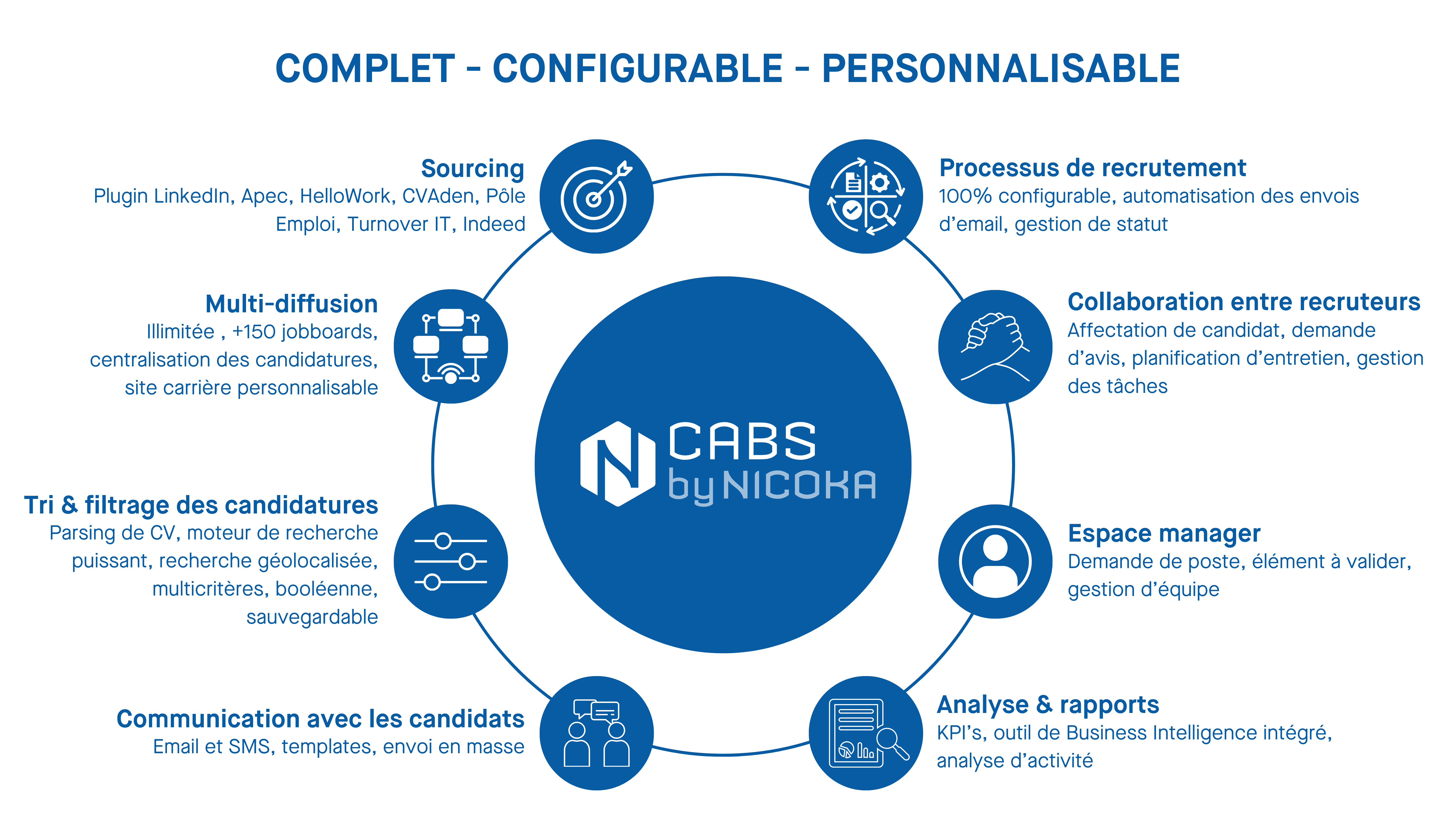
ATS software has become an essential tool in the field of human resources. Indeed, they are completely revolutionizing recruitment methods. These tools have revolutionized the way companies identify, assess, and select talent.
Equipping yourself with a good ATS is not an easy task. Given the multitude of options available on the market, each company must undertake a thoughtful approach to determine which tool best meets its specific needs. Making the right choice requires some prior reflection on the subject.
We have developed a checklist to help you identify essential criteria to assist you in selecting your ATS. Follow our advice below.

What is an ATS?
First of all, an ATS, (Applicant Tracking System) in English or otherwise called a 'candidate tracking system' in French, is software used by human resources professionals. Indeed, an ATS is more than just software, it is a tool for managing and tracking applications. This tool supports the recruiter, from receiving a CV (curriculum vitae) to making the final decision.
It can manage all stages of recruitment, from the job offer to the integration of the new recruit, through sourcing, multi-posting of job offers, managing communications, and interviews.
To learn more about ATS, visit our page: What is an ATS?
ATS are often coupled with CRM systems (Customer Relationship Management). A CRM, or Customer Relationship Management, is a complementary component that enhances the overall recruitment experience. It allows for tracking and managing interactions with candidates, building lasting relationships, and maintaining a comprehensive database for future recruitments.
Why use an ATS?
Choosing recruitment ATS software allows you and your team to improve your performance and avoid time-consuming tasks. Discover why integrating a candidate tracking system can play a crucial role in optimizing your recruitment process and ensuring its success.
- Centralization : The ATS offers an integrated solution that centralizes all facets of the recruitment process. You have the ability to redirect your candidates to a dedicated space, creating effective centralization. This encompasses various aspects such as managing the mailbox, scheduling interviews via the calendar, collecting feedback, accessing a CV library, and maintaining a conversation history. This centralization allows for smooth navigation within the recruitment process and promotes transparent management of all information.
- Automation : Automation represents one of the major pillars of efficiency offered by an ATS. By avoiding content duplication and automating repetitive tasks, this type of software frees up valuable time for your teams. By focusing on tasks with higher added value, your employees can fully leverage their expertise, thus improving the overall productivity of the team.
- Collaboration : By simplifying exchanges and cooperation among your team members, an ATS goes beyond organizational boundaries. Teams can exchange information in real-time without fearing the loss of important data. This promotes smooth collaboration, essential for quick decision-making and agile recruitment processes.
- Compliance : Human resources are subject to strict data protection regulations, such as the GDPR (General Data Protection Regulation). An ATS acts as an automatic and organized security shield for this sensitive information. By ensuring compliance with legal standards, the ATS tool ensures data security, allowing for corrections or deletions in case of specific requests.
In summary, using an ATS goes beyond merely adopting software. It is a smart strategy to maximize efficiency, encourage collaboration, and ensure compliance with current standards.
The different ATS formats
There are two different ATS formats, each with its advantages and disadvantages to consider. Choosing the right ATS format is a crucial step in selecting your recruitment tool.
In SaaS mode
An ATS software in SaaS mode, (Software as a Service) is an online recruitment management software hosted on the servers of the company that develops the software solution.
Recruiters can hire from anywhere at any time since this format does not require software installation on workstations; a simple internet connection and web browser suffice for its operation.
The advantage here is that this method avoids certain costs related to maintaining a dedicated server and the cost of a person in charge of updating the software within the server.
However, it is important to consider potential drawbacks related to dependence on a stable Internet connection and limited customization constraints.
In on-premise mode
An 'on-premise' software means on-site; it is installed directly on your company's servers. The advantage of this type of ATS is that it allows you to have full control over the software. This format is primarily reserved for large companies with significant material and human resources.
Managing and maintaining the software requires very powerful servers, a dedicated team of technicians to handle any failures, and updates to be performed. The drawback of this format is often reserved for companies with the necessary infrastructure to support an on-premise solution.
In addition to these two different formats, ATS can be classified based on their price.
Paid or Free
Some recruitment ATS are completely paid, others free, and others 'freemium.' Freemium tools are initially free but offer limited functionalities; to use more advanced features, you must upgrade to a paid version.
Understanding these different ATS formats and their impact on your company will allow you to make a good decision based on your specific needs and organizational structure.

The 6 essential questions to ask yourself:
It is essential for you, before acquiring a recruitment tool, to ask yourself the essential questions to ensure you make the right choice:
What is your strategy, and what are your recruitment volumes?
Ask yourself if your company anticipates rapid growth; if so, you will need a system capable of handling large volumes of applications. However, if you focus more on quality than quantity, functionalities focused on meticulous candidate selection may be prioritized.
What features are you looking for?
Features may include application management, job posting, interview tracking, candidate evaluations, etc. Evaluate the relevance of the features offered by each tool available on the market.
What is your budget?
Define a budget considering acquisition, maintenance costs, and potential hidden costs. A well-defined budget will help you avoid unnecessary expenses while ensuring the quality of the chosen tool.
What ATS format to choose?
The choice between an ATS integrated into a larger software suite or a standalone system will depend on your specific needs. Assess compatibility with your existing systems to ensure smooth integration.
Who and how many people will use the tool? (Recruiters, managers...)
Evaluate the number of intended users and ensure the tool can be adapted to their specific needs to maximize your team's overall efficiency.
What are your objectives?
Define clear objectives, indicators such as speeding up the process, improving candidate quality, etc.
Taking time to answer these fundamental questions will allow you to precisely target your needs and direct your selection towards a recruitment tool that will maximize the success of your recruitment process.

Your needs in terms of features
Before using and adopting an ATS, it is important to define the features you will need. The features you choose will have a direct impact on the efficiency of your recruitment process. Here is an overview of essential features to consider:
- Multi-posting of job ads : One of the major advantages of an ATS is the ability to distribute your job offers on multiple job boards. This allows reaching a wider audience and optimizing the visibility of your recruitment opportunities. Explore your ATS partnerships with job boards to maximize your ads' reach.
- Management and centralization : The tool should allow efficient management of applications by facilitating the transfer, selection of relevant profiles, and adding evaluation notes. Centralizing information, including shared comments among team members, is crucial for transparent collaboration and effective follow-up.
- Career site : An ATS often offers the ability to create a career site customized. It goes beyond a simple job listing. A well-designed career site, integrated into your employer brand, can significantly improve the visibility of your opportunities and attract qualified candidates.
- Performance tracking : Driving your recruitment activities requires relevant performance indicators (KPIs). The ATS should provide you with data such as the volume of applications processed, the number of spontaneous applications received, the source of applications, the recruitment timeline, etc. This information is crucial for evaluating the effectiveness of your processes and making adjustments if necessary.
- Budget : The budget question is unavoidable. Costs can vary depending on the features offered, the number of users accessing the platform, and the payment model (monthly or annual). Establish a realistic budget from the start to eliminate solutions that could be financially excessive.
- Flexibility - Time savings : Automating recruitment processes is a key feature. An effective ATS should relieve your HR teams of time-consuming tasks by automating repetitive processes. This allows your team to focus on more strategic and creative activities.
- Security : Protecting candidate data is paramount, especially in light of regulations such as the GDPR. Your ATS must guarantee the security and confidentiality of personal information. Ensure that the tool complies with data protection standards in force in the country where your company is established.
In summary, by identifying your specific needs based on these features, you will be able to choose an ATS that perfectly meets your recruitment process requirements while respecting your budget constraints and security standards in force in the country where your company is located.

Choosing and implementing an ATS
The choice and implementation of an ATS (Applicant Tracking System) are crucial steps to optimize your recruitment process. Here is a step-by-step guide to help you in this complex process.
Conduct market benchmarking
There are many ATS software on the market, so it is difficult to make a simple choice. Conduct a benchmark of the available tools, analyze the features offered to identify if they meet your needs. Compare the different existing software with each other. Check the provider's availability, whether their support throughout training, assistance in configuration, and use of the software is of quality or not. Consult customer reviews or testimonials, analyze the employer brand, and the online presence of the tool on social media, on a blog.
Learn about legislation, protect yourself and your candidates by analyzing the GDPR compliance of the tool.
Test the software
Following demos or testing the software will allow you to determine if the recruitment software can meet your needs. You can:
- Request to view the interface to determine its usability
- Request demonstrations; most ATS offer them
- Also request to test the software for free for a set period
This step is crucial, take advantage of it to check certain points:
- Ask the provider about the possibility of adding or removing features over time, depending on your needs
Evaluate the software's fluidity and intuitiveness to ensure easy adoption by your teams.
Check the responsiveness and quality of customer support to ensure effective assistance when needed
Ensure the software manages candidate information legally and in compliance with current regulations
Examine if the performance tracking features meet your expectations by analyzing the relevant KPIs for your recruitment process
Adopt the tool
Once convinced by the solution, finalize the details with your internal services. Work closely with the provider for the deployment and integration of the tool. Before going live, ensure your team is ready by organizing tailored training sessions. Consider training on the software to ensure optimal use. The successful adoption of the tool depends on transparent communication with the team, effective integration into existing processes, and adequate training to maximize the benefits of the ATS in your recruitment process.
To conclude
ATS software has revolutionized the world of recruitment by providing complete and efficient solutions for human resources professionals. These tools are not limited to managing applications but support the recruiter throughout the process, from posting job ads to integrating new employees.
Choosing the right ATS is a challenge, given the diversity of options on the market. Our article provided a comprehensive checklist to guide you in this process, highlighting the importance of addressing key questions such as recruitment strategy, desired features, budget, ATS format, user volume, and specific objectives.Understanding the different ATS formats such as SaaS and on-premise modes, as well as budget considerations, is crucial in your decision-making.
The use of an ATS offers significant benefits, including centralization, automation, collaboration, and compliance with legal standards such as GDPR. These tools improve performance and free up valuable time by automating repetitive tasks.
Finally, the choice and implementation of a candidate tracking system require conducting market benchmarking up to the effective adoption of the tool. Testing the software, evaluating customer support responsiveness, and ensuring adequate training for your team are crucial steps to ensure the success of this transition.
By following this advice and identifying your specific needs, you will be able to choose an ATS that will maximize the efficiency of your recruitment process.