❝The goal is to transform our ATS software into a kind of intelligent personal assistant powered by AI.❞ Xavier, CEO of Nicoka
Xavier (CEO) and Jules (AI Specialist) reveal all about AI integration in Nicoka
In a context where ATS and CRM software are increasingly relying on artificial intelligence (AI), Nicoka did not hesitate to embark on this adventure and position itself at the forefront of innovation by integrating generative AI solutions at the core of its talent management tool (Nicoka CABS ATS). Our platform is enhanced with automated matching and email management tools for smarter and more efficient management.
With a practical and user-oriented approach, we are gradually integrating AI into our recruitment tool to simplify and enrich the experiences of our clients. Whether it's improving the recruitment process, managing emails, or providing more responsive customer support, Xavier and Jules are at the helm of this transformation, sharing below their vision and the challenges encountered during AI integration.
1. Vision and Strategy
AI is almost everywhere, has Nicoka also ventured into this adventure?
Xavier: Of course, for implementing AI in Nicoka. We are integrating generative AI into all parts of our application. The goal is to transform our ATS software into a kind of intelligent personal assistant powered by AI, capable of automatically enriching and rewriting texts to optimize the recruitment process and talent management. This includes assisting with job offer writing in our recruitment module, a deployment already in place. We are also thinking about improving communication, whether positive for a successful candidate or negative for a disqualified candidate.
The aim is to use AI in a relevant way to bring real value to our clients, beyond a mere trend effect, or to avoid "AI washing" AI washing as some do (AI Washing is a marketing strategy where companies exaggerate the use of AI in their products to appear more advanced). Generative AI helps us complete text, extract data, and analyze texts, but it cannot yet select the perfect candidate.
2. AI Integration in Recruitment
For recruiters, how will AI integrate into Nicoka CABS?
Xavier: AI will enhance our Nicoka CABS recruitment tool through better data extraction and correction of information detection anomalies. With AI, we will be able to offer a more refined analysis of professional experiences, allowing for the correct extraction of key information. For example, AI will help us better determine the current position, years of experience, and geographic location even without a real address. In the long term, AI will also help create concise summaries of candidates. With better-qualified candidate data by AI, we will also strengthen our matching system.
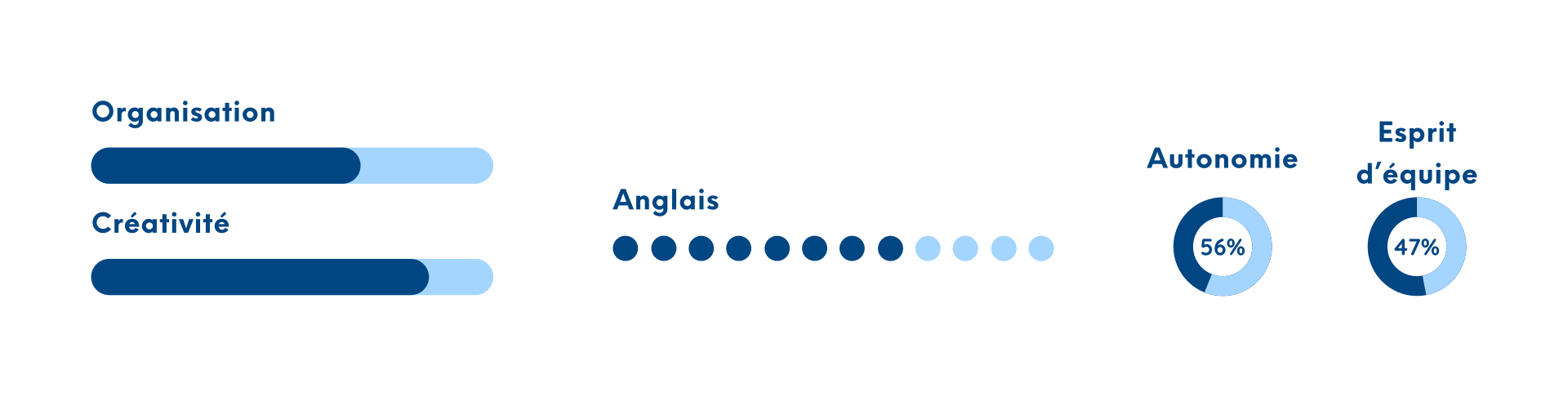
AI integration also allows processing textual and non-textual data, such as images in CVs, which are becoming more common in sectors like marketing and design. With advances in image processing, we can better extract and qualify visual skills (by star or bar, for example) to improve matching and offer relevant recommendations.
On Netflix, when you watch one or two similar movies, the platform will suggest another film equivalent to those already watched, offering recommendations based on information it has managed to extract.
With a better-informed resume database, generative AI also enables semantic work to find candidates who have worked in specific sectors without limiting to exact keywords.
You are looking for candidates who work in the automotive industry or have worked in this sector: the AI search will consider people who have the word “Peugeot,” “Ferrari,” or “Renault” in their CV.
A significant difference considering that today recruiters need to know all car brand names and type this name in their search engine to find these people.
Optimized candidate information extraction is a particularly important issue since most recruiters accumulate CVs over time. How many agencies have resume databases filled with thousands of profiles but do not have the right means to search for candidates? There are certainly good candidates, but due to keyword issues, because we don't know how to find them, we risk searching for new candidates and wasting time ultimately overlooking the "right candidate" already present in their talent pool.
What is the impact of AI on the recruitment process?
Xavier: AI has the potential to make the recruitment process more efficient by reducing the time needed to analyze applications and improving the precision of automatic matching. Nicoka users will gain in efficiency thanks to better management of repetitive tasks and more personalized responses for candidates.
The main difficulty accompanying this choice is the computing power required. The Large Language Models (LLM) we use require considerable computing power. To meet this requirement, we need a server infrastructure capable of supporting intensive computations.
3. AI Integration in Email Processing
How will AI integrate into email processing at Nicoka?
Xavier: AI integration in email processing at Nicoka aims to offer intentionality, as done by Google or Microsoft. The system will not only propose responses but will also indicate whether a candidate matches an offer by analyzing received applications. This will allow sorting among many candidates and selecting the most relevant ones.
You receive 203 applications for a job offer, and obviously, you cannot interview all candidates. A choice must be made, and the question arises: Can my software show me something that will guide my choice?
At Nicoka, we will analyze several dimensions such as experience level, requested salary, and skills, to match them with job requirements. These criteria can be customized by the user according to the relative importance for each position. AI will also help better interpret return emails after sourcing by classifying responses to facilitate the recruiter's work, who continues to focus on essential human interactions, such as phone or face-to-face interviews.
How can AI help personalize responses to candidates?
Xavier: We can also make responses more personalized. All recruiters would like to respond to every application, and every candidate would like feedback on their application, but this poses a volume problem. If you receive 10 applications per month, you can take the time to provide 9 negative responses explaining the reasons for refusal. However, with large volumes, responses become standardized and dehumanized. Paradoxically, AI will enable this personalization based on available information. AI can propose an email considering the reasons for refusal, the CV, and the position, offering a more personalized response. This response can be reviewed and validated by the recruiter before sending. Thus, thanks to AI, we could obtain more humanized and less industrial responses.
Additionally, AI can recommend positions to candidates even if their initial application does not perfectly match a specific position. This will allow for the best possible matches between talents and available positions using a reverse matching approach.
Ultimately, the idea is to become somewhat like the headhunter's personal assistant. And to be able to say today, you received 27 emails in response to your job push, and out of these 27 emails, you have 12 interested candidates and four who are not as interested but would like something else, while three no longer want to receive your emails. Like a computer, the system is commanded to classify and create order to be this assistant. The goal is to remove the time-consuming part of the recruiter's job so that, ultimately, they can focus on something AI cannot do for now, which is to call the candidate, interact with them, and go to the interview to ask questions and try to extract who they are.
What other modules are affected by AI?
Xavier: Besides the recruitment module, we are integrating AI into our CRM (Customer Relationship Management) system to assist with email writing and improve the diplomacy of commercial exchanges.
AI can help follow up with a client on an unpaid invoice with appropriate phrasing, thus preventing harm to the business relationship. In terms of prospecting, generative AI can propose texts adapted to different situations, serving as support for salespeople and helping new employees in their tasks.
What are the future plans to improve support with AI?
Xavier: Starting from the end of 2024 and into 2025, we plan to improve our support system. The idea is not to replace Nicoka's humans or support with a chatbot but to create an intelligent chatbot. This chatbot, based on the high number of support tickets we handle each year, could respond more quickly to recurring questions. We want this chatbot to provide less robotic and more detailed answers, explaining solutions to problems step by step.
Currently, support responses may seem dry, often due to the volume of tickets to be processed quickly. With generative AI, we hope they can learn to understand the Nicoka tool and proactively assist clients, either through support tickets or directly in the application.
A "I'm stuck here" button could guide the user with detailed solutions, as other applications do.
We are not looking to have an answer for everything, but to provide specific answers to Nicoka. We believe such a system would be more efficient than what we currently do.
6. How do you integrate AI into a solution like Nicoka?
Xavier: Jules is in charge of integrating an internal AI at Nicoka, ensuring data confidentiality by avoiding sending them to external servers. This internal AI is hosted on our servers, using advanced language models to offer quality services while mastering security and technology.
What specific technologies are used?
Jules: I use Retrieval-Augmented Generation (RAG), in other words, I take advantage of the generative AI's ability to interpret and extract information from a given context. To do this, I have deployed a Large Language Model (LLM) on Nicoka servers. It's a bit like having our own “ChatGPT,” but privately and using the latest OpenSource technologies available.
Xavier: The choice of technology was crucial, particularly between Named Entity Recognition (NER) and Large Language Models (LLM). We opted for LLMs for their ability to understand language more nuancedly. The main difficulty lies in the computing power required, which involved setting up a robust server infrastructure.
Jules, can you explain in detail how the CV parsing process you improved works?
Jules: We make a request to our Language Model, hosted on our servers. The request contains instructions for semantic analysis and preprocessed CV data. Our Language Model then returns all labeled and ordered data. Thanks to this, we have access to everything the candidate has entered in their CV automatically. The system can even interpret logos and skill bars (as shown below).
How does CV parsing improve the efficiency of the recruitment process?
Jules: Parsing automatically enriches the database on which matching is based. It allows exhaustive and precise information extraction, thus improving the match between candidates and positions.
The anonymization process is facilitated by AI, replacing, for example, "10 years of experience at EDF" with "10 years of experience in an energy sector company," which strengthens matching relevance.
9. Performance and Continuous Improvement
How do you measure performance, do you use measures or statistics?
Jules: I have a custom script that allows systematic evaluation of model quality on a set of model CVs. This allows us to compare our parsing method to current standards and identify potential improvement areas.
10. Data Management and GDPR (General Data Protection Regulation)
What does AI do with the data we provide it?
Jules: It depends on the type of AI. If we talk about the prompt, this data serves as instructions for the model. For Nicoka's AI, the data is not saved after processing. However, for ChatGPT, data may be saved to train future models. Regarding personal information, it is uncertain what some companies do with this data.
11. Current and Future Projects
What are Nicoka's current and future projects regarding AI?
Xavier: The dream feature for sourcing at Nicoka would be a tool capable of finding prospects everywhere, based on defined criteria. Ideally, this system could search on LinkedIn, HelloWork, Pôle Emploi, and other platforms, then analyze the results to suggest the 20 most relevant and available candidates for the position. This would represent a real game-changer in recruitment.
However, this approach presents several challenges. There are security, data access, and regulatory compliance issues, especially in terms of GDPR. AI could help interpret search results, but legal and data access issues remain.
Concerning AI implementation at Nicoka, we have just launched job offer generation. For parsing, we aim to have a new parser and email writing aid tool by the end of 2024, early 2025. The deployment will be gradual over 3 to 6 months.
As for the future, we want to keep Jules on this project, even if the subject is somewhat peripheral. He could then focus on Nicoka's automated support, which is another major topic. Some subjects may seem long but turn out to be quick, and vice versa. We will see how it evolves.
For Nicoka, AI is a real asset to make life easier for recruiters and users. By adding a touch of intelligence to daily tasks, the goal is clear: gain efficiency while keeping humans at the center of decisions.
