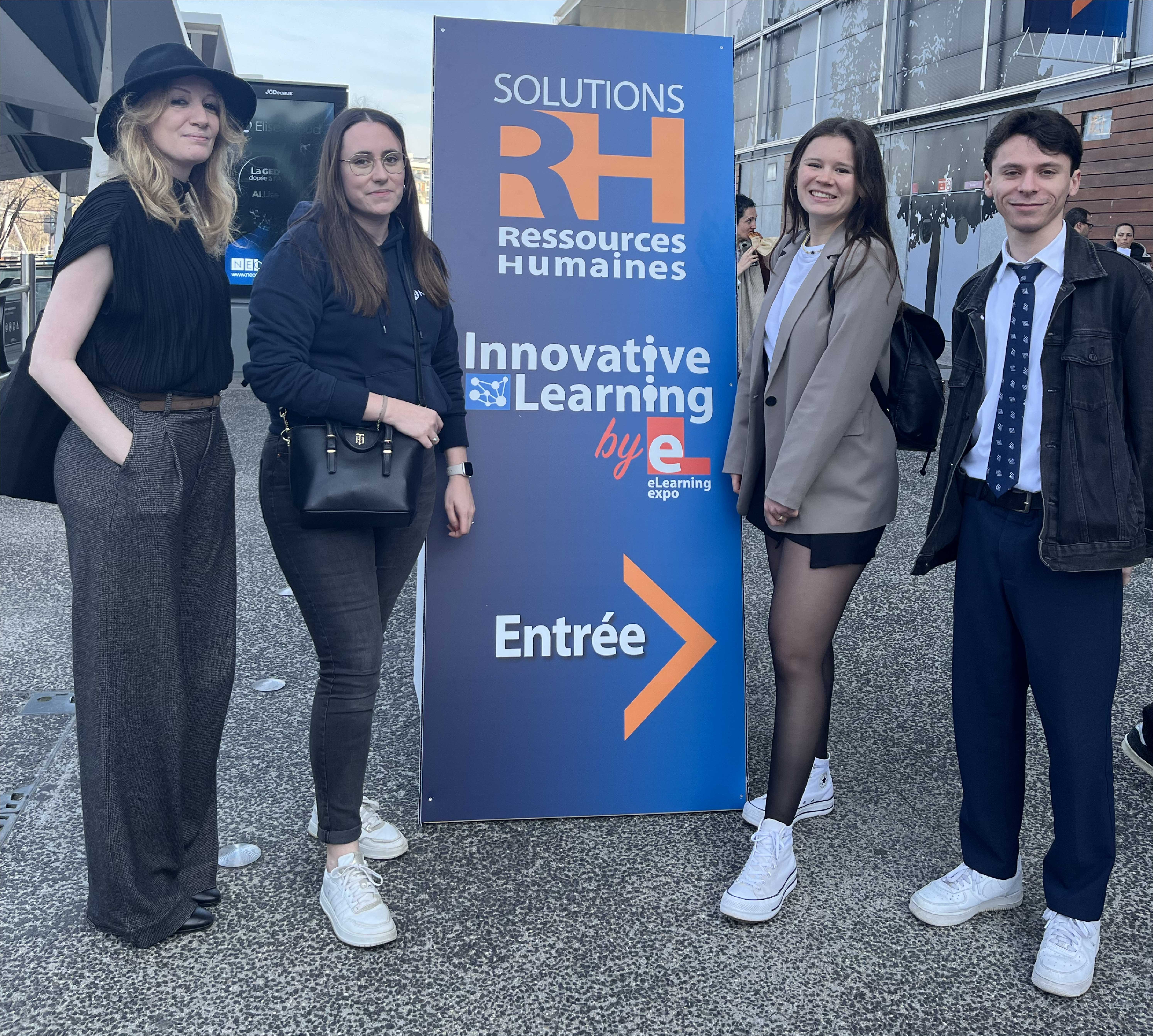
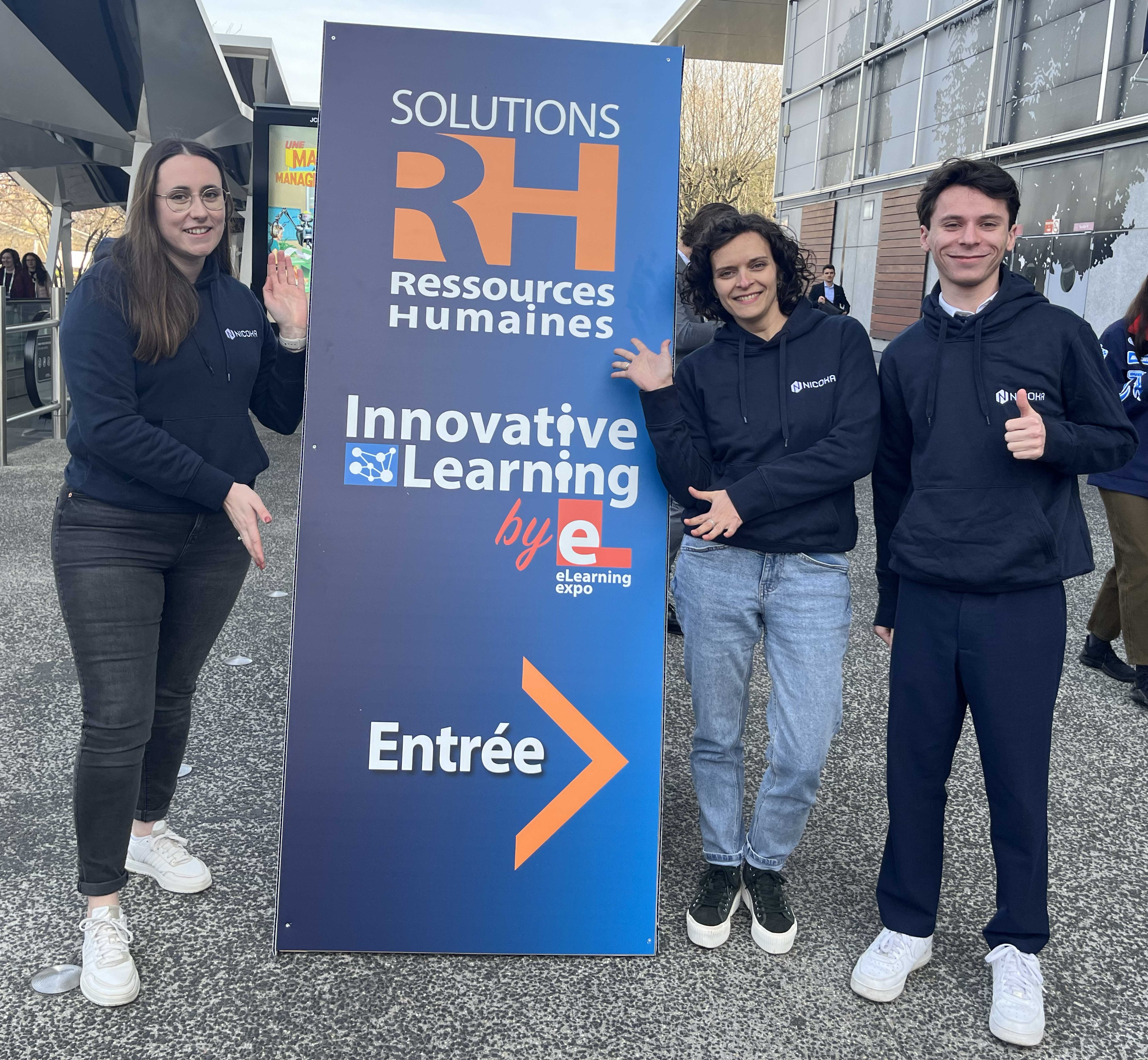
Let's quickly recap the Nicoka team's trip to the HR Solutions Expo, onThursday, March 21stinParis.
The30th edition of the HR Solutions Expo, marked by conferences, workshops, and round tables, highlighted best practices promoting the digitalization of the HR function. This essential event for HR managers and experts, represented a unique opportunity to share knowledge and experiences in the field.
A day at the HR Solutions Expo can be a culinary adventure as much as a professional quest. Picture yourself surrounded by tempting pastries, colorful candies, creamy ice cream, crunchy popcorn, and delicious macarons... Suffice it to say, going hungry was not on our agenda!
Don't worry, we sacrificed our taste buds to bring you the latest HR sector trends!
Our team explored the expo on the third and final day of the exhibition, visiting the booths in search of potential competitors in the ATS & HRIS field. Between conferences, our three Business Analysts closely examined commercial pitches.
Two of our team members, Angélique Sorin, HR Consultant and Elise Gasteau, Marketing & Communication Officer attended conferences, braving culinary temptations to immerse themselves in the world of HR process digitalization.
|
|
|
Facilitating the management of AT/MP (work accidents and occupational diseases)
Among the highlights was the workshop on improving and optimizing HR processes through digitalization led by OPTIMIS ACTION and presented by Valérie BARREAU-LE COUSIN, Senior Consultant - Head of HR Department and by Floriane JOUSSET, Sales Manager – HR Department, allowed us to discover some statistics on work accidents and occupational diseases.
Did you know there are more than a million accident reports every year? Or that commuting accidents by bike or scooter account for a significant portion of these incidents? With 286 deaths and 8% attributed to road hazards, we seriously considered teleportation for our next trips!
The sectors of healthcare, cleaning, and temporary work are also among the most affected, with an alarming prevalence of musculoskeletal disorders, accounting for up to 86% of reported cases.
But jokes aside, the data presented highlighted important challenges companies face in managing AT/MP.
Within companies, managing work accidents and occupational diseases is hindered by several internal obstacles. A study reveals that 33% of companies face difficulties in filling out CPAM questionnaires (Primary Health Insurance Fund), while 53% are unaware of the financial consequences of these incidents. Moreover, the multiplicity of stakeholders and data dispersion lead to delays in handling cases, thus compromising risk management's responsiveness and efficiency.
Fortunately, innovative solutions like dynamic dashboards and human resources management tools can help companies navigate through this administrative maze.
So yes, reducing work accidents and occupational diseases costs is possible thanks to digitalization!
- AT/MP declarations in just a few clicks
- Accessibility for different user profiles
- Simulation of financial impacts related to the duration of work stoppages
- Information / procedure tracking on the tool
- Integrated messaging
- Dashboards
In conclusion, managing work accidents and occupational diseases is an essential aspect of corporate social responsibility. Without an effective management tool, claims may persist or even increase, compromising employee safety and the company's financial health. By investing in integrated solutions and valuing professional training, companies can turn challenges into opportunities, ensuring a safer and more prosperous future for all.
Securing and financially valuing the employee integration journey
This second conference, also led by the group OPTIMIS ACTION and presented by Flavie DENOUAL - Recruitment Subsidies Manager, addressed two crucial points, notably the vital importance of securing and financially valuing the employee integration journey. The underlying objective is to promote internal professional training, a benefit extended to fixed-term contracts of more than six months.
The high costs of failed recruitments, which can range from 30% to 150% of the annual salary for the position, or approximately €10,000 on average, as well as the difficulties in retaining employees, with a turnover rate of 20% to 50% in the first year, highlight the need to adopt more precise recruitment strategies. These strategies include competency-based recruitment and the use of specialized recruitment agencies.
In a context of heightened competition in the job market, emphasizing social benefits becomes essential. This involves implementing wellness programs, promoting work flexibility, and optimizing leave policies.
Moreover, the establishment of structured integration programs is an absolute necessity. These programs include a detailed presentation of the company and its teams, the transmission of its distinctive corporate culture, training on processes and software tools used, as well as the development of position-specific skills. By investing in these initiatives, companies can not only ensure better integration of their employees but also enhance their attractiveness and competitiveness in the job market.
Scheduling and time management: what new trends are serving the HR of tomorrow?
In this conference, Kévin Sahki, the CTO of the Groupe OCTIME and Eric Carpentier, the HRIS Manager of the optical stores GRANDVISION presented several notable advances in the field of time management. The emphasis was on innovations likely to radically transform how companies approach this management.
Among these innovations, the use of sensors stands out for its ability to influence schedules, alert in case of time clocking needs, and even assess employees' stress levels. This technology promises a more proactive and personalized approach to time management, allowing companies to adapt their policies based on individual employee needs.
Another innovative aspect addressed in the workshop concerns the use of Chatbots, such as GrandVision's Iris user experience, aimed at enhancing customer experience. Unlike traditional solutions, the qualitative effect of these chatbots, illustrated by GrandVision's example, lies in their ability to offer personalized and instant support.
Moreover, according to the testimony of Eric Carpentier, GrandVision's manager, he emphasized the crucial importance of using an HRIS tool, especially during the COVID-19 period. When the company had to close its stores, communication with the teams became a major challenge. In these exceptional circumstances, using an HRIS proved to be a great help, allowing management to provide daily information and reassurance while maintaining some operational activities to meet urgent medical needs.
In conclusion, the workshop organized by Groupe Octime and GrandVision highlighted the growing importance of rethinking time management in a changing work context. By adopting these new trends and investing in innovative solutions, companies can position themselves advantageously to meet tomorrow's needs and challenges, while placing employee well-being at the heart of their concerns.
Employee experience, a criterion for choosing an HRIS?
This round table allowed us to capture pragmatic advice on setting up an HRIS thanks to the intervention of Médéric Gillet, Design & Innovation Manager atKelio and Raphaël Carenton, the CTO atACCRETIO.
The challenge in choosing an HRIS is to configure this tool to meet the various uses of employees. Hence the importance of thoroughly questioning needs and transcribing them into a specifications sheet because once launched into the comparison, one can quickly get lost among the 250 HRIS solutions on the market! The term "HRIS" has become somewhat overused as it encompasses so many things, between ERP, HR, and specialized solutions, it's better to determine what one is looking for to avoid dispersion.
Choosing management software is not just about choosing a product, it's also about choosing a partner to work with over the long term. The comparison to buying a guitar was well chosen by the speakers: you can buy a great guitar, but if you don't have a good teacher to give you lessons, you won't play beautiful melodies or progress! This is also our philosophy at NICOKA, it is important to provide our clients with the keys to understanding the configuration of their tool so they can customize it based on their practices. Step by step, module by module, we follow a timeline and shape the HRIS to fit.
The focus was also placed on the importance of building a Project Team that coordinates the various deployment stages and also ensures internal change management. Implementing an HRIS means being able to allocate time to it, the implementation duration can vary greatly depending on the project team.
Here's a list of emerging functions mentioned by the speakers:
- The ability to delegate actions to all company actors to foster responsibility,
- Electronic signing of HR documents,
- Pre-onboarding,
- Dematerialization of access badges,
- The collaborative spirit of the tool (digital suggestion box, news sharing, document resource sharing...)
Then came the topic everyone talks about: AI. What we took away is that AI hasn't yet sparked much enthusiasm in HR: HRIS publishers will have to prove themselves with relevant uses. For example, AI could provide answers by browsing company documents (like internal regulations, agreements..) without having to read the entire content. AI is already making its way into recruitment: writing job offers, analyzing resumes, drafting approach emails...
There's no need to fear, AI is not going to eliminate jobs but will change practices to give more room to Humans!
If you want to experiment, you can check out MOOCs on prompts in the HR function: https://www.fun-mooc.fr/fr/cou...
To conclude
In short, the HR Solutions Expo was a true culinary and professional adventure for the Nicoka team, we braved culinary temptations to bring you the tastiest innovations in the sector.
Between conferences on HR process digitalization and time management, we discovered some statistics on work accidents and occupational diseases, these data highlighted the crucial challenges facing companies.
Fortunately, innovative solutions such as dynamic dashboards and human resource management tools can save us from getting lost in this administrative maze. By reducing work accidents and occupational diseases costs through digitalization, we can turn these challenges into opportunities, ensuring a safer and more prosperous future for all.
Exploring new trends in time management revealed advances such as the integration of sensors and chatbots, confirming that the future of human resources will undoubtedly be marked by technology.
Moreover, it is important to emphasize that artificial intelligence should not be feared; it aims not to eliminate jobs but to transform professional dynamics by granting more space to humans. After all, who else could appreciate pastries and candies as much as we do?
One thing is certain, our minds are enriched with new knowledge and ideas to further improve our ATS and HRIS tools.
